Brief Report - (2025) Volume 15, Issue 3
Received: 02-Jun-2025, Manuscript No. jprm-25-174446;
Editor assigned: 04-Jun-2025, Pre QC No. P-174446;
Reviewed: 18-Jun-2025, QC No. Q-174446;
Revised: 23-Jun-2025, Manuscript No. R-174446;
Published:
30-Jun-2025
, DOI: 10.37421/2161-105X.2025.15.739
Citation: Johansson, Erik. ”Evolving ILD: Diagnostics, Therapies, Personalized Care.” J Pulm Respir Med 15 (2025):739.
Copyright: © 2025 Johansson E. This is an open-access article distributed under the terms of the Creative Commons Attribution License, which permits unrestricted use, distribution and reproduction in any medium, provided the original author and source are credited.
Recent advancements in interstitial lung diseases (ILD) provide a comprehensive overview, emphasizing new diagnostic approaches like Artificial Intelligence (AI) in imaging and integrated clinicoradiological discussions. These developments also highlight emerging therapeutic options and personalized management strategies, addressing the evolving landscape of ILD care [1].
There's a critical need for early and accurate diagnosis of connective tissue disease-associated ILD (CTD-ILD). A multidisciplinary approach, involving rheumatologists and pulmonologists, is crucial. Timely intervention is emphasized to manage disease progression and improve patient outcomes within this complex group [2].
Progressive fibrosing ILD (PF-ILD) is now recognized as a distinct clinical entity, emphasizing shared pathological features. Identifying progressive fibrosis across various ILD subtypes is key, boosting the relevance of antifibrotic therapies in altering the natural history of these progressive conditions [3].
Current overviews of ILD management cover both pharmacological and non-pharmacological interventions. An evolving understanding of ILD pathogenesis leads to more targeted therapies and a multidisciplinary approach, ultimately aiming for improved quality of life and better patient outcomes [4].
Artificial Intelligence (AI) is increasingly important in ILD diagnosis and management. AI can enhance HRCT scan interpretation, predict disease progression, and assist in treatment selection. This offers a promising future for more precise and personalized ILD care [5].
Pulmonary rehabilitation is a crucial non-pharmacological intervention for ILD. A systematic review and meta-analysis show significant improvements in exercise capacity, dyspnea, and quality of life following rehabilitation programs, underscoring its vital role in holistic ILD management [6].
Managing interstitial lung disease associated with systemic sclerosis (SSc-ILD) involves current treatment paradigms like immunosuppressants and antifibrotic agents. Future therapeutic avenues are being explored, emphasizing early detection and personalized strategies to improve outcomes in this challenging manifestation [7].
An updated review focuses on the diagnosis and management of sarcoidosis-associated ILD (SA-ILD). It covers diagnostic challenges, the role of imaging and biopsies, and therapeutic options from corticosteroids to novel immunosuppressants, emphasizing individualized treatment approaches [8].
Genetic research provides a comprehensive overview of ILD's genetic underpinnings, identifying risk genes and their impact on disease susceptibility, progression, and treatment response. Advancements in this area pave the way for more precise diagnostic tools and personalized therapeutic strategies [9].
Lung transplantation serves as a life-saving option for selected patients with advanced ILD. This involves careful patient selection, pre-transplant evaluation, post-transplant care, and managing potential complications, all requiring multidisciplinary coordination to optimize outcomes [10].
Recent research highlights significant progress in understanding and managing interstitial lung diseases (ILD). A comprehensive overview details the latest developments, particularly focusing on new diagnostic approaches. These include the sophisticated use of Artificial Intelligence (AI) in medical imaging and the value derived from integrated clinicoradiological discussions. Additionally, advancements are seen in emerging therapeutic options and the development of personalized management strategies, which are crucial for addressing the evolving landscape of ILD care [1]. The transformative role of Artificial Intelligence (AI) in both diagnosing and managing ILD cannot be overstated. AI technologies are shown to greatly enhance the interpretation of high-resolution computed tomography (HRCT) scans, offer predictive insights into disease progression, and provide critical assistance in treatment selection. This application of AI points towards a promising future, enabling more precise and highly personalized care for ILD patients [5].
Emphasizing early and accurate diagnosis, a critical focus remains on connective tissue disease-associated ILD (CTD-ILD). It underscores the indispensable role of a multidisciplinary approach, actively involving both rheumatologists and pulmonologists, to ensure timely intervention. This collaborative effort is paramount for managing disease progression effectively and improving patient outcomes in this uniquely complex patient group [2]. Further defining distinct clinical challenges, progressive fibrosing interstitial lung disease (PF-ILD) is now recognized as a specific entity. This recognition highlights shared pathological features across various ILD subtypes and stresses the vital importance of identifying progressive fibrosis. The increasing relevance of antifibrotic therapies in altering the natural history of these progressive conditions is also a key finding [3].
An updated perspective on the management of interstitial lung disease provides a current overview of comprehensive strategies. These strategies encompass both pharmacological treatments and essential non-pharmacological interventions. The ongoing evolution in understanding ILD pathogenesis is continually leading to the discovery of more targeted therapies and fostering a robust multidisciplinary approach, ultimately aimed at enhancing patients' quality of life and improving overall outcomes [4]. In the realm of non-pharmacological interventions, pulmonary rehabilitation stands out as a highly effective approach. A systematic review and meta-analysis consolidates compelling evidence regarding its efficacy, demonstrating significant improvements in patients' exercise capacity, a reduction in dyspnea, and an enhanced quality of life. This firmly establishes pulmonary rehabilitation's crucial role in the holistic management of ILD [6].
The management landscape for interstitial lung disease associated with systemic sclerosis (SSc-ILD) continues to evolve. Discussions center on current treatment paradigms, including both immunosuppressants and antifibrotic agents, while also exploring promising future therapeutic avenues. There is a strong emphasis on the necessity for early detection and the implementation of personalized strategies to significantly improve outcomes in this challenging manifestation of systemic sclerosis [7]. Another specific area of focus is sarcoidosis-associated ILD (SA-ILD), for which an updated review details diagnostic and management considerations. This includes covering diagnostic challenges, clarifying the critical role of imaging and biopsies, and outlining therapeutic options ranging from corticosteroids to novel immunosuppressants. The review strongly advocates for individualized treatment approaches tailored to this specific ILD phenotype [8].
Understanding the genetic underpinnings of interstitial lung disease is a burgeoning area of research. Reviews provide a comprehensive overview of identified risk genes and their substantial impact on disease susceptibility, progression patterns, and individual patient responses to treatment. These advancements in genetic research are pivotal for paving the way toward more precise diagnostic tools and truly personalized therapeutic strategies in ILD [9]. For selected patients suffering from advanced interstitial lung disease, lung transplantation represents a crucial and often life-saving therapeutic option. The process involves meticulous patient selection criteria, thorough pre-transplant evaluation, comprehensive post-transplant care, and careful management of potential complications. Optimizing outcomes for these complex cases demands exemplary multidisciplinary coordination among all involved healthcare professionals [10].
The landscape of interstitial lung diseases (ILD) is rapidly evolving, driven by advancements in diagnostic technologies and personalized management strategies. New diagnostic approaches, including the integration of Artificial Intelligence (AI) in imaging and multidisciplinary clinicoradiological discussions, are enhancing precision. A critical focus is placed on early and accurate diagnosis, particularly for conditions like connective tissue disease-associated ILD (CTD-ILD) and progressive fibrosing ILD (PF-ILD), which is now recognized as a distinct clinical entity. Antifibrotic therapies are gaining importance in altering the natural history of progressive fibrotic conditions. Comprehensive management strategies for ILD encompass both pharmacological and non-pharmacological interventions, with pulmonary rehabilitation showing significant benefits in improving patient quality of life and exercise capacity. Specific ILD subtypes, such as those associated with systemic sclerosis (SSc-ILD) and sarcoidosis-associated ILD (SA-ILD), require tailored, individualized treatment approaches involving immunosuppressants and antifibrotic agents. Genetic research is increasingly clarifying the underlying mechanisms of ILD, identifying risk genes that influence disease susceptibility and treatment response, thus enabling more precise diagnostic tools. For advanced cases, lung transplantation remains a vital, life-saving option, necessitating extensive multidisciplinary coordination for optimal patient outcomes. Collectively, these advancements emphasize a holistic, patient-centered approach to ILD care, continuously seeking to improve diagnosis, treatment efficacy, and overall patient well-being.
None
None
1. George S, Abeles A, Devaraj A. "Recent Advances in Interstitial Lung Diseases".Chest 162 (2022):1345-1358.
Indexed at, Google Scholar, Crossref
2. Mathai S, Agrawal T, Assayag D. "Connective tissue disease-associated interstitial lung disease: a call to action".Lancet Respir Med 10 (2022):83-93.
Indexed at, Google Scholar, Crossref
3. Raghunath A, Balakrishnan A, Rajendran R. "Progressive fibrosing interstitial lung disease: a new paradigm for an old problem".Clin Respir J 16 (2022):255-266.
Indexed at, Google Scholar, Crossref
4. Grewal D, Agrawal N, Sharma A. "Update on the Management of Interstitial Lung Disease".Cureus 15 (2023):e37684.
Indexed at, Google Scholar, Crossref
5. Chung J, Lee K, Han K. "Artificial intelligence for interstitial lung diseases".Expert Rev Respir Med 16 (2022):393-402.
Indexed at, Google Scholar, Crossref
6. Li J, Lu H, Fu R. "Pulmonary rehabilitation in interstitial lung disease: A systematic review and meta-analysis".Front Med (Lausanne) 9 (2022):945532.
Indexed at, Google Scholar, Crossref
7. Khanna D, Tashkin D, Distler O. "Current and future perspectives in the management of interstitial lung disease associated with systemic sclerosis".Lancet Respir Med 8 (2020):93-100.
Indexed at, Google Scholar, Crossref
8. Adebayo O, Shiffman M, Shah N. "Diagnosis and management of sarcoidosis-associated interstitial lung disease: An updated review".World J Clin Cases 11 (2023):2381-2401.
Indexed at, Google Scholar, Crossref
9. Marem E, Ghamraoui H, Ryerson C. "The genetics of interstitial lung disease: a state-of-the-art review".Eur Respir Rev 32 (2023):220144.
Indexed at, Google Scholar, Crossref
10. Zegarra-Ruiz D, Adebayo O, Shiffman M. "The role of lung transplantation in the management of interstitial lung disease".World J Clin Cases 11 (2023):2418-2433.
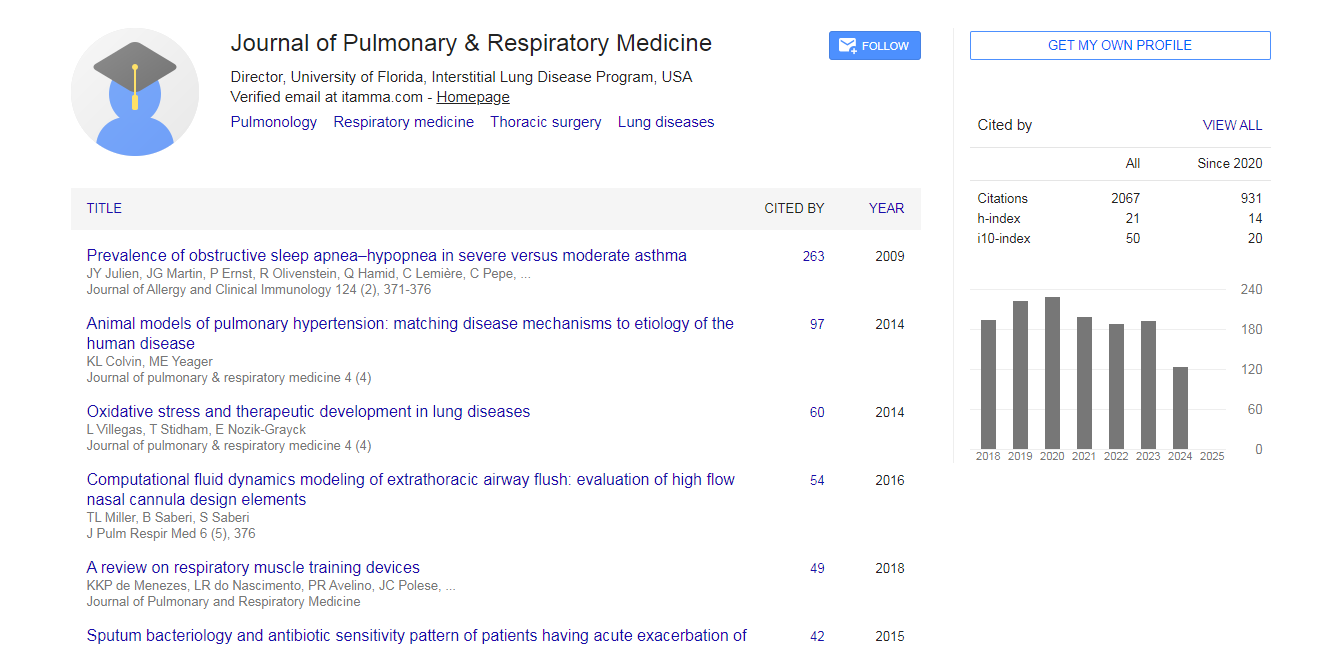
Pulmonary & Respiratory Medicine received 1690 citations as per Google Scholar report