Brief Report - (2025) Volume 13, Issue 5
Received: 01-Oct-2025, Manuscript No. jcdd-25-177658;
Editor assigned: 03-Oct-2025, Pre QC No. P-177658;
Reviewed: 17-Oct-2025, QC No. Q-177658;
Revised: 22-Oct-2025, Manuscript No. R-177658;
Published:
29-Oct-2025
, DOI: 10.37421/2329-9517.2025.13.689
Citation: Andrei Popescu. "Evolving Dyslipidemia Management:
Drugs, Lifestyle, Genetics." J Cardiovasc Dis Diagn 13 (2025):689.
Copyright: © 2025 P. Andrei This is an open-access article distributed under the terms of the Creative Commons Attribution License, which permits unrestricted use, distribution
and reproduction in any medium, provided the original author and source are credited.
PCSK9 inhibitors represent a significant advancement in lipid-lowering therapy, particularly for patients unable to achieve adequate LDL-C reduction with statins or those with familial hypercholesterolemia. These agents effectively lower LDL-C levels, leading to improved cardiovascular outcomes. Their role is increasingly critical in managing high-risk patients, offering a potent non-statin option[1].
Beyond statins, several non-statin therapies are emerging or have been established for managing hypercholesterolemia. These include ezetimibe, PCSK9 inhibitors, bempedoic acid, inclisiran, and evinacumab, among others. These agents target different pathways of lipid metabolism, offering additional LDL-C reduction and cardiovascular risk reduction, especially for patients with statin intolerance or very high residual risk[2].
Adopting healthy lifestyle modifications remains a cornerstone in the management of hyperlipidemia. This involves dietary changes focused on reducing saturated and trans fats, increasing soluble fiber, and consuming plant sterols. Regular physical activity, maintaining a healthy weight, and avoiding smoking and excessive alcohol consumption are also crucial for improving lipid profiles and overall cardiovascular health[3].
Genetic factors play a substantial role in determining an individual's lipid profile and risk for dyslipidemia. From rare monogenic disorders like familial hypercholesterolemia to common polygenic variations, genetics influence cholesterol absorption, synthesis, and catabolism. Understanding these genetic determinants helps identify high-risk individuals and tailor personalized treatment strategies[4].
The relationship between dietary cholesterol intake and cardiovascular disease risk has evolved over time. Current evidence suggests that for most healthy individuals, dietary cholesterol has a relatively modest impact on blood cholesterol levels compared to saturated and trans fats. However, for those with existing hypercholesterolemia or genetic predispositions, dietary cholesterol intake still warrants consideration in overall dietary patterns[5].
Updated guidelines from organizations like the National Lipid Association emphasize a patient-centered approach to managing dyslipidemias for cardiovascular disease prevention. These guidelines provide updated recommendations on identifying at-risk individuals, setting individualized LDL-C goals, and integrating lifestyle modifications with pharmacotherapy, including the optimal use of statins and non-statin therapies, to reduce overall cardiovascular risk[6].
For patients requiring further LDL-C reduction beyond statin therapy, several novel therapeutic options have emerged. These include agents targeting PCSK9, such as monoclonal antibodies and small interfering RNA (inclisiran), as well as ATP-citrate lyase inhibitors (bempedoic acid). These therapies offer significant additional LDL-C lowering and contribute to enhanced cardiovascular risk reduction, particularly in high-risk populations[7].
Inflammation is intricately linked with dyslipidemia and plays a critical role in the pathogenesis and progression of cardiovascular disease. High cholesterol, particularly elevated LDL-C, can trigger inflammatory responses in the arterial wall, contributing to atherosclerosis. Therapeutic strategies that address both dyslipidemia and inflammation may offer enhanced protection against cardiovascular events[8].
Familial hypercholesterolemia (FH) is a common genetic disorder characterized by profoundly elevated LDL-C levels from birth, leading to premature cardiovascular disease. Early diagnosis, often through screening and genetic testing, is crucial. Management typically involves aggressive lipid-lowering therapy, primarily high-intensity statins, often combined with ezetimibe or PCSK9 inhibitors, to prevent severe cardiovascular complications[9].
Universal lipid screening in childhood and adolescence is gaining recognition for identifying young individuals at risk for premature cardiovascular disease, especially those with familial hypercholesterolemia. Early identification allows for timely lifestyle interventions and, in select cases, pharmacotherapy, which can significantly modify the long-term trajectory of cardiovascular risk. Clinicians need updated guidance on screening protocols and subsequent management strategies[10].
PCSK9 inhibitors represent a significant advancement in lipid-lowering therapy, especially for patients unable to achieve adequate LDL-C reduction with statins or those with familial hypercholesterolemia. These agents effectively lower LDL-C levels, leading to improved cardiovascular outcomes, establishing a critical role in managing high-risk patients as a potent non-statin option [1]. Beyond statins, various non-statin therapies like ezetimibe, PCSK9 inhibitors, bempedoic acid, inclisiran, and evinacumab are crucial for managing hypercholesterolemia [2]. These agents target diverse lipid metabolism pathways, providing further LDL-C and cardiovascular risk reduction, particularly for statin-intolerant patients or those with high residual risk. Novel therapeutic options for further LDL-C reduction beyond statin therapy include agents targeting PCSK9, like monoclonal antibodies and small interfering RNA (inclisiran), and ATP-citrate lyase inhibitors (bempedoic acid) [7]. These therapies offer significant additional LDL-C lowering, contributing to enhanced cardiovascular risk reduction in high-risk populations.
Adopting healthy lifestyle modifications is a cornerstone in managing hyperlipidemia [3]. This involves dietary changes focused on reducing saturated and trans fats, increasing soluble fiber, and consuming plant sterols. Regular physical activity, maintaining a healthy weight, avoiding smoking, and limiting excessive alcohol are crucial for improving lipid profiles and overall cardiovascular health. The relationship between dietary cholesterol intake and cardiovascular disease risk has evolved, with current evidence suggesting a modest impact on blood cholesterol for most healthy individuals compared to saturated and trans fats [5]. However, for those with existing hypercholesterolemia or genetic predispositions, dietary cholesterol still warrants consideration in overall dietary patterns.
Genetic factors substantially determine an individual's lipid profile and risk for dyslipidemia [4]. From rare monogenic disorders like familial hypercholesterolemia to common polygenic variations, genetics influence cholesterol absorption, synthesis, and catabolism. Understanding these determinants helps identify high-risk individuals and tailor personalized treatment strategies. Familial hypercholesterolemia (FH) is a common genetic disorder marked by profoundly elevated LDL-C levels from birth, leading to premature cardiovascular disease [9]. Early diagnosis, often through screening and genetic testing, is vital. Management typically includes aggressive lipid-lowering therapy, primarily high-intensity statins, often combined with ezetimibe or PCSK9 inhibitors, to prevent severe cardiovascular complications.
Inflammation is intricately linked with dyslipidemia, playing a critical role in the pathogenesis and progression of cardiovascular disease [8]. High cholesterol, especially elevated LDL-C, can trigger inflammatory responses in the arterial wall, contributing to atherosclerosis. Therapeutic strategies addressing both dyslipidemia and inflammation may offer enhanced protection against cardiovascular events. Updated guidelines from organizations like the National Lipid Association emphasize a patient-centered approach to managing dyslipidemias for cardiovascular disease prevention [6]. These guidelines provide current recommendations on identifying at-risk individuals, setting individualized LDL-C goals, and integrating lifestyle modifications with pharmacotherapy, including optimal use of statins and non-statin therapies, to reduce overall cardiovascular risk. Universal lipid screening in childhood and adolescence is gaining recognition for identifying young individuals at risk for premature cardiovascular disease, particularly those with familial hypercholesterolemia [10]. Early identification allows for timely lifestyle interventions and, in select cases, pharmacotherapy, which can significantly modify the long-term trajectory of cardiovascular risk. Clinicians need updated guidance on screening protocols and subsequent management strategies.
The landscape of dyslipidemia management for cardiovascular disease prevention is evolving, encompassing both significant pharmacological advancements and essential lifestyle interventions. PCSK9 inhibitors have emerged as a powerful non-statin option, providing substantial LDL-C reduction and improved cardiovascular outcomes, especially crucial for patients unable to reach targets with statins or those with familial hypercholesterolemia. Further expanding the therapeutic arsenal are other non-statin agents like ezetimibe, bempedoic acid, and inclisiran, which target various lipid metabolism pathways to offer additional LDL-C lowering, particularly beneficial for individuals with statin intolerance or very high residual risk. Complementing these medical therapies, healthy lifestyle modifications, including focused dietary changes to reduce saturated and trans fats, increase soluble fiber, and engage in regular physical activity, remain foundational for improving lipid profiles and overall cardiovascular health. The understanding of dietary cholesterol's impact has refined, showing a modest effect for most healthy individuals, though it's still considered for those with predispositions. Genetic factors play a substantial role in determining individual lipid profiles and dyslipidemia risk, from rare monogenic disorders like familial hypercholesterolemia to common polygenic variations, guiding personalized treatment strategies. Familial hypercholesterolemia itself is a common genetic disorder requiring early diagnosis, often through screening, and aggressive lipid-lowering therapy. This need extends to universal lipid screening in childhood and adolescence, which is gaining recognition for identifying young individuals at risk for premature cardiovascular disease, enabling timely interventions. Moreover, inflammation is recognized as intricately linked with dyslipidemia, contributing significantly to atherosclerosis, suggesting that strategies addressing both aspects may offer enhanced protection. Updated clinical guidelines consistently advocate a patient-centered approach, integrating these diverse methods â?? from advanced pharmacotherapy to lifestyle changes and early screening â?? to effectively manage dyslipidemias and reduce overall cardiovascular risk.
Indexed at, Google Scholar, Crossref
Indexed at, Google Scholar, Crossref
Indexed at, Google Scholar, Crossref
Indexed at, Google Scholar, Crossref
Indexed at, Google Scholar, Crossref
Indexed at, Google Scholar, Crossref
Indexed at, Google Scholar, Crossref
Indexed at, Google Scholar, Crossref
Indexed at, Google Scholar, Crossref
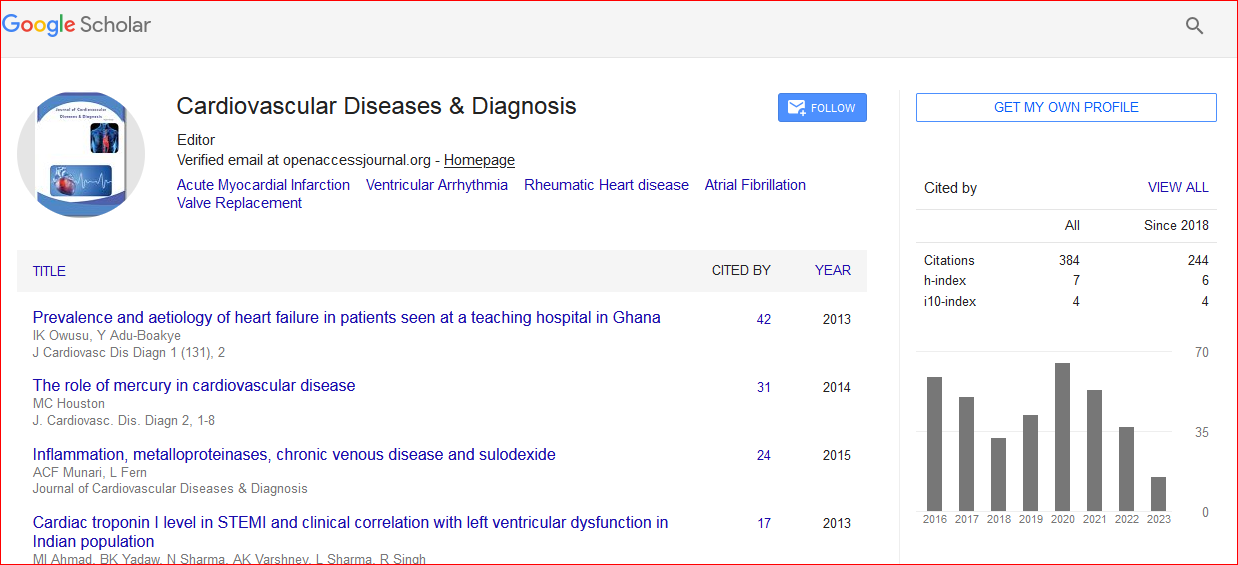
Cardiovascular Diseases & Diagnosis received 427 citations as per Google Scholar report