Perspective - (2025) Volume 13, Issue 2
Received: 01-Apr-2025, Manuscript No. jpgeb-25-741568;
Editor assigned: 03-Apr-2025, Pre QC No. P-741568;
Reviewed: 17-Apr-2025, QC No. Q-741568;
Revised: 22-Apr-2025, Manuscript No. R-741568;
Published:
29-Apr-2025
, DOI: 10.37421/2329-9002.2025.13.376
Citation: Ricci, Matteo. ”Evolutionary GWAS: Insights, Challenges, Future.” J Phylogenetics Evol Biol 13 (2025):376.
Copyright: © 2025 Ricci M. This is an open-access article distributed under the terms of the Creative Commons Attribution License, which permits unrestricted use, distribution
and reproduction in any medium, provided the original author and source are credited.
Genome-wide association studies (GWAS) serve as a powerful tool for exploring the evolutionary forces that shape human quantitative traits. By dissecting the genetic architecture of these complex traits, researchers can uncover clear signatures of natural selection, understand gene flow patterns, and pinpoint adaptations, thereby providing crucial insights into human evolutionary history and health. This approach offers a foundational understanding of how our genetic makeup has been influenced over time. [1] Beyond human studies, GWAS applications extend to natural, non-model populations, where they are instrumental in deciphering the genetic basis of adaptive traits within their native environments. This provides unique opportunities and addresses specific challenges in establishing direct links between genotypes and observable phenotypes, ultimately shedding light on ongoing evolutionary processes in the wild. Understanding these dynamics in ecological contexts is vital for broader evolutionary biology. [2] Despite its power, interpreting GWAS findings within an evolutionary framework presents inherent complexities. Key challenges include accurately distinguishing causal relationships from mere correlations, effectively accounting for population structure, and reliably identifying genuine adaptive signals amidst widespread pleiotropy and polygenicity. These difficulties underscore the critical need for sophisticated and robust methodological approaches to ensure accurate interpretations. [3] A significant area of investigation involves the growing evidence for polygenic adaptation in human complex traits. GWAS data, when integrated with advanced population genetic methods, has the potential to reveal widespread yet subtle shifts in allele frequencies across numerous genomic loci. These shifts collectively contribute to adaptive evolution, though definitively proving polygenic adaptation remains a complex task requiring careful analysis. [4] Recent advancements in GWAS research are continuously enhancing our comprehension of adaptation. New computational and statistical methods are being developed and refined to help differentiate between various evolutionary forces. This progression offers a clearer and more nuanced understanding of how genetic variation precisely contributes to adaptive phenotypes observed across diverse populations, refining our analytical capabilities. [5] The broader field of ecological genomics, which incorporates GWAS approaches, is instrumental in dissecting the genetic basis of adaptive divergence between different populations. It tackles the challenges involved in pinpointing specific loci responsible for adaptation and explores how environmental heterogeneity significantly influences the evolutionary trajectories of various traits. This interdisciplinary perspective offers rich insights into how species adapt to varied conditions. [6] Specifically within plant biology, GWAS proves highly valuable for uncovering the genetic underpinnings of adaptation in plants within their unique ecological settings. By carefully integrating detailed environmental data with comprehensive genomic analysis, researchers can effectively identify candidate genes and biochemical pathways crucial for local adaptation and for the evolutionary responses plants exhibit to pressing environmental pressures. [7] Insights derived from human GWAS are profoundly transforming our understanding of the evolutionary dynamics governing complex traits. These studies meticulously reveal how intricate interactions between natural selection, demographic history, and polygenic inheritance collaboratively shape the vast spectrum of phenotypic variation and the associated disease risks observed within human populations. This paints a detailed picture of human genetic evolution. [8] This evolving field of evolutionary genomics, bridging GWAS findings to a deeper understanding of adaptation in complex traits, has seen comprehensive reviews synthesizing current knowledge. Such reviews illustrate how genomic data is increasingly effective at identifying the targets of natural selection and clarifying the mechanisms underpinning polygenic adaptation, charting future directions for research in this dynamic area. [9] To further refine our understanding, researchers are actively exploring advanced statistical and computational methodologies. These methods leverage extensive GWAS data to accurately distinguish between the often intertwined effects of natural selection and genetic drift on human complex traits. This ongoing work addresses challenges and celebrates breakthroughs in precisely inferring the evolutionary history and the specific selective pressures acting upon polygenic traits. [10]
Genome-wide association studies (GWAS) have emerged as an indispensable tool in evolutionary biology, profoundly enhancing our ability to understand the genetic foundations of quantitative traits and their adaptive evolution. These powerful studies offer a direct lens into the genetic architecture of complex human traits, meticulously revealing the nuanced signatures of natural selection, the intricate patterns of gene flow, and specific adaptations that are pivotal for comprehending human evolutionary history and contemporary health challenges [1]. Beyond the human realm, the application of GWAS has broadened significantly to encompass natural, non-model populations. Here, it plays a critical role in identifying the underlying genetic basis of adaptive traits as they manifest within their native environments, thereby establishing concrete links between genotypes and observable adaptive phenotypes in the wild [2]. This expansive application is crucial for observing and deciphering the ongoing evolutionary processes in their authentic ecological settings, providing a holistic perspective on adaptation.
Despite the immense potential, interpreting GWAS findings within a comprehensive evolutionary framework poses considerable complexities and challenges. Researchers frequently contend with the intricate task of distinguishing genuine causal relationships from mere statistical correlations, effectively managing the confounding influences of population structure, and reliably pinpointing true adaptive signals that are often obscured by widespread pleiotropy and the polygenic nature of traits [3]. Recognizing these inherent difficulties, the scientific community is dedicated to the continuous development and refinement of new computational and statistical methods. These cutting-edge advancements are fundamental for accurately differentiating between the various evolutionary forces at play and for constructing a clearer, more precise understanding of how specific genetic variations contribute to the diverse adaptive phenotypes observed across a multitude of populations [5]. Such methodological rigor is essential for ensuring the validity and interpretability of evolutionary inferences drawn from GWAS data.
A central and intensely investigated aspect of current evolutionary genomics is the concept of polygenic adaptation, which describes how adaptive evolution can arise from numerous, subtle allele frequency shifts distributed across many genomic loci. When GWAS data is meticulously integrated with sophisticated population genetic methods, it provides compelling, albeit challenging, evidence for this widespread phenomenon in human complex traits. However, unequivocally proving polygenic adaptation remains a formidable task, requiring rigorous statistical validation and careful biological interpretation [4]. Moreover, the profound insights garnered from human GWAS studies are fundamentally reshaping our understanding of the evolutionary dynamics governing these complex traits. These investigations intricately reveal how the concerted interplay of natural selection, specific demographic histories, and the principles of polygenic inheritance collectively shape the vast spectrum of phenotypic variation and the associated disease risks prevalent within human populations [8]. This integrated perspective offers a more complete and dynamic picture of human genetic evolution and its health implications.
The power of GWAS extends significantly into the realm of ecological genomics, where it is a cornerstone for dissecting the genetic basis of adaptive divergence observed between distinct populations. This encompasses the critical identification of specific genetic loci responsible for adaptation and a deeper exploration of how environmental heterogeneity profoundly influences the evolutionary trajectories of various traits [6]. For instance, within the specialized field of plant biology, GWAS proves invaluable for meticulously uncovering the genetic underpinnings of adaptation in plants, particularly within their specific ecological contexts. The strategic integration of detailed environmental data with comprehensive genomic analysis allows researchers to effectively pinpoint candidate genes and the biochemical pathways that are central to local adaptation and the evolutionary responses plants exhibit to diverse environmental pressures [7]. These cross-species studies greatly enrich our understanding of the universal mechanisms of adaptation.
Looking forward, the ongoing evolution of evolutionary genomics is characterized by the development and application of increasingly sophisticated statistical and computational methodologies designed to more effectively leverage the expansive datasets generated by GWAS. A primary objective of these advanced methods is to accurately disentangle the often-complex and intertwined effects of natural selection from those of genetic drift on human complex traits [10]. This critical work is paramount for precisely inferring the evolutionary history and the specific selective pressures that have acted upon polygenic traits over time. Comprehensive reviews within the field play a crucial role by synthesizing the current body of knowledge, meticulously tracing the intellectual journey from initial GWAS findings to a profound understanding of adaptation in complex traits, and critically charting the exciting and challenging future directions for research in this rapidly advancing domain of evolutionary genomics [9].
Genome-wide association studies (GWAS) are essential for understanding evolutionary forces that shape traits across diverse populations and species. These studies illuminate the genetic architecture of human quantitative traits, revealing signatures of natural selection, gene flow, and adaptation, which are critical for understanding human evolutionary history and health. GWAS is also applied in natural, non-model populations to identify the genetic basis of adaptive traits in their native environments, bridging genotypes to phenotypes in the wild. The field faces challenges like distinguishing causality from correlation, addressing population structure, and identifying true adaptive signals amid pleiotropy and polygenicity. However, new computational and statistical methods are advancing our ability to interpret GWAS findings within an evolutionary framework, helping to differentiate various evolutionary forces. This includes exploring evidence for polygenic adaptation, where subtle allele frequency shifts across many loci contribute to adaptive evolution. Ecological genomics, utilizing GWAS, dissects the genetic basis of adaptive divergence and local adaptation in plants, showing how environmental data integration with genomic analysis helps identify candidate genes. Insights from human GWAS are transforming our understanding of complex trait dynamics, showing how selection, demographic history, and polygenic inheritance interact. The ongoing research leverages advanced methods to disentangle selection and genetic drift, charting a clear path from GWAS findings to a comprehensive understanding of adaptation in complex traits and highlighting future directions in evolutionary genomics.
None
None
1. Vivek S, Loïc Y, Peter MV. "Genome-wide association studies to understand evolutionary forces shaping human quantitative traits".Trends Genet 37 (2021):425-438.
Indexed at, Google Scholar, Crossref
2. Casey LF, Megan B, Lauren SA. "GWAS in natural populations: linking genotype to phenotype in the wild".Mol Ecol 32 (2023):1930-1946.
Indexed at, Google Scholar, Crossref
3. Shay Y, Peter MV, Joel IW. "The challenges of interpreting genome-wide association studies in an evolutionary context".Mol Ecol 29 (2020):4725-4739.
Indexed at, Google Scholar, Crossref
4. Fernando R, Jeremy JB, Joseph KP. "Signatures of polygenic adaptation in human complex traits".Trends Genet 36 (2020):495-502.
Indexed at, Google Scholar, Crossref
5. Carl V, Peter MV, Loïc Y. "Recent developments in understanding adaptation with genome-wide association studies".Trends Genet 38 (2022):673-685.
Indexed at, Google Scholar, Crossref
6. Kate EL, Stephen Y, Gideon SB. "Dissecting the genetic basis of adaptive divergence: insights from ecological genomics".Annu Rev Ecol Evol Syst 51 (2020):57-80.
Indexed at, Google Scholar, Crossref
7. Megan B, Lauren SA, Casey LF. "The genetic basis of adaptation: GWAS in ecological contexts".Curr Opin Plant Biol 70 (2022):102324.
Indexed at, Google Scholar, Crossref
8. Kirk EL, Graham C, Joseph KP. "The evolutionary dynamics of complex traits: lessons from human genetics".Curr Opin Genet Dev 70 (2021):10-18.
Indexed at, Google Scholar, Crossref
9. Peter MV, Loïc Y, Carl V. "Evolutionary genomics of complex traits: from GWAS to adaptation".Nat Rev Genet 24 (2023):691–708.
Indexed at, Google Scholar, Crossref
10. Masoud S, Loïc Y, Peter MV. "Disentangling the effects of selection and drift in human complex traits using GWAS".Trends Genet 37 (2021):452-466.
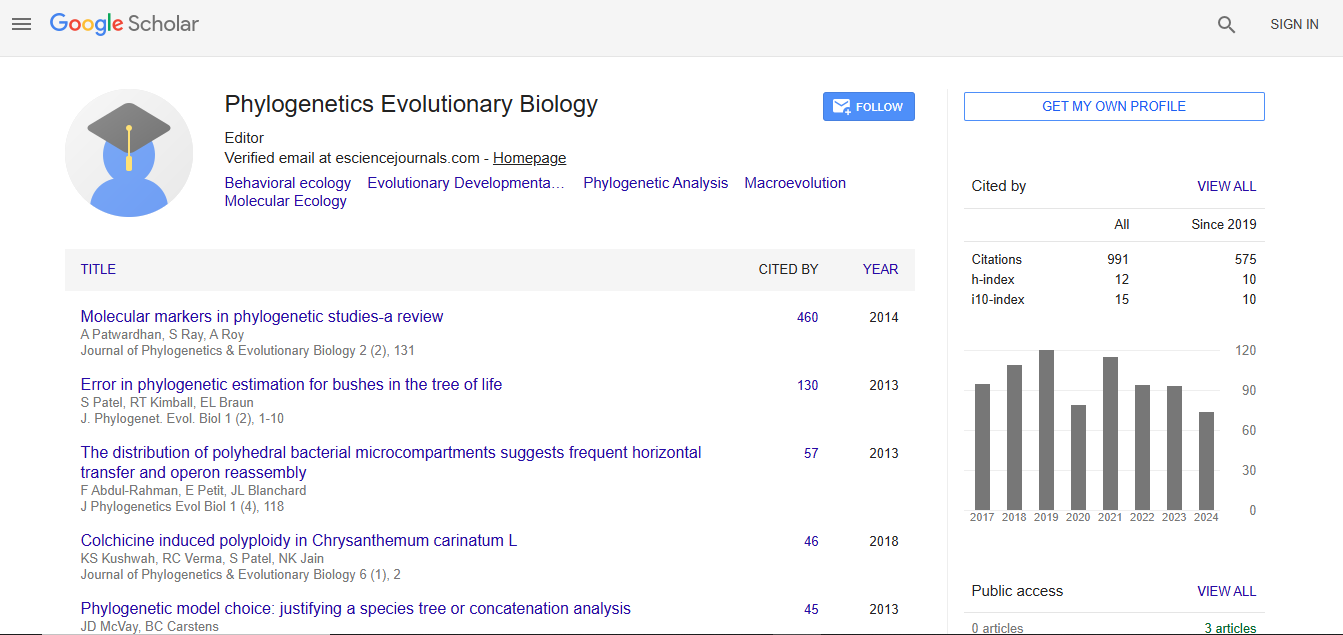
Journal of Phylogenetics & Evolutionary Biology received 911 citations as per Google Scholar report