Opinion - (2025) Volume 14, Issue 4
Received: 01-Jul-2025, Manuscript No. pbt-25-173764;
Editor assigned: 03-Jul-2025, Pre QC No. P-173764;
Reviewed: 17-Jul-2025, QC No. Q-173764;
Revised: 22-Jul-2025, Manuscript No. R-173764;
Published:
29-Jul-2025
, DOI: 10.37421/2167-7689.2025.14.493
Citation: Alvarez, Sofia. ”EU Medicines: Regulatory Evolution, Challenges, Innovation.” Pharmaceut Reg Affairs 14 (2025):493.
Copyright: © 2025 Alvarez S. This is an open-access article distributed under the terms of the Creative Commons Attribution License, which permits unrestricted use,
distribution and reproduction in any medium, provided the original author and source are credited.
The European Clinical Trials Regulation (EU CTR 536/2014) is changing how pediatric investigation plans are handled. What this really means is a significant shift in the regulatory landscape for children's medicines, aiming for more harmonized clinical trials across Europe while introducing new challenges and considerations for drug developers. This regulation introduces a streamlined application process and greater transparency, fundamentally changing how sponsors conduct clinical trials in the EU, particularly for vulnerable populations, thereby impacting study design, approval timelines, and operational complexities [1].
A group of European stakeholders has called for a re-evaluation of the EMA's orphan drug designation process. Here's the thing: they're proposing perspectives and solutions to make the system more effective and accessible, ensuring that medicines for rare diseases truly meet unmet patient needs. This re-evaluation focuses on refining criteria for designation, addressing challenges in market exclusivity, and promoting equitable access to therapies for patients with rare conditions, highlighting the need for continuous adaptation of regulatory frameworks to scientific advancements and patient advocacy [2].
Understanding pharmacovigilance and drug safety in Europe requires a grasp of its intricate legal framework and core requirements. What this really means is that a robust system is in place to monitor the safety of medicines once they're on the market, involving clear responsibilities for all parties. This legal framework, stemming from EU directives and regulations, covers adverse drug reaction reporting, risk management plans, and post-authorization safety studies, emphasizing proactive measures to ensure patient safety throughout a product's lifecycle [3].
Developing Advanced Therapy Medicinal Products (ATMPs) in Europe comes with specific clinical and regulatory hurdles. Let's break it down: these cutting-edge therapies, like gene and cell therapies, face unique challenges in their journey from research to patient access, requiring tailored regulatory approaches. These hurdles include complex manufacturing processes, specific safety concerns related to their biological nature, and intricate development pathways, necessitating specialized scientific advice and adaptive regulatory strategies to facilitate their market authorization [4].
The European Medicines Agency's scientific advice plays a crucial role in drug development, influencing clinical trial design and patient access. Here's the thing: analyzing trends in this advice reveals its impact on accelerating innovative medicines to patients, reflecting regulatory strategies and industry engagement. The EMA's scientific advice mechanism offers developers guidance on quality, non-clinical, and clinical development aspects, helping to optimize trial designs and avoid common pitfalls, thus speeding up the availability of new treatments for patients [5].
Sharing clinical trial data from Europe introduces a complex data protection challenge. What this really means is balancing transparency and public health benefits with stringent privacy regulations, creating a nuanced environment for scientific collaboration and ethical data use. The EU's General Data Protection Regulation (GDPR) adds layers of complexity, requiring careful anonymization or pseudonymization techniques and clear consent frameworks to enable responsible data sharing for research purposes without compromising individual privacy [6].
The use of real-world evidence (RWE) in European regulatory decision-making is evolving, presenting both existing landscapes and future opportunities. Let's break it down: RWE helps inform decisions about drug effectiveness and safety in routine clinical practice, complementing traditional clinical trial data for a more complete picture. Its application spans across various stages of drug development and post-market surveillance, providing insights into diverse patient populations and real-world treatment patterns, though its methodological rigor and data quality require careful consideration [7].
The EU Clinical Trial Regulation 536/2014 significantly impacts data transparency, creating both challenges and opportunities for public access to trial information. What this really means is a push for greater openness, which can foster public trust and facilitate research, while also navigating concerns about data privacy and commercial confidentiality. The regulation mandates public access to clinical trial information and results, aiming to increase transparency, reduce redundant research, and ultimately benefit public health, albeit with ongoing discussions about data redaction and access modalities [8].
Pediatric drug development in Europe faces distinct challenges and opportunities under the existing Pediatric Regulation. Here's the thing: ensuring children have access to safe and effective medicines requires specific incentives and regulatory pathways to overcome hurdles in conducting trials in vulnerable populations. The Pediatric Regulation aims to stimulate research into medicines for children by offering rewards such as extensions of market exclusivity, but the ethical and practical challenges of conducting pediatric trials remain significant, necessitating continuous efforts to improve participation and data generation [9].
The European Medicines Agency's Regulatory Science Strategy to 2025 outlines a clear vision for fostering innovation in medicines. What this really means is proactive engagement with emerging science and technology, aiming to facilitate the development and availability of new treatments for patients. This strategy emphasizes areas like advanced analytics, new clinical trial methodologies, and patient-centered development, ensuring the regulatory framework remains agile and responsive to scientific advancements, ultimately benefiting patient care [10].
The European pharmaceutical landscape is characterized by a dynamic regulatory environment, with significant reforms shaping how medicines are developed and monitored. The EU Clinical Trials Regulation (EU CTR 536/2014), for instance, has fundamentally altered the approach to pediatric investigation plans. What this really means is a significant shift in the regulatory landscape for children's medicines, aiming for more harmonized clinical trials across Europe while introducing new challenges and considerations for drug developers [1]. This regulation streamlines the application process for clinical trials across multiple EU member states, fostering a more consistent approach to pediatric studies. Concurrently, the existing Pediatric Regulation presents its own set of distinct challenges and opportunities, emphasizing the need for specific incentives and regulatory pathways to ensure children have access to safe and effective medicines despite the hurdles of conducting trials in vulnerable populations [9]. These frameworks collectively underscore Europe's commitment to improving access to innovative and safe treatments for its youngest citizens.
Addressing unmet patient needs, particularly for rare diseases, remains a critical focus. A group of European stakeholders has called for a re-evaluation of the European Medicines Agency's (EMA) orphan drug designation process. Here's the thing: they're proposing perspectives and solutions to make the system more effective and accessible, ensuring that medicines for rare diseases truly meet unmet patient needs [2]. This initiative aims to refine the criteria for orphan designation, optimize market incentives, and ensure that the system effectively facilitates the development of therapies for conditions affecting small patient populations. Beyond rare diseases, the development of Advanced Therapy Medicinal Products (ATMPs) in Europe comes with specific clinical and regulatory hurdles. Let's break it down: these cutting-edge therapies, like gene and cell therapies, face unique challenges in their journey from research to patient access, requiring tailored regulatory approaches due to their complex nature and manufacturing demands [4].
Transparency and data management are increasingly central to European regulatory discussions. The EU Clinical Trial Regulation 536/2014 significantly impacts data transparency, creating both challenges and opportunities for public access to trial information [8]. What this really means is a push for greater openness, which can foster public trust and facilitate research, while also navigating concerns about data privacy and commercial confidentiality. This challenge is further highlighted by the complexities of sharing clinical trial data from Europe, which introduces a complex data protection conundrum [6]. Balancing transparency and public health benefits with stringent privacy regulations like GDPR is crucial for scientific collaboration and ethical data use. Underlying all these efforts is a comprehensive system of pharmacovigilance and drug safety in Europe, which requires a grasp of its intricate legal framework and core requirements. What this really means is that a robust system is in place to monitor the safety of medicines once they're on the market, involving clear responsibilities for all parties to ensure patient well-being [3].
Fostering innovation and adapting to new scientific advancements are key strategic priorities. The European Medicines Agency's scientific advice plays a crucial role in drug development, influencing clinical trial design and patient access [5]. Analyzing trends in this advice reveals its impact on accelerating innovative medicines to patients, reflecting evolving regulatory strategies and industry engagement. Furthermore, the EMA's Regulatory Science Strategy to 2025 outlines a clear vision for fostering innovation in medicines [10]. What this really means is proactive engagement with emerging science and technology, aiming to facilitate the development and availability of new treatments for patients. This forward-looking strategy is complemented by the evolving use of real-world evidence (RWE) in European regulatory decision-making. Let's break it down: RWE helps inform decisions about drug effectiveness and safety in routine clinical practice, complementing traditional clinical trial data for a more complete picture, and presents both existing landscapes and future opportunities for enhancing regulatory insights [7].
The European regulatory landscape for medicines is undergoing significant evolution, particularly with the EU Clinical Trials Regulation (EU CTR 536/2014), which is reshaping pediatric investigation plans and enhancing data transparency. This shift aims for more harmonized clinical trials across Europe while introducing challenges related to public access and data privacy. Stakeholders are advocating for a re-evaluation of the European Medicines Agency's (EMA) orphan drug designation process, seeking solutions to better meet unmet patient needs for rare diseases. Similarly, pediatric drug development continues to present distinct challenges and opportunities, requiring specific incentives and regulatory pathways to ensure children have access to safe and effective treatments. Robust pharmacovigilance systems are in place, defined by a complex legal framework, to monitor drug safety once medicines are on the market. Furthermore, the development of Advanced Therapy Medicinal Products (ATMPs) faces unique clinical and regulatory hurdles, demanding tailored approaches to bring these innovative therapies from research to patients. The EMA's scientific advice is instrumental in drug development, influencing trial design and patient access, with trends showing its role in accelerating innovative medicines. The agency's Regulatory Science Strategy to 2025 further underscores a commitment to proactive engagement with emerging science and technology to facilitate new treatments. Concurrently, the use of real-world evidence in regulatory decision-making is expanding, complementing traditional clinical trial data for a more comprehensive understanding of drug effectiveness and safety. However, sharing clinical trial data from Europe also poses a complex data protection challenge, requiring a balance between transparency and privacy.
None
None
1. Fabrizio D, Andrea P, Mariella B. "The clinical trial regulation in Europe and its impact on pediatric investigation plans and regulatory guidance".Expert Rev Clin Pharmacol 16 (2023):1047-1058.
Indexed at, Google Scholar, Crossref
2. Stuart KG, Roberto A, Birgitte B. "Re-thinking the EMA's orphan drug designation process-Perspectives and solutions from a European stakeholder group".Br J Clin Pharmacol 88 (2022):4331-4340.
Indexed at, Google Scholar, Crossref
3. Aintzane R, Mari CA, Jose LDP. "Pharmacovigilance and drug safety: an overview of the European legal framework and main requirements".Expert Opin Drug Saf 20 (2021):1097-1108.
Indexed at, Google Scholar, Crossref
4. Xavière V, Francesco P, Patrick D. "Challenges in the clinical development and regulatory review of advanced therapy medicinal products (ATMPs) in Europe: A review".J Transl Med 18 (2020):260.
Indexed at, Google Scholar, Crossref
5. Guido R, Maddalena R, Sandra H. "The European Medicines Agency's scientific advice: analysis of trends, impact on clinical development, and patient access".Nat Rev Drug Discov 18 (2019):901-902.
Indexed at, Google Scholar, Crossref
6. Alice B, Fabrizio L, Elena C. "Sharing clinical trial data from Europe: a new data protection conundrum".Nat Rev Drug Discov 23 (2024):201-202.
Indexed at, Google Scholar, Crossref
7. Linnea J, Rachel O, Claire O. "Real-World Evidence Use in European Regulatory Decision-Making-Landscape and Opportunities".Front Pharmacol 14 (2023):1163456.
Indexed at, Google Scholar, Crossref
8. Hans-Georg E, Francesco P, Guido R. "The EU Clinical Trial Regulation 536/2014 and data transparency: an overview and analysis of challenges and opportunities for public access".Expert Rev Clin Pharmacol 15 (2022):969-976.
Indexed at, Google Scholar, Crossref
9. Patrick D, Fatoumata T, Guido R. "Pediatric drug development in Europe: Challenges and opportunities under the Pediatric Regulation".Expert Rev Clin Pharmacol 14 (2021):1221-1229.
Indexed at, Google Scholar, Crossref
10. Hans-Georg E, Thomas A, Joanna B. "The European Medicines Agency's Regulatory Science Strategy to 2025: A vision for supporting innovative medicines".Clin Pharmacol Ther 108 (2020):905-907.
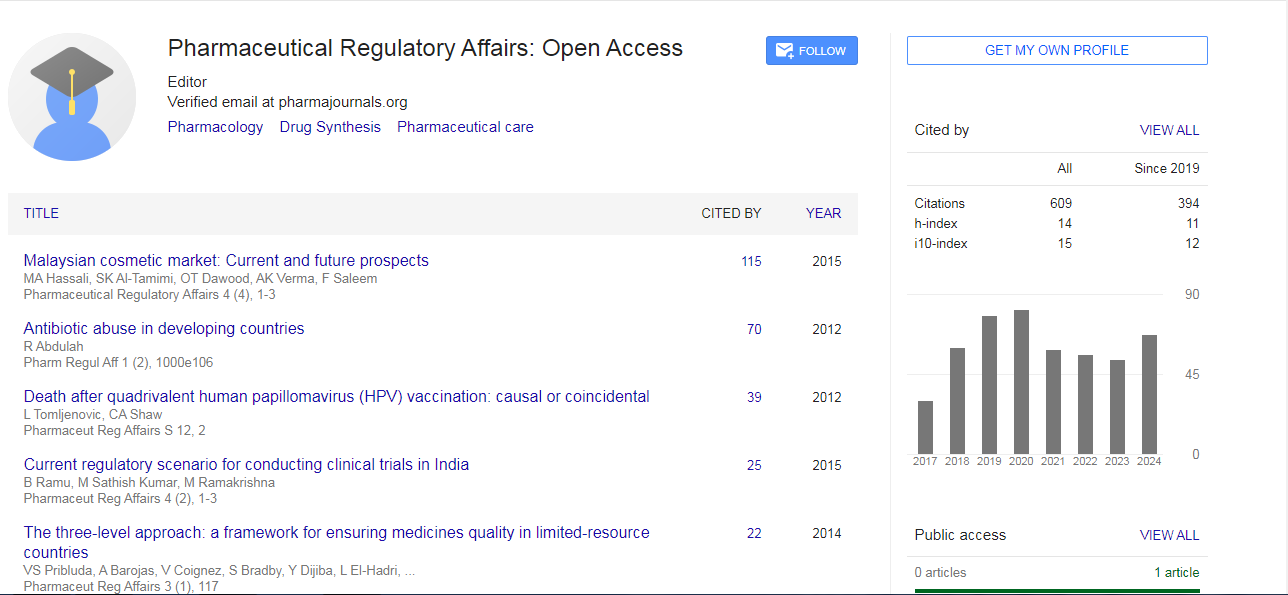
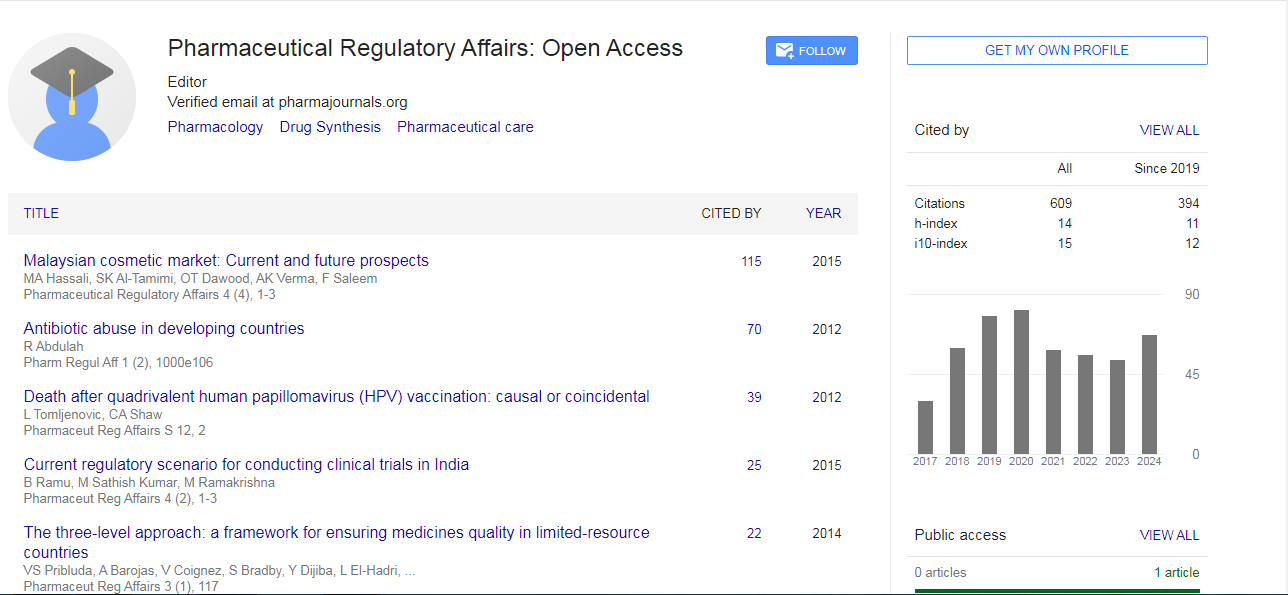
Pharmaceutical Regulatory Affairs: Open Access received 533 citations as per Google Scholar report