Research Article - (2026) Volume 15, Issue 1
Received: 19-Nov-2024, Manuscript No. PBT-24-152837;
Editor assigned: 22-Nov-2024, Pre QC No. PBT-24-152837 (PQ);
Reviewed: 09-Dec-2024, QC No. PBT-24-152837;
Revised: 04-Feb-2026, Manuscript No. PBT-24-152837 (R);
Published:
11-Feb-2026
, DOI: 10.37421/2167-7689.2026.15.409
Citation: Fedotov, Alexander. "EU GMP Annex 1 of 2022: A View in Depth." Pharmaceut Reg Affairs 15 (2026): 409.
Copyright: © 2026 Fedotov A. This is an open-access article distributed under the terms of the creative commons attribution license which permits unrestricted use, distribution and reproduction in any medium, provided the original author and source are credited.
The latest version of EU GMP Annex 1 was approved in August 2022 after a very long period of discussions [1]. People can expect that regulatory innovations are steps forward in quality assurance of medicinal products. But is it really so? Many presentations describe changes as to be progressive without explaining in depth. If to do so, one can see huge confusions in Annex 1 regarding requirements for cleanrooms. It is a pity that those who made changes ignored results of investigations [2,3], that were submitted to EU GMP Commission. New confusions were added to old contradictions and dogmas. A look in depth allows to understand whether changes are positive or they even jeopardize quality of products.
EU GMP • CCS • Fractional efficiency • Dogmas • Emperor
Annex 1 introduces the term “Contamination Control Strategy – CCS” and declares that this is a step forward. The very word “Strategy” promises a fundamentally new level of management with a scientific shade.
Bur what does CCS really mean?
Annex 1 defines Contamination Control Strategy (CCS) as “A planned set of controls for microorganisms, endotoxin/pyrogen and particles, derived from current product and process understanding that assures process performance and product quality. The controls can include parameters and attributes related to active substance, excipient and drug product materials and components, facility and equipment operating conditions, in-process controls, finished product specifications, and the associated methods and frequency of monitoring and control”.
Is there anything new in this definition?
• “A planned set of controls...” is a mandatory routine practice for every facility and is in use for centuries, e.g. control of steam pressure in steam machines and many other applications.
• “Derived from current product and process understanding that assures process performance and product quality” – This is well known and no other approach can be accepted. Norms, suppliers or design specifications form the basis that can be adjusted in operation. What new is in CCS?
• The controls can include parameters and attributes related to...
All these are in use for decades at each facility and are already in standards and guidance.
Nothing new can be found in CCS!
If so, then what is it for?
To give nutrient for numerous consultants, validators etc.? – No other can be imagined.
What is a CCS for a given facility?
CCS is an overall list of all parameters and attributes for all premises, utilities, processes etc. through the whole facility.
Now manufactures have separate lists for all of them: One for cleanrooms, the second for water treatment systems, the third for process gases etc.
All of them are controlled by different departments or specialists.
There is no sense to construct a special general file that includes all parameters. They are already in separate files that can be assembled in one volume if needed.
So CCS gives an impression of care on quality but in fact it is a new circle of a sad interpretation of GMP as Great Mounts of Paper.
Item 2.3 of Annex 1 says: “A Contamination Control Strategy (CCS) should be implemented across the facility in order to define all critical control points and assess the effectiveness of all the controls”.
So Annex 1 constitutes CCS as a point of departure to define critical critial control points and to assess effectivenes.
But it is not so!
CCS is a compedium of these from primary documents and adds nothing to them.
Furthermore, CCS plants a real danger for quality. Now Annex 1 says that one shall look into CCS what to do or consult how to deal with controls of parameters.
This is a fundamental change. Normally technicians or others involved look into primary norms, must know and understand them.
Procedures for personal behavior, hygiene, garments, testing etc. are well known and were described sufficiently. They all are in common use for decades.
SOPs, programs for control are everywhere. If something fails, the correction shall be done.
What to add else? Why existing and well-established system is not enough?
CCS turns it from the head to bottom.
Replacing of primary documents by secondary ones is dangerous!
Spreading the same information and duplicating is misleading. Repeating the same words many times gives one result: Nobody listens or reads them or does it formally.
If something new appears, it shall be added to existing systems, if contrary is not proved.
Those who insist on CCS must show first whether existing contamination control order is not sufficient and what shall be done to improve it without overloading people.
The worst is that some (or many?) manufacturers prefer to follow formal schemes without understanding what they do. Otherwise they shall try, think, apply efforts and not to be lazy.
How did people live without CCS?
How did facilities produce good products according to all requirements?
The answer is clear: Good facilities produced good products. Bad facilities had to be improved a transparent way without artificial and muddy formal methods.
If so, why and what for CCS appeared? To satisfy interests of those who construct artificial schemes for earning more money? – This is out of regulatory expectations and shall be stopped.
The old story with ≥ 5.0 μm particles and unnecessary difficulties for air sampling as consequences
A background
There is a significant difference between in EU GMP Annex 1 and FDA requirements for airborne particle limits:
• Annex 1 specifies limits both for particles ≥ 0.5 and ≥ 5.0 μm but
• FDA does it for particles ≥ 0.5 μm only [4].
The difference goes back to 1980th when the first norms appeared. They were based on expert’s opinions without enough analysis. Since that time 40 years passed, new data appeared and some people ask: What is the reason for this deference?
Actually particles ≥ 5.0 μm create huge problems:
• The acceptable limit is very low and big volumes of samples (up to 1 m3 of air) for zones A/B are required for statistical reasons.
• It caused to construct particle counters with big air flow rate up to 100 l/min specially for markets where EU GMP are in force.
• Particles deposition on sample tubes is big for particles ≥ 5.0 μm, not for ≥ 0.5 μm.
Physics of product contamination is different for zones with unidirectional (laminar air flow) - zones A and for zones with nonunidirectional (turbulent) air flow.
Zones A or ISO Class 5 are of critical importance so let’s discuss them first [5].
What do we really control in zones A?
There are two sources of air/product contamination:
• The first is particles emission from personal, equipment etc.
• The second is particles penetration through HEPA filters.
The first case means a side influence of personal etc. on the product.
When does this side effect takes place? It appears in a close proximity of the source to the product. The author has made a simple experiment. A particle counter was placed in the laminar flow bench and an operator with normal street closes made different hand movements. There was a zero count at the distance of 5 cm and more to the sampling probe placed on the level above the probe. The operator made not quick movements. Particles count started only at the distance less than 5 cm and for very quick hand movements that disturbed unidirectional air flow severely.
Anyone can repeat this experiment.
There is only one way to avoid such contamination. This is to arrange working zones without any obstacles between HEPA filters and the product. It is well known and GMPs specify a whole system for arranging process, validation and control without CCS.
In contrary neither CCS or monitoring can help both for particles ≥ 0.5 and ≥ 5.0 μm.
In the second case particles can come to the product in presence of an obstacle on the direct route between HEPA filter and the product. It may be a hand or some part of equipment. Product will be always contaminated and no CCS or monitoring can help.
Is there any sense to control particles ≥ 5.0 μm in addition to ≥ 0.5 μm?
- No!
The reason lies in filtration physics. Filter efficiency depends dramatically on particle size. It has a clear minimum at so called Maximum Particles Penetrating Size – MPPS.
Maximum penetration at MPPS point means minimum efficiency (Figure 1).
Normally MPPS is somewhat around 0.15–0.2 μm. Particle size ≥ 0.5 μm is not so far from MPPS point (Figure 1). If the air after HEPA filter passes 0.5 μm limit, then it will pass 5.0 μm limit with great redundancy of several orders of magnitude!
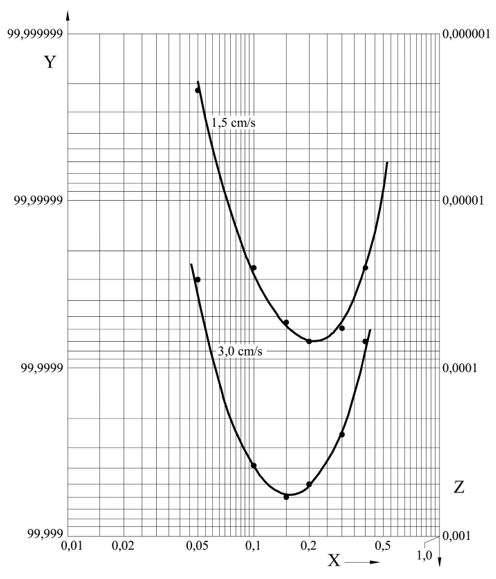
Figure 1. Fractional efficiency E and penetration P of an ULPA filter medium as function of particle diameter DP for two different filter medium velocities (example).
Less clean zones
No sense of 5.0 μm particles control for critical zones was shown in the above item.
There is also no sense for less clean zones/rooms.
Some people say that ≥ 5.0 μm particles can carry microorganisms, personal is the main source of them and such a control is needed.
But increasing of number of ≥ 5.0 μm particles will be accompanied with increasing number of ≥ 0.5 μm particles.
In what correlation? Probably no precise data can be found. From our experience this correlation is about 10:1 (fluctuations can occur).
Correlation in ISO 14644-1 is 121:1. Is it based on any real statistics? – No!
ISO 146441-1:2015 is based on the formula (E.1) [6]
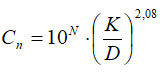
where
Cn is the maximum permitted concentration (particles per cubic metre) of airborne particles that are equal to and greater than the considered particle size;
N is the ISO Class number,
D is the considered particle size, in μm.
K is a constant, 0,1, expressed in micrometres.
This formula has nothing common with reality and never represented particles concentrations in actual conditions. It cannot be used as a source for comparing particles concentration.
This formula is artificial. It is an analytical presentation of decimal row of numbers: 1; 10; 100 … and has nothing common with real life.
Tubing line length and configuration
They are not important for ≥ 0.5 μm particles. Deposition on tubing starts and increases for bigger sizers because of inertia effect. Particles ≥ 5.0 μm loss can be big for complex tubing lines configurations with bends. It creates headache, special investigations, “scientific” services etc.
Isokinetic sampling of air
Annex 1 mentions it without explaining where it is needed. Probably the best explaining can be found in the USA Fed. Std. 209E, C.40, page 35, clause 2:
“The analysis indicates that anisokinetic of particles 0.5 μm and smaller is not a problem in typical clean zones and will rarely be a problem when sampling 5.0 μm unless sampling is carried out to detect a point source of particles.”
Calculations confirm it and even show that an error for particles 5 μm are less than 5%.
It means that discussions on isokinetic sampling for majority of cleanrooms have no sense and are misleading, even for 5.0 μm.
We see again: No unneeded particles 5.0 μm no problems!
Annex 1 requires isokinetic sampling but does say when it is needed. SO it can be understood that such a sampling is necessary everywhere.
But there two absolutely different kinds of clean rooms (clean zones):
• With unidirectional air flow.
• With nonunidirectional airflow.
Isokinetic sampling can have sense to unidirectional airflow. It is not applied to nonunidirectional airflow. But the vast majority of cleanrooms in pharma industry have this nonunidirectional airflow. So Annex 1 pushes manufacturers to make senseless job and pushes inspectors to request it.
This nonsense cannot be accepted!
Annex 1 harmonization with ISO 14644-1 standard
Changes in Annex were made under the slogan of harmonization.
• Harmonization with what?
• A real GMP practice with abstract numbers?
It was never an intention to describe in ISO 14644-1 any realistic picture. And ISO 14644-1 does not consider any specific requirements of a given application. It was never deemed that somebody will harmonize real practice with artificial approach in ISO 14644-1.
But Annex 1 has taken artificial ISO 14644-1 numbers as point of departure and has broken well accepted limits of earlier Annex 1 versions (before 2008). The limits were increased from 1 via 20 to now 29 for ≥ 5.0 μm particles. This was already discussed with details.
Such increasing is a huge and obvious jeopardizing of product’s quality.
Comparison of 20 or 29 particles/m3 and 1 particle/m3 cannot be a subject for a discussion.
A cleanroom with 29 particles/m3 is dirtier than with 1 particle/m3 one. Risk for quality of product is an order of magnitude bigger. 29 particles/m3 limit cannot be advocated considering that satisfying 1 particle/m3 was achieved long ago.
FDA and EU differences
FDA does not request to control ≥ 5.0 μm particles.
Does it mean that American drugs are worse than European ones? No! No evidence can be found. The difference could be understood for 1980-s when there was a lack of knowledge and subjective expert’s opinions could be a guide. But now we have knowledge and experimental data. It is not possible to ignore them!
Anyone who sets regulations must prove them, analyzing surrounding world. This is a mandatory making condition for any serious work.
Why EU GMP Commission does not follow it?
The general conclusion is simple: ≥ 5.0 μm particle is an artificial problem and an archaic dogma.
Classifications and monitoring: more changes – more confusions
The was a single Table of limits concentrations of airborne particles in previous versions of Annex 1, both for classification at start-up and for monitoring in operation.
Now there are two different tables in Annex 1 for classification and for monitoring (Tables 1 and 2). Numeration of tables is given as in Annex 1.
| Grade | Maximum limits for total particle m/m3 | Maximum limits for total particle m/m3 | ||
| At rest | In operation | At rest | In operation | |
| A | 3 520 | 3 520a | Not specified(a) | Not specified(a) |
| B | 3 520 | 352 000 | Not specified(a) | 2 930 |
| C | 352 000 | 3 520 000 | 2 930 | 29 300 |
| D | 3 520 000 | Not predetermined(b) | 29 300 | Not predetermined(b) |
| Note: aClassification including 5 m particles may be considered were indicated by the CCS or historical trends. bFor grade D in operation limits are not predetermined. The manufacturer should establish in operation limits based on risk assessment and routine data where applicable. |
||||
Table 1. Maximum permitted total particle concentration for classification.
| Grade | Maximum limits for total particle 0.5 m/m3 | Maximum limits for total particle 5.0 m/m3 | ||
| At rest | In operation | At rest | In operation | |
| A | 3 520 | 3 520a | 29 | 29 |
| B | 3 520 | 352 000 | 29 | 2 930 |
| C | 352 000 | 3 520 000 | 2 930 | 29 300 |
| D | 3 520 000 | Not predetermined(a) | 29 300 | Not predetermined(a) |
| Note: aFor grade D in operation limits are not predetermined. The manufacturer should establish in operation limits based on risk assessment and routine data where applicable. | ||||
Table 2. Maximum permitted total particle concentration for monitoring.
For grade D in operation limits are not predetermined. The manufacturer should establish in operation limits based on risk assessment and routine data where applicable.
Table 1 does not specify limits for zone A both at rest and in operation and for zone B at rest, but specifies them for less clean zones C and D. It is strange. A common logic says that more attention shall be payed to critical zones. For non-critical zones an attention shall be less or can be absent at all.
Forms of Tables
The new Annex 1 offers different forms for Tables than earlier ones.
Before 2022 occupancy states were in the second horizontal line of the table and threshold sizes were in the third. Now we see the opposite picture: Threshold sizes are in the second line and occupancy states are the third.
Somebody can try to seek for a sense of this change, thinking that a change without sense is not permitted for a normative document.
Unfortunately, the sense is absent. Simple changes in location of symbols and parameters can create huge mixings and confusions in the field. They increase risks in the most unreliable and sensitive sector – people.
Start-up testing vs. routine monitoring
Annex 1 separates requirements for start-up and routine monitoring and makes it in a very strange way. Annex 1 makes a step forward regarding ≥ 5.0 μm particles in some sense. It cancelled these particles from classification (start-up) testing for grades A and B, but, at the same time, it retains monitoring of particles ≥ 5.0 μm for routine control. Thus, the new Annex 1 specifies a more detailed and rigorous routine control than start-up testing.
A fundamental rule says “A scope of start-up testing shall be always bigger (wider) than for routine monitoring”. Otherwise, a fault can be overlooked at start-up and found at routing control only. Table 3 of Annex 1 breaches this rule.
| Volumes of testing for start-up and monitoring | ||
| Normal practice | Annex 1 draft | |
| Start-up | Bigger | Smaller |
| Monitoring | Smaller | Bigger |
Table 3. Volumes of testing for start-up and monitoring.
Analogue with water treatment
A story with particles ≥ 5.0 μm reminds discussions in Europe on reversal osmosis for Water for Injections treatment. Reversal osmosis was allowed in the US and Japan since 1980th to treat Water for Injections (WFI). But Europe did not allow it till late 2010th.
Why? It was the subject for discussions at many conferences and there was only one argument in favor of distillation that distillation is effective.
But no estimation of other methods was done in conjunction with monitoring method.
The author asked one of apologist of solely distillation in early 2000: Why you do not permit other approaches together with monitoring?
The answer was: “I think so! You may think different”.
No other and effective methods from the experience of other countries were even listened.
The opinion of one person was keeping EU on the old dogmatic position.
It took 30 years to accept modern technologies. And it happened not thanks to investigations and analysis that were done much before in the US and Japan. The generation of conservative experts left activity but it cost 30 years’ delay of progress in Europe.
A mandatory doors interlocking as a danger for personal safety
The previous Annex 1 version did not require doors in interlocking air locks. Now a mandatory requirement to do so for zones A/B appeared. This dangerous for personal safety. People can fail to escape from the room in emergency case.
There is an opinion that alarm buttons for unblocking the doors can be a solution. But the matter is not so simple. Alarm buttons and others are trivial and widely known at least for a century. But there are some issues that do not lie on the surface.
Panic:
That first factor is a panic.
Fire or another dangerous event is not common and is a rare event.
When it happens people act according to their normal behavior. They try to escape a normal way, not a specific one as they were taught. We shall consider a real fact that such training is sometimes formal and does not implant an automatic behavior in a human mind for the alarm case. There were severe events that confirm it.
People can act two modes of behavior:
• Standard or
• Non-standard.
Standard behavior is a normal mode. People follow it every day automatically, not much thinking.
Unusual and dangerous events are non-standard. People shall be trained to act in such situations but automatic behavior is not the case. People must think, decide what to do and only then act.
Not everybody can think quickly. Some people simply follow a standard mode and bump into obstacle.
An emergency exit panic bar is a different route for escape. It is standard for emergency case and shall be implanted into minds when training.
We discuss changing rooms. The same route for exit can be standard or non-standard.
So a person shall preclude his behavior from standard to nonstandard mode. A person has two choices and has to decide to act a right way.
At this point two kinds of ruling human behavior should be considered. They are:
• Conscience and
• Subconscious minds.
The subconscious mind rules people (or some of them, at least) in unusual situations and at a short time interval.
In highly responsible professions operators are trained intensively to catch a dangerous event and to act properly. But cleanrooms are not the case. Acting shall be quick in emergency cases. So we have to consider and respect modes of behavior.
To allow people to escape without additional actions is the only solution.
Sudden illness (fainting etc.) is an opposite example.
Such case happened actually.
A man was working in the cleanroom with doors interlocking. He felt sick and tried to get out. He opened the first door of the air lock and had fallen down between the door and its frame and lost consciousness.
The red light at the outer side of the air lock said that no entrance is permitted. It lighted long and people from outside tried to open the door but it was blocked. It took time to understand that something is out of order and to release the door.
Fortunately, a sick man came to order himself. But the end could be sad. The border between life and death is very thin and seconds can be of dramatic value.
This is a real example in author’s practice. It was discussed intensively at the plant. Key persons who carried personal responsibility took part in this meeting. The solution was unanimously and categorically: not to accept any interlocking in cleanrooms!
This was a decision of people who carry real responsibility.
Position of these people is of only value.
Why others wait until disaster will happen and not learn a known experience?
Reliability:
Any system can fail. Interlocking is not an exception.
Theory and practice of reliability separate measures against dangerous failures from other ones. These are for aircrafts, railways, pressure vessels etc.
These methods are not used for cleanrooms. The only realistic way for cleanrooms is to make simple solutions.
One shall keep in mind that safety is the first priority before any other reasons.
What to do without interlocking? Practice, e.g. from FDA, gives the answer:
• To arrange an additional airlock between changing room and aseptic room; this arrangement is included in the new Annex 1, but it is written not clear enough and creates confusions in the field.
• Determining doors position by electric/electronic means with transmitting data to management and including alarm, if necessary.
• Video cameras allow to find the guilty in a moment. It gives an excellent disciplinary result.
Who takes the decision?
Authors of norms make the highly responsible decisions but they carry no responsibility and not always understand what they do. The responsibility lies on other people.
Manufacture’s management carries the sole responsibility for decisions of other people.
It is abnormal and shall be changed. A manufacturer shall take a decision whether to imply interlocking or not.
So mandatory requirement in Annex 1 shall be withdrawn. The previous Annex 1 version gave flexibility. At mentioned interlocking, but left the decision to the user.
Scientific justification: what does it really mean?
Is ICH Q9 scientific?
Scientific justification means a logical proof and proof by experiments.
Unfortunately, everybody takes this scientific slogan on trust, as a dogma. People even do not try to estimate critically what they do.
The detailed explaining of such methods of risk analysis as FEMECA of ICH O9 show that they anti-scientific.
Three starting points for a discussion
It is useful to keep in mind three starting points for a professional discussion.
Responsibility: Manufacturer of medicinal products is entirely responsible for a product he produces. All others: Authorities, writers of norms, validators are not responsible for anything. There is no evidence that somebody was brought to a court for bad norms he wrote.
Professionalism: Engineers, pharmacists, QA/QC managers and others shall understand what they do and not follow recommendations blindly. They shall estimate what real result those recommendations or norms give.
To avoid formalism:
Requirements shall be reasonable, transparent and useful.
They shall not overload a manufacturer. Formalism will be a response otherwise. That’s what we observe in GMPs now. Following formal schemes without understanding replaces care on quality. Formalism is the worst enemy.
Good practice for developing norms
A good practice of standardization requests:
• To prove that a proposal is useful and not trivial.
• To estimate the cost of implementation.
• To learn if a user will suffer without this new method.
Only after sound discussion and considering different views the offer has right for life.
This is a normal practice, but not everybody follows it. Some GMP, quality management, risk analysis issues are among them.
It cannot be accepted, especially for products that shall be safe and effective.
Preparing of a good quality norms and recommendations is a responsible and not a simple task.
There are three mandatory conditions to avoid confusions:
The first condition is that any proposal shall be based on facts and investigations, not opinions.
Personal experience is mandatory too, not opinions or somebody declarations.
The second condition is a common sense. Anything opposite shall be thoroughly investigated to find the reason of unusual event.
The third condition is that any proposal shall be verified and proved on practical examples. No trust to declarations and slogans!
All products, e.g., planes, cars, different devices etc. are subjects for a thorough testing before start manufacturing. Improving a design and constructive elements can be long and include many cycles of changes, remakes, manufacturing of experimental samples and their testing, estimation, redesign etc. There may be many circles of it, even complete changing of the idea or rejecting it.
But we see nothing like in creating norms, standards and recommendations.
There are numerous examples for it including FMECA method of risk analysis, some GMP postulates etc.
Is not it time to understand that quality of norms is mandatory for quality of products?
Dogmas:
The next principle is to avoid dogmas.
Human history presents examples of dogmas. Here are only few examples:
Three elephants:
“The Earth sits on three elephants or three whales, as an option”.
It was an official ideology at some ancient civilizations for thousands yeas. Those who were in doubt were severely executed.
Egyptian gong:
The Egyptian priests were proving for thousands of years that Striking the gong returns the sun to the sky after an eclipse.
This is an example of cheating when the experiment was constructed deliberately to confirm the result, ignoring other facts. So the correct planning of experiment is essential.
The key feature of such ideologies is that they were based on opinions, not on facts and arguments from experiments/practice.
Time was passing by and for ancient Greeks we see a quite different picture. Their laws in all branches were based on experiments and studies.
The sense of Greeks approach is a clear distinguishing roles of opinion vs. experiment.
Experiment and understanding are primary, opinions are secondary.
The last author’s argument to plant seeds of doubt in formal methods is from Hans Christian Andersen tale “The Emperor’s New Clothes”.
An Emperor was very fond on clothes and spent a lot of money for them.
Two conmen came to him and offered him extremely beautiful clothes that are invisible to those who are stupid or incompetent. They weaved the dress form the air and mimed dressing him.
The naked Emperor went in a procession before the whole city. Everyone praised him to avoid being thought a fool.
Only a child shouted that the Emperor was naked!
Is it so necessary to wait for a child to start thinking on obvious matters?
We really live in a dangerous world. Responsible decisions on norms are made by people who carry no responsibility for it and do not properly understand what they do.
A well-arranged discussion could help, but authorities and “experts” simply ignore proposals.
Can we trust such a mode? - No!
Of course, it can seem from the first view that EU norms are solely EU matter.
But let’s look deeper again.
• Medicinal products from EU are distributed worldwide. EU GMP shall to provide quality of medicinal products at manufacturing site. But these GMPs orient manufacturers on formal methods that are misleading in important cases. Can customers trust them? National inspectorates of non-EU countries shall be anxious about quality of medicinal products produced according to such GMPs.
• EU GMP guide regulates manufacturing of medicinal products not in EU only. China, Russia and some other big countries approved it as a normative document. Such decisions were taken based on EU GMPs of 1990th – beginning of 2000th. They were not huge and were more clear and argumentative. But it is being changed dramatically for the last 15-20 years.
• The next is even more interesting. FDA and EU agreed to accept results of the inspection on mutual basis. So sterile products produced under FDA umbrella at the facilities passed FDA inspection have an access to EU market. But they all were produced at facilities tested on ≥ 0.5 μm only! For European products requirements are stronger.
This means a technical barrier in trade.
This is a violence of WTO agreement on technical barriers.
World Trade Organization (WTO) considers technical barriers as unacceptable.
An excellent analysis was done by late John Sharp. He was a real Guru. He was the editor of the famous Orange Guide that was the first British GMP. John Sharp had intensive personal experience of practical work at leading companies.
But his proposals were ignored.
The author does not want to offend anybody. But how to attract attention and to convince people to think? The way is a stress, disturbing from steady life, sometimes with sharp words.
[Crossref] [Google Scholar] [PubMed]
[Crossref] [Google Scholar] [PubMed]
[Crossref] [Google Scholar] [PubMed]
[Crossref] [Google Scholar] [PubMed]
[Crossref] [Google Scholar] [PubMed]
Pharmaceutical Regulatory Affairs: Open Access received 533 citations as per Google Scholar report