Commentary - (2025) Volume 9, Issue 2
Received: 02-Jun-2025, Manuscript No. rrms-25-175058;
Editor assigned: 04-Jun-2025, Pre QC No. P-175058;
Reviewed: 18-Jun-2025, QC No. Q-175058;
Revised: 23-Jun-2025, Manuscript No. R-175058;
Published:
30-Jun-2025
, DOI: 10.37421/2952-8127.2025.9.220
Citation: Kingsley, Robert. ”Equitable Global Health: Building Resilient Futures.” Res Rep Med Sci 09 (2025):220.
Copyright: © 2025 Kingsley R. This is an open-access article distributed under the terms of the Creative Commons Attribution License, which permits unrestricted use, distribution and reproduction in any medium, provided the original author and source are credited.
The discourse on global health security consistently underscores the critical need for an equitable approach to pandemic preparedness. Relying solely on national efforts proves insufficient, especially for infectious diseases that transcend borders. This perspective advocates for stronger international collaboration and robust mechanisms to guarantee all nations, irrespective of their economic standing, equitable access to essential health resources during crises. What this truly means is that global health transcends a mere medical concern; it embodies shared vulnerability and collective responsibility, necessitating a more just system for universal protection [1].
Universal health coverage (UHC) and robust global health cooperation are fundamental for achieving non-communicable disease (NCD) prevention targets. The argument is made that tackling NCDs extends beyond individual lifestyle choices, demanding strengthened health systems and equitable worldwide access to both care and preventive services. Here's the thing: without genuine global solidarity and comprehensive UHC, ambitious NCD reduction goals will remain elusive, thereby perpetuating existing health disparities across populations [2].
Global mental health emerges as an urgent public health priority. Mental health conditions are globally pervasive, contributing substantially to disability and premature mortality, yet they frequently suffer from inadequate attention and resource allocation. Proponents advocate for comprehensive, integrated, and rights-based strategies embedded within public health systems to effectively address this profound burden. What this really means is treating mental health with the same gravity as physical health, integrating its care seamlessly into primary health services and national policy frameworks [3].
Climate change stands out as a defining challenge for public health, demanding immediate global attention and concerted action. It is emphasized that climate change is more than an environmental issue; it directly impacts human health through phenomena like heatwaves, extreme weather events, food insecurity, and the increased spread of infectious diseases. The call is for health-centered climate policies, suggesting that proactive climate action offers significant co-benefits for public health. Let's break it down: integrating health considerations into climate policy is not optional, it is absolutely essential for safeguarding populations both now and in the future [4].
Synthesizing critical lessons, a Lancet Commission report on the COVID-19 pandemic highlighted public health imperatives for forging an equitable and sustainable future. The report pinpointed systemic failures in global preparedness and response, which were severely exacerbated by deep-seated inequalities. The key insight here is that confronting future crises mandates a radical shift towards fortified social protection, universal health coverage, and evidence-based policymaking, all firmly grounded in principles of equity and robust global cooperation, moving decisively beyond narrow national interests [5].
Digital public health, tracking its evolution from nascent applications to its current expansive role, offers a glimpse into its future potential. This area explores how digital tools, ranging from mobile applications to Artificial Intelligence (AI), are fundamentally transforming health promotion, disease surveillance, and the delivery of services. The point is, digital health is far from being a mere auxiliary; it is rapidly becoming an indispensable component of modern public health strategy, opening avenues for broader reach and personalized interventions, while simultaneously presenting challenges concerning equity and data privacy [6].
A rapid systematic review and meta-analysis specifically delved into COVID-19 vaccine hesitancy, meticulously identifying its key determinants across diverse global populations. It dissects the multifaceted reasons behind reluctance or outright refusal to vaccinate, which include a lack of trust, the proliferation of misinformation, perceived health risks, and various socio-economic factors. Understanding these determinants is critically important for developing effective public health communication and targeted intervention strategies. Here's the thing: effectively addressing vaccine hesitancy requires more than simply disseminating additional information; it demands tailored approaches that genuinely acknowledge and respond to specific community concerns and deeply held beliefs [7].
The global impact of the COVID-19 pandemic on maternal and child health outcomes has been profoundly examined. The pandemic significantly disrupted essential health services, contributing to increased maternal and child mortality rates, and undeniably worsened existing health inequalities among vulnerable populations. The authors strongly emphasize that safeguarding maternal and child health must be a foundational principle of public health responses to any crisis. What this really means is that even amid emergencies, sustaining and fortifying vital health services for mothers and children is non-negotiable for ensuring long-term societal well-being [8].
Furthermore, the COVID-19 pandemic presented profound challenges to global food security and nutrition. It vividly demonstrated how disruptions to supply chains, economic downturns, and shifts in consumer behavior jeopardized food access and intensified malnutrition, especially within low-income countries. The authors unequivocally stress the importance of cultivating resilient food systems and establishing robust social safety nets as indispensable public health interventions during periods of crisis. Let's break it down: guaranteeing food and nutrition is not solely an agricultural concern; it is a fundamental pillar of public health that absolutely requires protection in times of systemic shock [9].
Finally, urban health in the 21st century is comprehensively addressed, offering a global perspective on the distinct challenges and inherent opportunities presented by rapid urbanization. This exploration delves into how urban environments profoundly influence health through critical factors such as pollution levels, housing quality, transportation infrastructure, and access to green spaces, and how these, in turn, affect the prevalence of chronic diseases, mental health, and the transmission of infectious diseases. The paper strongly advocates for integrated urban planning alongside public health policies that unequivocally prioritize health equity and long-term sustainability. Here's the thing: healthy cities are absolutely foundational to global public health, demanding cross-sectoral collaboration to design environments that genuinely support overall well-being [10].
The contemporary landscape of global public health is marked by complex, interconnected challenges demanding comprehensive, equitable, and cooperative responses. A crucial aspect is global health security and pandemic preparedness, where an equitable approach is paramount. Relying solely on national efforts proves insufficient for infectious diseases that inherently cross borders, emphasizing the need for robust international collaboration and mechanisms ensuring fair access to essential health resources for all nations during crises [1]. Lessons from the COVID-19 pandemic further reinforce this, revealing systemic failures and how existing inequalities were exacerbated. This highlights the imperative for a radical shift towards stronger social protection, universal health coverage (UHC), and science-based policymaking, all deeply rooted in principles of equity and global cooperation, extending beyond narrow national interests to secure a more equitable and sustainable future [5]. Furthermore, tackling COVID-19 vaccine hesitancy involves understanding its diverse determinants, such as lack of trust, misinformation, perceived risks, and socio-economic factors. Effectively addressing this requires tailored communication and intervention strategies that genuinely respond to specific community concerns and beliefs, not just more information [7].
Beyond infectious disease outbreaks, the burden of non-communicable diseases (NCDs) remains a significant global health concern. Achieving NCD prevention targets is inextricably linked to UHC and vigorous global health cooperation. It is argued that addressing NCDs goes beyond individual choices, requiring strengthened health systems and equitable access to care and preventive services worldwide. Without global solidarity and UHC, the ambitious goals for reducing NCD burdens risk remaining out of reach, perpetuating health disparities [2]. Another critical, often underserved, area is global mental health. Mental health conditions are pervasive globally, contributing substantially to disability and premature mortality, yet frequently receive inadequate attention and resources. The call is for comprehensive, integrated, and rights-based approaches within public health systems, which means treating mental health with the same seriousness as physical health and embedding its care into primary health services and national policies [3].
The profound impact of environmental factors, particularly climate change, on public health is undeniable. Climate change is a defining challenge, demanding immediate global attention and action. It is not merely an environmental issue but one that directly affects human health through phenomena like heatwaves, extreme weather, food insecurity, and the spread of infectious diseases. Health-centered climate policies are advocated, recognizing that addressing climate change offers significant co-benefits for public health. Integrating health into climate policy is essential for protecting populations both now and in the future [4]. Relatedly, urban health in the 21st century presents unique challenges and opportunities driven by urbanization. Urban environments profoundly influence health through factors such as pollution, housing quality, transport infrastructure, and access to green spaces, impacting chronic diseases, mental health, and infectious disease transmission. This necessitates integrated urban planning and public health policies that prioritize health equity and sustainability. Healthy cities are foundational to global public health, requiring cross-sectoral collaboration to design environments that support overall well-being [10].
The COVID-19 pandemic also illuminated vulnerabilities in other critical health areas. Its global impact on maternal and child health outcomes was stark, disrupting essential services, increasing maternal and child mortality, and exacerbating existing health inequalities in vulnerable populations. Protecting maternal and child health should be a central tenet of public health responses to any crisis, emphasizing that maintaining and strengthening vital services for mothers and children is non-negotiable for long-term societal well-being, even during emergencies [8]. Similarly, the pandemic posed profound challenges to global food security and nutrition. Supply chain disruptions, economic downturns, and changes in consumer behavior threatened food access and intensified malnutrition, particularly in low-income countries. This underscores the importance of resilient food systems and robust social safety nets as crucial public health interventions during crises. Securing food and nutrition is a fundamental pillar of public health that needs robust protection in times of shock [9].
Looking ahead, digital public health is rapidly transforming the landscape of healthcare delivery and public health strategy. Tracking its evolution from early applications to its current expansive role, and gazing into its future potential, it is clear that digital tools, from mobile apps to Artificial Intelligence (AI), are reshaping health promotion, disease surveillance, and service delivery. Digital health is becoming an integral component of modern public health strategy, offering opportunities for wider reach and personalized interventions. However, it also brings challenges concerning equity and data privacy that need careful consideration for inclusive implementation [6].
The collective body of work emphasizes the interconnectedness and global nature of public health challenges, advocating for equitable, collaborative, and systemic solutions. A key theme is the imperative for an equitable approach to global health security and pandemic preparedness, highlighting that national efforts alone are insufficient for cross-border diseases and necessitate international cooperation for fair access to health resources. Lessons from the COVID-19 pandemic reinforce this, stressing a shift towards stronger social protection, universal health coverage, and science-based policymaking rooted in equity. The pandemic also exposed vulnerabilities in areas like maternal and child health, and global food security, underscoring the non-negotiable need to protect these vital services and systems during crises. Beyond acute emergencies, the prevention of non-communicable diseases and the elevation of global mental health to a priority status are crucial. Both require strengthened health systems, equitable access to care, and integrated, rights-based approaches. Climate change emerges as a defining public health challenge, demanding health-centered policies and integration into broader climate action for population protection. Finally, the evolving role of digital public health, leveraging tools like Artificial Intelligence (AI), offers transformative potential for health promotion and service delivery, though challenges around equity and data privacy must be addressed. Ultimately, these works collectively champion a vision of public health centered on global solidarity, equity, and resilient systems for collective well-being.
None
None
Paul JH, Shweta K, Devi S. "Global health security and pandemic preparedness: the imperative of equitable access".BMJ Glob Health 7 (2022):e008984.
Indexed at, Google Scholar, Crossref
Ole FN, Sudhir A, Kristine B. "Achieving NCD prevention targets: the role of universal health coverage and global health cooperation".Lancet Glob Health 8 (2020):e950-e957.
Indexed at, Google Scholar, Crossref
Vikram P, Dan C, Roshini P. "Global mental health: a priority for public health".Lancet 395 (2020):1665-1681.
Indexed at, Google Scholar, Crossref
Kristie LE, Alex C, Helen LB. "Climate change and health: a new global agenda".Lancet Planet Health 5 (2021):e747-e755.
Indexed at, Google Scholar, Crossref
Jeffrey DS, Salim SAK, Lara A. "The Lancet Commission on lessons for the future from the COVID-19 pandemic: Public health imperatives for an equitable and sustainable future".Lancet 400 (2022):1224-1280.
Indexed at, Google Scholar, Crossref
Elizabeth M, Eric BH, Gerhard A. "Digital public health: The past, present, and future".J Med Internet Res 24 (2022):e38210.
Indexed at, Google Scholar, Crossref
Carl AL, Liza D, Jessica C. "COVID-19 vaccine hesitancy and its determinants: A rapid systematic review and meta-analysis".Vaccine 39 (2021):5227-5237.
Indexed at, Google Scholar, Crossref
Tanvir A, Md. SR, Md. AR. "The impact of COVID-19 on maternal and child health: A global perspective".J Glob Health 11 (2021):02008.
Indexed at, Google Scholar, Crossref
Shenggen F, Zhining F, Jing Z. "Food security and nutrition in the time of COVID-19".Nat Food 1 (2020):333-334.
Indexed at, Google Scholar, Crossref
Yvonne R, Aurel B, Mike D. "Urban health in the 21st century: a global perspective".Lancet 400 (2022):1206-1223.
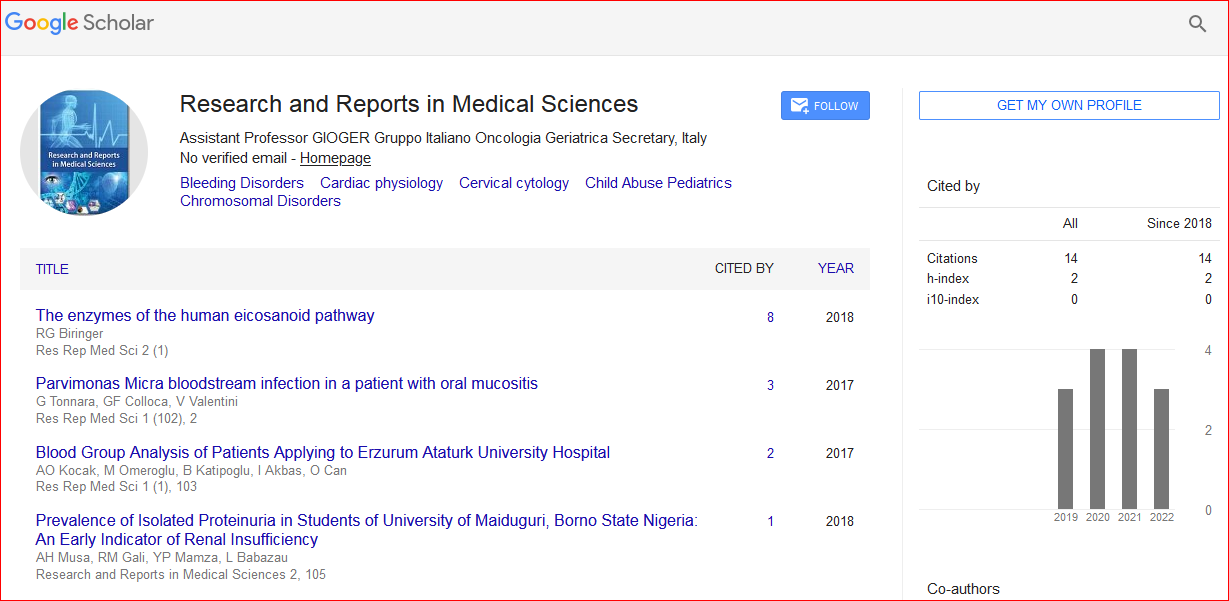
Research and Reports in Medical Sciences received 13 citations as per Google Scholar report