Brief Report - (2025) Volume 14, Issue 5
Received: 01-Oct-2025, Manuscript No. idse-26-183620;
Editor assigned: 03-Oct-2025, Pre QC No. P-183620;
Reviewed: 17-Oct-2025, QC No. Q-183620;
Revised: 22-Oct-2025, Manuscript No. R-183620;
Published:
29-Oct-2025
, DOI: 10.37421/2168-9768.2025.14.507
Citation: Khan, Rashid. "Engineering Solutions for Agricultural
Water Management." Irrigat Drainage Sys Eng 14 (2025):507.
Copyright: © 2025 Khan R. This is an open-access article distributed under the terms of the Creative Commons Attribution License, which permits unrestricted use, distribution
and reproduction in any medium, provided the original author and source are credited.
This collection of research articles delves into the critical domain of agricultural water management, exploring innovative engineering designs and advanced techniques aimed at optimizing resource utilization and enhancing agricultural productivity. The studies collectively address the multifaceted challenges faced in irrigation and drainage systems, proposing solutions that range from sophisticated modeling to practical on-field interventions. The first paper investigates advanced modeling techniques for optimizing irrigation scheduling, considering soil moisture, crop water requirements, and weather forecasts. It highlights the benefits of precision irrigation in enhancing water use efficiency and crop yield, while also addressing the challenges of integrating real-time data into these models. The study emphasizes the role of engineering design in developing sustainable and adaptable irrigation systems [1].
The second study examines the hydrological impacts of different agricultural drainage designs on groundwater levels and surface runoff in a semi-arid region. It presents a comparative analysis of conventional and subsurface drainage systems, demonstrating how engineered drainage can mitigate waterlogging and salinity issues, thereby improving agricultural land productivity. The study stresses the importance of proper design considerations for effective drainage [2].
The third paper focuses on the design and performance evaluation of micro-irrigation systems, specifically drip irrigation, for high-value crops. It examines the impact of emitter type, spacing, and operating pressure on water distribution uniformity and crop water use. The findings underscore the efficiency gains and water savings achievable with well-designed micro-irrigation systems in water-scarce environments [3].
The fourth research article assesses the effectiveness of various engineered wetland designs for treating agricultural drainage water. It analyzes the removal efficiency of nutrients (nitrogen and phosphorus) and common pollutants from drainage effluent through constructed wetlands. The research highlights the potential of ecological engineering solutions for improving water quality and enabling safe reuse of agricultural drainage [4].
The fifth study integrates remote sensing technologies and geographic information systems (GIS) for mapping and analyzing soil moisture variability across agricultural fields. It demonstrates how these tools can inform precise irrigation application, leading to optimized water use and improved crop performance. The study emphasizes the engineering design considerations for developing integrated spatial decision-support systems [5].
The sixth research paper investigates the impact of land leveling techniques on water distribution uniformity in flood irrigation systems. It analyzes the role of precise engineering design and execution of land leveling in minimizing water losses and maximizing the efficiency of water application. The study provides practical insights for improving irrigation performance in traditional systems [6].
The seventh study focuses on the design considerations and performance evaluation of canal lining materials to reduce seepage losses in irrigation networks. It compares the effectiveness of different lining technologies, including concrete and geomembranes, in conserving water resources. The research emphasizes the engineering aspects of selecting and implementing durable and cost-effective lining solutions [7].
The eighth paper examines the application of computational fluid dynamics (CFD) for simulating flow dynamics in open drainage channels. It explores how CFD models can be used to analyze flow patterns, predict erosion, and optimize channel cross-sections for improved drainage capacity. The study highlights the engineering value of advanced simulation tools in drainage system design [8].
The ninth research investigates the design and effectiveness of rainwater harvesting systems for supplementary irrigation in arid and semi-arid regions. It evaluates different catchment types and storage methods, analyzing their potential to augment water availability for crops. The study emphasizes the engineering principles required for successful implementation of rainwater harvesting as a sustainable irrigation strategy [9].
Finally, the tenth paper presents a comprehensive analysis of the challenges and opportunities in managing agricultural drainage water salinization. It explores various engineering interventions, including improved drainage design, leaching strategies, and the use of salt-tolerant crops, to mitigate the impacts of salinity on soil and crop productivity. The study underscores the integrated approach needed for effective saline drainage management [10].
The research presented herein collectively addresses critical aspects of agricultural water management, encompassing irrigation, drainage, and water quality improvement through innovative engineering solutions. The first article, "Optimizing Irrigation Scheduling Using Machine Learning and Climate Data: A Case Study of Wheat Production," introduces sophisticated modeling techniques that integrate soil moisture, crop water needs, and meteorological predictions to refine irrigation schedules. This approach aims to boost water use efficiency and crop yields, acknowledging the complexities of real-time data integration and the foundational role of engineering design in creating adaptable systems [1].
"Hydrological Performance of Subsurface Drainage Systems in Irrigated Agricultural Lands: A Spatiotemporal Analysis" evaluates the consequences of various agricultural drainage designs on groundwater and surface runoff in arid environments. It contrasts traditional and subsurface systems, illustrating how engineered drainage can combat waterlogging and salinity, thereby enhancing land productivity and highlighting the necessity of meticulous design for drainage effectiveness [2].
"Design and Performance Evaluation of Drip Irrigation Systems for Sustainable Water Management in Agriculture" scrutinizes the design parameters and operational performance of micro-irrigation, particularly drip systems, for high-value crops. The study investigates how emitter type, spacing, and pressure influence water distribution uniformity and crop water consumption, demonstrating significant water savings and efficiency gains in water-limited conditions [3].
In "Constructed Wetlands for the Treatment of Agricultural Drainage Water: A Comprehensive Review and Meta-Analysis," the effectiveness of engineered wetland designs for purifying agricultural drainage is assessed. The research quantifies the removal rates of key nutrients like nitrogen and phosphorus, as well as other pollutants, from drainage water, underscoring the potential of ecological engineering for water quality enhancement and safe water reuse [4].
"Integrating Remote Sensing and GIS for Precision Irrigation Management: A Case Study in Cotton Cultivation" showcases the synergistic use of remote sensing and GIS for mapping and analyzing soil moisture variations. This integration facilitates precise irrigation, leading to optimized water use and improved crop outcomes, with a strong emphasis on the engineering design of spatial decision-support systems [5].
"Effect of Land Leveling Techniques on Water Distribution Uniformity in Flood-Irrigated Rice Fields" explores how precise land leveling, executed through sound engineering practices, can substantially improve water distribution uniformity in flood irrigation. The study details how minimizing water losses and maximizing application efficiency are achieved, offering valuable guidance for traditional irrigation systems [6].
The paper "Performance Evaluation of Different Canal Lining Materials for Seepage Control in Irrigation Systems" focuses on engineering solutions to curb water losses in irrigation networks. It evaluates various lining materials, including concrete and geomembranes, assessing their efficacy in conserving water and emphasizes the engineering considerations for implementing durable and economical lining options [7].
"Computational Fluid Dynamics (CFD) Simulation of Flow Behavior in Agricultural Drainage Channels" delves into the application of CFD for modeling fluid dynamics in open drainage channels. The research explores how CFD can analyze flow patterns, predict erosion risks, and optimize channel designs for enhanced drainage capacity, thereby demonstrating the engineering utility of advanced simulation tools [8].
"Design and Performance Analysis of Rainwater Harvesting Systems for Supplementary Irrigation in Arid Regions" investigates the design and efficacy of rainwater harvesting systems for supplemental irrigation in dry climates. It analyzes various catchment and storage configurations to assess their contribution to water availability, stressing the engineering principles essential for successful implementation of this sustainable strategy [9].
Lastly, "Strategies for Managing Salinization in Agricultural Drainage Systems: An Engineering Perspective" offers a thorough examination of the challenges and solutions associated with salinization in agricultural drainage. It discusses engineering interventions such as improved drainage design, leaching techniques, and the cultivation of salt-tolerant crops, advocating for an integrated approach to salinity management in drainage systems [10].
This collection of research highlights advancements in agricultural water management through engineering solutions. Studies focus on optimizing irrigation scheduling using data-driven models and precision techniques, improving drainage system performance to combat waterlogging and salinity, and enhancing water use efficiency through micro-irrigation and land leveling. The research also explores ecological engineering for water treatment, the integration of remote sensing and GIS for informed irrigation, and the use of CFD for drainage channel design. Furthermore, it addresses water conservation through canal lining and rainwater harvesting, and outlines strategies for managing salinization in drainage systems. Collectively, these works emphasize the importance of robust engineering design for sustainable and productive agriculture.
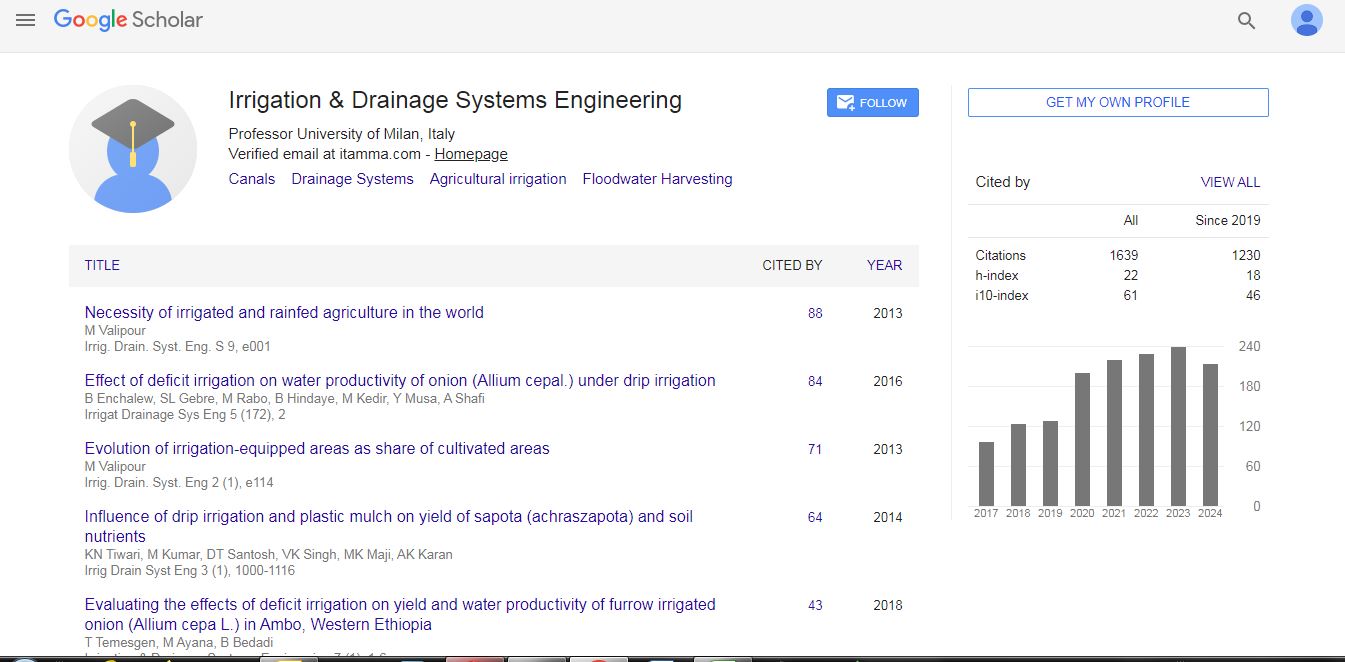
Irrigation & Drainage Systems Engineering received 835 citations as per Google Scholar report