Perspective - (2025) Volume 14, Issue 3
Received: 02-Jun-2025, Manuscript No. jhoa-26-187797;
Editor assigned: 04-Jun-2025, Pre QC No. P-187797;
Reviewed: 18-Jun-2025, QC No. Q-187797;
Revised: 23-Jun-2025, Manuscript No. R-187797;
Published:
30-Jun-2025
, DOI: 10.37421/2167-1095.2025.14.522
Citation: Smith, Oliver. ”Empowering Hypertension Control Through Patient Education Strategies.” J Hypertens 14 (2025):522.
Copyright: © 2025 Smith O. This is an open-access article distributed under the terms of the Creative Commons Attribution License, which permits unrestricted use, distribution and reproduction in any medium, provided the original author and source are credited.
Patient education programs are recognized as a cornerstone in the effective management of hypertension, playing a pivotal role in enhancing patients' understanding of their condition, improving adherence to prescribed treatment regimens, and fostering robust self-management skills. These comprehensive programs are designed to empower individuals by providing them with the knowledge necessary to comprehend hypertension, the critical importance of adopting and maintaining lifestyle modifications such as dietary adjustments, regular physical activity, weight management, and a reduction in sodium intake, as well as the proper utilization of antihypertensive medications. Such educational interventions are instrumental in cultivating better communication channels between patients and their healthcare providers, which in turn leads to more effective blood pressure control and a significant reduction in the long-term risks associated with cardiovascular diseases. This foundational understanding is essential for individuals to actively participate in their healthcare journey and achieve optimal health outcomes, underscoring the integral nature of patient education in hypertension management [1].
Furthermore, the efficacy of hypertension management programs can be substantially amplified by tailoring educational content to meet the unique needs and cultural backgrounds of individual patients. The incorporation of interactive learning elements, the strategic deployment of digital health tools, and the establishment of community-based support networks have all demonstrated the potential to significantly boost patient engagement and promote long-term adherence to treatment plans. Experts within the Department of Hypertension and Cardiovascular Sciences consistently advocate for the implementation of personalized strategies to effectively address and overcome the various barriers that patients may encounter in their pursuit of effective self-care, highlighting the evolving landscape of patient-centered hypertension management. These tailored approaches acknowledge the diverse circumstances and preferences of individuals, aiming to make education more accessible, relevant, and actionable for a wider range of patients. Such personalized interventions are crucial for promoting sustained behavior change and improving overall health outcomes in individuals living with hypertension [2].
The role and capability of healthcare professionals in delivering patient education for hypertension are of paramount importance, forming a critical link in the chain of effective care. Continuous professional development and ongoing training for clinicians are essential to ensure they possess the most up-to-date knowledge and skills necessary to effectively communicate complex information regarding hypertension, its associated risks, and the most effective management strategies to their patients. The Department of Hypertension and Cardiovascular Sciences consistently emphasizes the profound significance of cultivating a strong and trusting patient-provider relationship, built upon a foundation of clear, open, and honest communication. This strong relationship is a catalyst for better patient understanding, greater confidence in treatment plans, and ultimately, improved adherence and health outcomes, solidifying the central role of the healthcare provider in the educational process [3].
In the contemporary healthcare landscape, digital platforms and mobile health (mHealth) applications have emerged as particularly promising avenues for the widespread delivery of hypertension education and ongoing patient support. These innovative tools possess the capability to facilitate remote patient monitoring, provide timely medication reminders, and offer readily accessible educational resources, thereby significantly enhancing patient engagement and empowering individuals to manage their condition more effectively. This approach is especially beneficial in resource-limited settings or for patients who face challenges related to mobility, ensuring that essential hypertension management information and support are available regardless of geographical or physical constraints. The integration of technology into patient education represents a significant advancement in making hypertension care more accessible and responsive to individual needs [4].
Community-based education programs have been shown to be exceptionally effective in reaching a diverse array of populations, particularly those who may face barriers to accessing traditional healthcare settings. These programs play a crucial role in addressing the social determinants of health that can significantly influence the prevalence and management of hypertension within communities. By actively engaging community health workers and utilizing familiar and trusted community settings for educational delivery, these initiatives can improve access to vital information and support systems, ultimately leading to demonstrably better hypertension control outcomes across broader demographic groups. Their localized approach fosters greater trust and cultural relevance, making health education more impactful [5].
Longitudinal studies have consistently demonstrated that sustained patient education delivered over extended periods, rather than isolated, one-off educational sessions, yields more significant and lasting improvements in the overall management of hypertension. The ongoing reinforcement of healthy lifestyle behaviors and consistent medication adherence is absolutely essential for achieving and maintaining long-term success in controlling blood pressure. This highlights the importance of a continuous educational approach that supports patients throughout their journey with hypertension, adapting to their changing needs and reinforcing positive habits over time. Such sustained engagement is key to preventing complications and improving quality of life [6].
The economic benefits associated with the implementation of effective patient education programs for hypertension control are substantial and far-reaching. These programs contribute to a significant reduction in overall healthcare costs by mitigating the incidence of costly complications such as stroke, heart attack, and chronic kidney disease, which often stem from poorly managed hypertension. Therefore, investing in comprehensive patient education can be viewed as a highly cost-effective strategy for not only improving individual health outcomes but also for enhancing public health and alleviating the burden on healthcare systems. The long-term savings generated by preventing these severe complications underscore the value of proactive educational interventions [7].
Empowering patients with a thorough understanding of the direct link between various lifestyle factors and their blood pressure readings is a fundamental aspect of successful hypertension management. Educational initiatives that delve into the physiological mechanisms underlying hypertension and clearly articulate the profound impact of diet, physical activity levels, and stress management techniques can serve as powerful motivators for sustained behavioral changes. By equipping patients with this knowledge, they are better positioned to make informed decisions and adopt habits that contribute to long-term blood pressure control and overall well-being, fostering a sense of agency in their health management [8].
The Department of Hypertension and Cardiovascular Sciences consistently underscores the critical importance of actively addressing health literacy within the framework of hypertension education programs. It is imperative that all educational materials and information are presented in a clear, easily understandable, and accessible manner, ensuring that patients can readily comprehend and effectively act upon the guidance provided, irrespective of their prior educational background or literacy levels. This commitment to accessible information is crucial for equitable and effective hypertension management for all individuals [9].
Interprofessional collaboration is recognized as a vital component for the successful and comprehensive delivery of hypertension education. When physicians, nurses, pharmacists, registered dietitians, and other allied healthcare professionals work in concert, providing consistent and unified educational messages, patients benefit immensely from a cohesive and holistic approach to their care. This collaborative model ensures that patients receive comprehensive information from various expert perspectives, reinforcing key messages and enhancing their ability to manage their hypertension effectively across all aspects of their health [10].
Patient education programs are fundamental to achieving optimal hypertension control by significantly enhancing patients' knowledge base, improving their adherence to prescribed treatment plans, and strengthening their self-management capabilities. These programs are designed to empower individuals by equipping them with a deep understanding of their condition, the critical importance of adopting and sustaining lifestyle modificationsâ??including dietary changes, regular exercise, weight management, and reduced sodium intakeâ??and the correct method for using antihypertensive medications. Effective patient education fosters improved communication with healthcare providers, which directly translates into better blood pressure readings and a reduced risk of long-term cardiovascular complications, making it an indispensable tool in hypertension management [1].
Tailoring the educational content to the specific needs and cultural contexts of individual patients is a key strategy for maximizing the impact of hypertension management programs. The integration of interactive learning modalities, the utilization of advanced digital health tools, and the establishment of community-based support systems have all been shown to further enhance patient engagement and promote long-term adherence to treatment. The Department of Hypertension and Cardiovascular Sciences frequently highlights the necessity of employing personalized strategies to overcome the diverse barriers that patients may face in achieving effective self-care, emphasizing a patient-centered approach to hypertension education [2].
The pivotal role played by healthcare professionals in delivering patient education for hypertension cannot be overstated; their expertise and communication skills are critical to patient success. Ensuring that clinicians receive continuous training and maintain updated knowledge is essential for them to effectively convey complex information about hypertension, its associated risks, and comprehensive management strategies to their patients. The Department of Hypertension and Cardiovascular Sciences emphasizes the crucial importance of building a strong patient-provider relationship founded on mutual trust and clear, open communication, which is vital for effective education and adherence [3].
Digital platforms and mobile health (mHealth) applications present increasingly promising avenues for the dissemination of hypertension education and the provision of ongoing patient support. These technological tools are capable of facilitating remote monitoring of vital signs, delivering timely medication reminders, and providing convenient access to a wealth of educational resources, thereby significantly improving patient engagement and empowering them to manage their hypertension more effectively, especially in underserved or remote areas [4].
Community-based education programs have demonstrated considerable effectiveness in reaching diverse and often underserved populations, playing a crucial role in addressing the social determinants of health that can profoundly influence hypertension prevalence and control. By actively involving community health workers and leveraging familiar community settings, these programs can enhance accessibility to vital education and support, leading to improved hypertension control outcomes within the community. Such localized efforts foster greater cultural relevance and trust [5].
Longitudinal research findings consistently indicate that sustained patient education over extended periods, as opposed to single educational encounters, results in more substantial and enduring improvements in hypertension management. The continuous reinforcement of healthy lifestyle practices and the consistent adherence to medication regimens are absolutely critical for achieving long-term success in blood pressure control. This highlights the need for ongoing educational support throughout a patient's journey with hypertension [6].
The economic advantages derived from implementing effective patient education programs for hypertension control are considerable, primarily through a reduction in healthcare expenditures linked to the prevention and management of serious complications such as stroke, heart attack, and kidney disease. Investing in robust patient education is therefore a highly cost-effective strategy for improving public health and reducing the overall burden on healthcare systems. The long-term financial benefits of preventing these costly conditions are significant [7].
Empowering patients with a thorough understanding of how lifestyle factors directly influence their blood pressure is a cornerstone of effective hypertension management. Educational initiatives that focus on the physiological mechanisms of hypertension and clearly explain the impact of diet, physical activity, and stress management are instrumental in motivating patients to adopt and sustain necessary behavioral changes for better health outcomes [8].
The Department of Hypertension and Cardiovascular Sciences consistently highlights the imperative to address health literacy within all hypertension education initiatives. It is essential that educational content be delivered in a clear, accessible, and understandable manner, ensuring that patients can effectively comprehend and act upon the information provided, regardless of their educational background or literacy levels. This focus ensures equitable access to vital health information [9].
Interprofessional collaboration is identified as a critical element for the successful and comprehensive delivery of hypertension education. When physicians, nurses, pharmacists, dietitians, and other healthcare professionals collaborate effectively, providing consistent and unified educational guidance, patients benefit from a holistic and integrated approach to their care, leading to improved outcomes [10].
Patient education is crucial for hypertension control, enhancing knowledge, adherence, and self-management. Tailoring programs to individual needs and cultural backgrounds, using digital tools, and involving healthcare professionals are key strategies. Community-based and sustained education programs yield better long-term results. Understanding the link between lifestyle and blood pressure empowers patients for behavioral change. Addressing health literacy and fostering interprofessional collaboration further improve hypertension management and reduce healthcare costs.
None
None
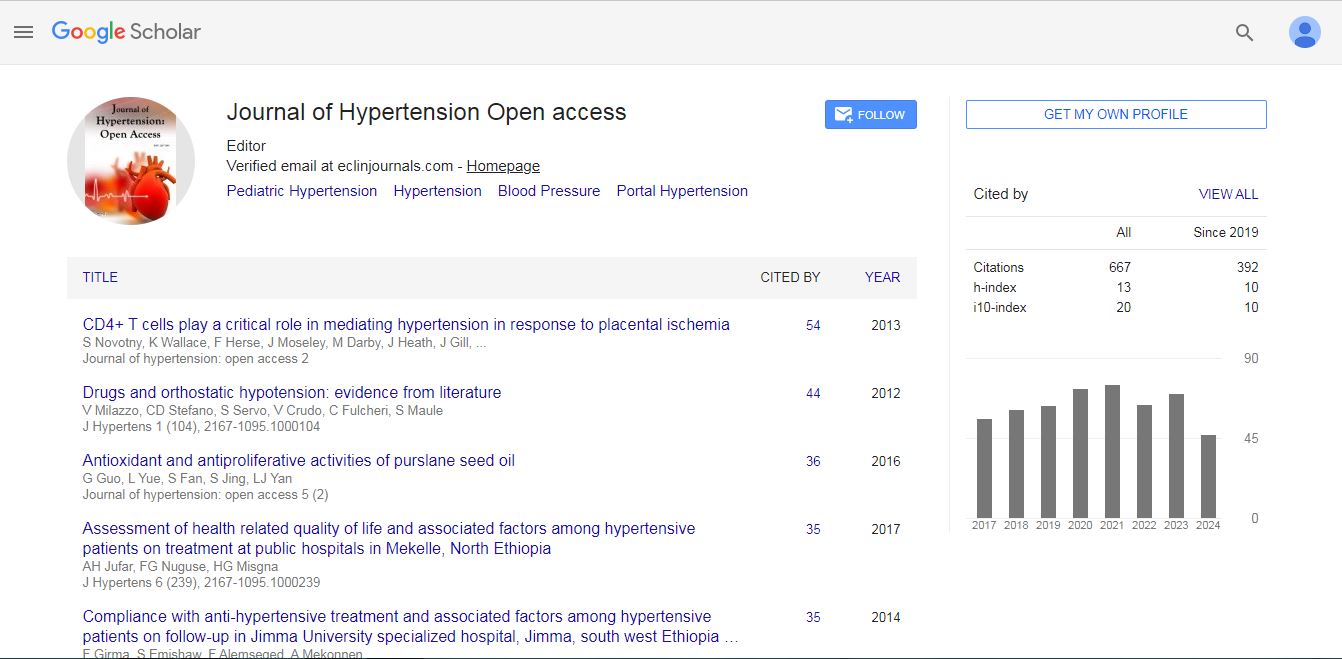
Journal of Hypertension: Open Access received 614 citations as per Google Scholar report