Short Communication - (2023) Volume 10, Issue 5
Received: 02-Oct-2023, Manuscript No. fmoa-23-119472;
Editor assigned: 04-Oct-2023, Pre QC No. P-119472;
Reviewed: 16-Oct-2023, QC No. Q-119472;
Revised: 21-Oct-2023, Manuscript No. R-119472;
Published:
28-Oct-2023
, DOI: 10.37421/2476-2296.2023.10.313
Citation: Oikmou, Fromos. “Emerging Technologies: The Future of Computing with Scalar Waves.” Fluid Mech Open Acc 10 (2023): 313.
Copyright: © 2023 Oikmou F. This is an open-access article distributed under the terms of the Creative Commons Attribution License, which permits unrestricted use, distribution, and reproduction in any medium, provided the original author and source are credited.
As technology continues to advance at an astonishing pace, the future of computing is taking on exciting new dimensions. One of the most promising and intriguing emerging technologies in this field is scalar waves, a concept that challenges traditional computing paradigms. Scalar waves hold the potential to revolutionize computing, communication and various other applications by offering advantages like instantaneous data transmission, reduced energy consumption and immunity to electromagnetic interference. In this article, we will explore the world of scalar waves and delve into their potential to reshape the future of computing. Scalar waves, also known as longitudinal waves, are a type of electromagnetic wave that differs from the conventional transverse waves in several fundamental ways. While transverse waves oscillate in a direction perpendicular to their motion, scalar waves oscillate in the direction of their propagation. This unique characteristic sets them apart and offers a plethora of applications and advantages. Scalar waves were first theorized by the famous scientist James Clerk Maxwell in the mid-1800s but remained relatively unexplored until the work of Nikola Tesla in the late 19th and early 20th centuries. Tesla was intrigued by the idea of non-Hertzian waves, or waves that were not limited by the speed of light and he believed that scalar waves could offer revolutionary possibilities. However, his work largely remained obscure and it wasn't until more recent years that the concept began to gain momentum [1].
Scalar waves are not bound by the limitations of the speed of light. Unlike electromagnetic waves, which propagate at a finite speed, scalar waves can potentially transmit information instantaneously over any distance, violating the constraints of spacetime. Scalar waves oscillate in the direction of their propagation, as opposed to electromagnetic waves that oscillate perpendicular to their direction. This fundamental difference has significant implications for their applications. Scalar waves exist beyond the electromagnetic spectrum, which means they are not subject to the same interference or attenuation as traditional radio waves, microwaves, or other electromagnetic signals. Scalar waves could be used to create superconducting qubits for quantum computers. The ability to transmit information instantaneously would dramatically improve the coherence and efficiency of quantum processors, potentially solving some of the challenges faced in conventional quantum computing [2].
Scalar waves could be harnessed for instantaneous data transmission over vast distances. This has profound implications for data centers, global communication networks and remote computing. Scalar waves may allow for extremely energy-efficient computing. The elimination of the need to transmit data over long distances at the speed of light would lead to substantial energy savings, which is of paramount importance in our energy-conscious world. Scalar waves are extremely difficult to intercept or interfere with, making them an ideal choice for secure data transmission and communication. This could address growing concerns about data privacy and cyber threats. Scalar waves are immune to electromagnetic interference, making them suitable for computing in challenging environments such as space, deep underwater, or near strong magnetic fields [3].
Harnessing scalar waves for computing requires the development of new technologies and infrastructure, which can be a lengthy and resource-intensive process. The instantaneous transmission of information raises ethical and security concerns, particularly in the context of privacy and data security. Integrating scalar wave technology with existing computing infrastructure and devices may be complex and require a significant investment. The use of scalar waves for various applications, especially in communication, may require regulatory approval and international standards, which can be challenging to establish. As we look to the future, the integration of scalar waves into computing is a fascinating prospect. The potential benefits of instantaneous data transmission, reduced energy consumption and enhanced data security are too substantial to ignore. While there are significant challenges to overcome, history has shown that breakthrough technologies can eventually find their way into mainstream applications [4].
The healthcare industry could benefit significantly from scalar wave technology. Real-time data transmission and remote monitoring of patients could become much more efficient and secure. Additionally, medical imaging and diagnostics could see improvements in both speed and accuracy. For instance, MRI and CT scans could benefit from scalar waves for faster image acquisition and transfer, potentially leading to quicker diagnoses and treatments. Autonomous vehicles rely on a constant flow of data for navigation and safety. Scalar waves' ability to transmit information instantaneously could enhance the real-time decision-making capabilities of autonomous vehicles, making them safer and more reliable. Furthermore, transportation systems that operate in extreme conditions, such as underwater or in space, could harness scalar waves to overcome the challenges posed by traditional electromagnetic communication methods [5].
Scalar waves represent a truly transformative technology on the horizon of computing. While still in the early stages of development, their potential to revolutionize the way we compute, communicate and secure our data cannot be overstated. As we continue to explore and unlock the mysteries of scalar waves, we may find ourselves on the cusp of a new era in computing, where speed, efficiency and security reach unprecedented levels. The future of computing with scalar waves is an exciting journey that promises to reshape the technological landscape in ways we can only begin to imagine. The future of computing with scalar waves is promising, offering transformative possibilities in various sectors.
While there are challenges and concerns that must be addressed, it's important to remember that the history of technology is replete with innovations that initially faced skepticism and obstacles but eventually became integral to our lives. The continued research and development of scalar wave technology, along with responsible and ethical deployment, could open up new frontiers in computing and communication, reshaping the way we interact with our world. As we move forward, it is essential to maintain a balance between the potential benefits and the ethical, security and environmental considerations that come with any groundbreaking technology. The future of computing with scalar waves is a journey into the unknown, but one filled with endless possibilities and the potential to change our world for the better.
None.
There are no conflicts of interest by author.
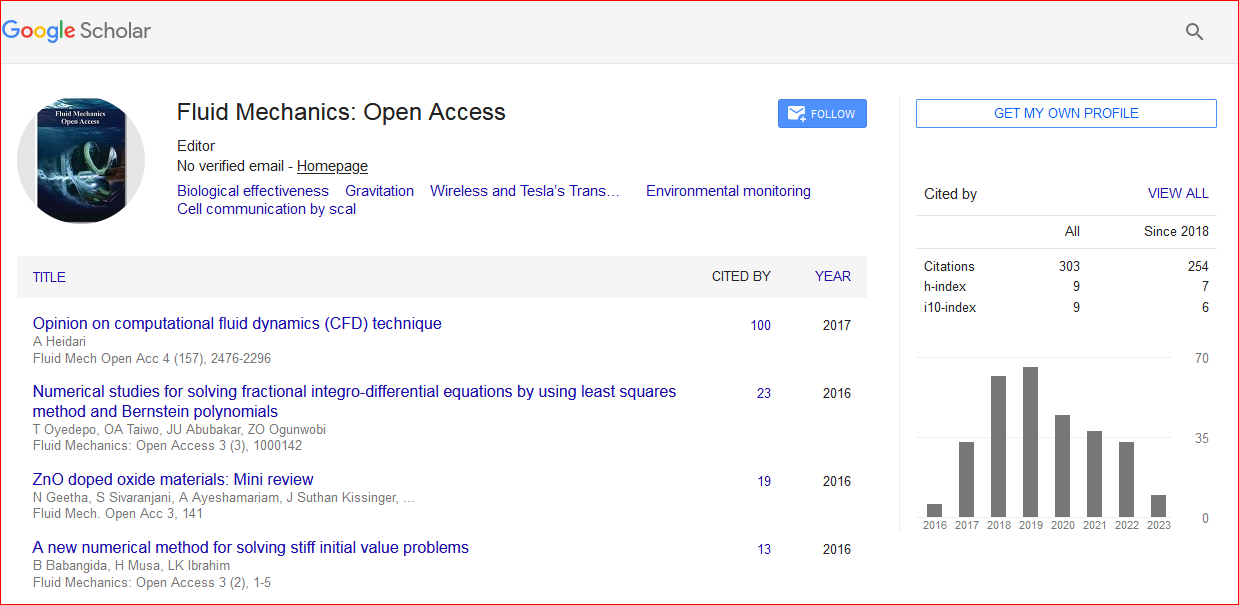
Fluid Mechanics: Open Access received 291 citations as per Google Scholar report