Research Article - (2026) Volume 15, Issue 1
Received: 25-Nov-2024, Manuscript No. IEM-24-153290;
Editor assigned: 28-Nov-2024, Pre QC No. IEM-24-153290 (PQ);
Reviewed: 12-Dec-2024, QC No. IEM-24-153290;
Revised: 26-Jan-2026, Manuscript No. IEM-24-153290 (R);
Published:
02-Feb-2026
, DOI: 10.37421/2169-0316.2026.15.302
Citation: Admas, Anmen. "Effect of Weft Yarn, Air Pressure, and Loom Speed on Pilling Resistance of Plain Weaves: Air-Jet Loom Case Study." J Ind Eng Manag 15 (2026): 302.
Copyright: © 2026 Admas A. This is an open-access article distributed under the terms of the creative commons attribution license which permits unrestricted use, distribution and reproduction in any medium, provided the original author and source are credited.
Sources of funding : This research work is self-funded.
The serviceability qualities of the fabric are compromised when weft insertion occurs in air-jet weaving because it causes twist loss to the weft yarn. The single and combined impacts of yarn type and weaving condition on fabric pilling resistance are the main subject of this study, which has not been studied previously. The effects of using 16 Ne ring-spun and rotor-spun yarns as weft yarns on the ability of the fabric to withstand pilling were examined. The air-jet loom's relay nozzle air pressure and loom speed were adjusted between 350 and 600 rpm for loom speed, 2.5 and 4.5 bar for the Left Side Relay Nozzles (LSRNP), and 3.5 and 6.5 bar for the Right Side Relay Nozzles (RSRNP). The experiment's design and analysis employed a full factorial design. In both relay nozzle groups, the trials showed that lowering the weaving speed and raising the air pressure reduced the fabric's susceptibility to pilling. Compared to rotor-spun weft yarn, ring-spun weft yarn has a larger twist loss, which makes fabric samples less resistant to pilling.
Yarn • Pilling • Loom speed • Air pressure
A textile woven fabric is made up of two sets of strands called the warp and the weft that are interwoven. Weft yarns cross the fabric transversely, whereas warp strands traverse it longitudinally. Based on the type of weave or design, these strands are woven into one another. It is convenient to refer to the warp threads as ends and the weft yarns as picks or fills [1,2]. Numerous variables may have an impact on the woven fabric's mechanical qualities. The quality of the cloth is greatly influenced by the loom setting and the type of input yarn [3]. Abrasion resistance, snagging resistance, and pilling performance are the three most important mechanical characteristics of fabric [4]. Several researchers have studied the properties of snagging, abrasion, and pilling in knitted and woven fabrics made of ring, compact, and rotor yarns.
Pilling is a wear-related issue that develops when tiny tangled fiber "pills" stick to the fabric's surface, giving it an unattractive appearance. There is a significant issue with fabric that not only degrades its look but also shortens its lifespan. During washing and wearing, the pills are created by the tangle of fibers that stick out from the fabric's surface. Many variables can influence fabric pilling, including yarn parameters (such as twist, hairiness, etc.), spinning technology (such as ring spinning, rotor, compact spinning, etc.), fabric production technology (such as weaving, knitting, etc.), and additional processing variables. The ability of a fabric to resist pilling is significantly impacted by its weave design. As per the study conducted by G Ke, W Yu, the resistance of the fabric to pilling decreases when the float length of yarn changes from plain to sateen design. This is because the yarn has a lower binding point than twill and plain textiles, which makes it easier to pick out from the fabric body. Furthermore, some writers have investigated how yarn characteristics and twist level affect fabric resistance to pilling. Twist levels of the yarn have a major impact on fabric pilling performance, as demonstrated by D Atalie, G Ashagre. According to this study the strongest pilling resistance is found in fabrics manufactured from finer ring yarns as opposed to those made from coarser yarns. This suggests that there is less twist in the coarser yarns, and as a result, the fiber can be easily pilled out from the body of the yarn. In contrast, materials made from the finest yarns have a compact structure, which implies that higher twists would firmly bind the fibers. And this has a direct impact on fabric pilling resistance. Yet another study on this phenomenon has also demonstrated that the fabric's resistance to pilling increases as the weft yarn's twist level increases.
Various researchers have noted that the degree of twist mostly influences the fabric's pilling resistance. However, the weft yarn loses its twist while being woven on the air jet loom. The reason for this twist loss was the weft insertion settings of the loom. In air-jet weaving, the two most significant factors influencing twist loss are weft insertion air pressure and loom speed. According to these studies, weft yarn twist loss increases when insertion air pressure the air pressure inside relay nozzles increases and loom speed decreases. Moreover, compared to rotor spun yarn, ring spun yarn has a higher twist loss.
However, there hasn't been enough research done on the combined impacts of yarn kinds, insertion air pressure, and loom speed on fabric serviceability qualities. Because changing more than one independent variables at once can have unanticipated consequences.
Determining how ring and rotor yarns of the same count impact plain-woven fabric's ability to pill at different relay nozzle air pressures and loom speeds in air-jet weaving is the aim of this study.
Material
The ring spinning (Rieter G-35) and rotor spinning (Rieter 923) machines were used to spin 100% cotton yarns for this investigation. Yarn parameters are displayed in Table 1. 16 Ne counts of yarns were gathered from ring and rotor spinning machines at the Bahir Dar Textile Share Facility, Bahir Dar, Ethiopia. Using the untwist/re-twist method, an SDL electrical twist tester machine was used to measure the yarn's twist level. The modular laboratory apparatus USTER® TESTER 5 is used to measure the yarn's diameter and hairiness. In compliance with ISO 2062, the strength of the yarns was assessed using a STATIMAT ME+ yarn strength tester equipment.
| Yarn type | Count (Ne) | Twist (TPM ) | Diameter (2D Ф) mm | Hairiness | Strength (cN/Tex) |
| Ring | 16 | 860 | 0.36 | 8.63 | 7.98 |
| Rotor | 16 | 910 | 0.392 | 6.89 | 7.55 |
Table 1. Selected yarn specification.
Methods
To generate the experimental run (design), a full factorial design was employed with the Design Expert 11 program. This study takes into account the type of yarn, loom speed, and air pressure in the relay nozzles on the left and right sides. For every factor, as shown in Table 2, two levels were selected. The design of the experiment that was created using the input of greater and lower values of the components is shown in Table 3. Following that, the trials were conducted according to the design that was originally envisaged [5]. At the Bahir Dar Textile Share Factory, the fabric samples were made using an OMNI PLUS-800 air-jet loom.
| Factor type | Coded levels | Actual levels | ||
| Low | High | Low | High | |
| Yarn type | -1 | +1 | Ring | Rotor |
| Loom Speed (Rpm) | -1 | +1 | 350 | 600 |
| Left-side relay nozzle (LSRN) (bar) | -1 | +1 | 2.5 | 4.5 |
| Right-side relay nozzle (RSRN) (bar) | -1 | +1 | 3.5 | 6.5 |
Table 2. Coded and actual levels of the factors.
| Run | Factors | |||
| Yarn type | Loom speed (RPM) | Left side relay nozzle (bar) | Right side relay nozzle (bar) | |
| 1 | Ring | 350 | 2.5 | 3.5 |
| 2 | Ring | 350 | 4.5 | 3.5 |
| 3 | Ring | 600 | 4.5 | 6.5 |
| 4 | Rotor | 350 | 2.5 | 3.5 |
| 5 | Ring | 350 | 2.5 | 6.5 |
| 6 | Rotor | 350 | 2.5 | 6.5 |
| 7 | Rotor | 350 | 4.5 | 6.5 |
| 8 | Rotor | 600 | 4.5 | 6.5 |
| 9 | Ring | 600 | 2.5 | 3.5 |
| 10 | Ring | 600 | 4.5 | 3.5 |
| 11 | Rotor | 350 | 4.5 | 3.5 |
| 12 | Rotor | 600 | 2.5 | 3.5 |
| 13 | Ring | 600 | 2.5 | 6.5 |
| 14 | Ring | 350 | 4.5 | 6.5 |
| 15 | Rotor | 600 | 2.5 | 6.5 |
| 16 | Rotor | 600 | 4.5 | 3.5 |
Table 3. Experimental design with actual levels values of the factors.
The same warp yarn type, density, and number of ends were used to produce all of the samples (rotor warp yarns were used for all trials, and ring and rotor weft yarns were used as specified in the experiment in Table 3). This information is shown in Table 4. Next, each type of weft yarn's characteristics for pilling was examined.
| Fabric parameters | Values |
| Fabric structure | Plain |
| Width (cm) | 168 |
| Warp density (end/cm) | 16 |
| Weft density (end/cm) | 16 |
| Warp count (Ne) | 16 |
| Total number of warp ends | 3330 |
Table 4. Fabric sample specification.
Characterization of fabric serviceability properties
Fabric pilling resistance: The samples were prepared as illustrated in Figure 1 and there pilling characteristics were evaluated using ES ISO12947-2:2022 after 5,000 rubbing cycles using an Abrasion and Pilling Martindale tester. Finally, the tested fabrics were evaluated by the EMPA (S. No. 19825) photographic standard for rating the pilling grade. Ten replicates were taken for each experiment and the mean values were taken for analysis.
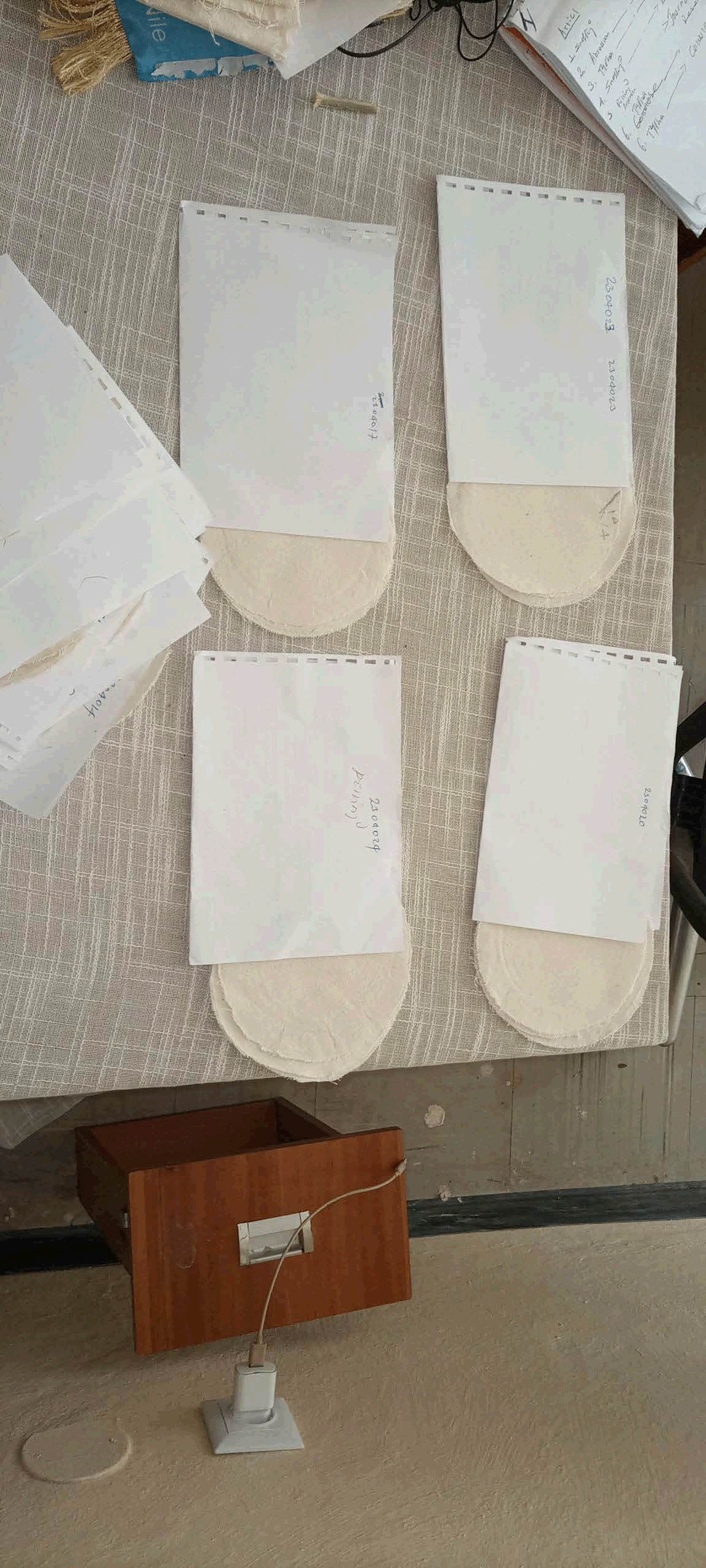
Figure 1. Preparing of the sample for testing of its pilling resistance.
Data analysis
ANOVA, regression analysis, Excel charts, and graphs were among the statistical methods used to examine the resultant data. An ANOVA is also used to determine whether the factors significantly affect the response variable. Regression analysis was used to examine the empirical relationship between the components and answers.
Tests were carried out to ascertain the fabric's resistance to pilling after it was produced at different factors combinations. Table 5 displays the average test results for the fabrics included in the sample.
| Run | Yarn type | Loom speed | Factors | Response pilling resistance | |
| Left side relay nozzles air pressure | Right side relay nozzles air pressure | ||||
| RPM | Bar | Bar | Grading | ||
| 1 | Rotor | 600 | 4.5 | 6.5 | 4 |
| 2 | Ring | 600 | 4.5 | 3.5 | 2.5 |
| 3 | Rotor | 600 | 2.5 | 3.5 | 4.5 |
| 4 | Ring | 600 | 2.5 | 3.5 | 3.5 |
| 5 | Ring | 350 | 4.5 | 6.5 | 1.5 |
| 6 | Rotor | 350 | 4.5 | 3.5 | 2.5 |
| 7 | Rotor | 600 | 2.5 | 6.5 | 3 |
| 8 | Ring | 350 | 2.5 | 6.5 | 1.5 |
| 9 | Ring | 350 | 2.5 | 3.5 | 2.5 |
| 10 | Rotor | 350 | 4.5 | 6.5 | 1.5 |
| 11 | Ring | 600 | 2.5 | 6.5 | 2 |
| 12 | Ring | 350 | 4.5 | 3.5 | 1.5 |
| 13 | Ring | 600 | 4.5 | 6.5 | 3 |
| 14 | Rotor | 350 | 2.5 | 6.5 | 2.5 |
| 15 | Rotor | 350 | 2.5 | 3.5 | 4 |
| 16 | Rotor | 600 | 4.5 | 3.5 | 3.5 |
Table 5. Average test results of fabric pilling resistance properties.
Fabric pilling resistance
Pilling is a fabric surface defect characterized by tiny pills of entangled fiber clinging to the fabric's surface and giving clothes an unappealing appearance. During use and washing, pills form due to the tangling of strands that protrude from the fabric surface. Table 5 shows the pilling resistance test results based on the predetermined combination of independent parameters. The ANOVA was built based on the results of this test, as shown in Table 6. According to the results of the ANOVA, the loom speed (p-value=0.0003), yarn type (pvalue= 0.0004), right side relay nozzle pressure (p-value=0.0025), and interaction effects of the left and right-side relay nozzle air pressure (pvalue= 0.0025) have significant effects on the pilling resistance of fabric samples [6]. In addition to these variables, left side relay nozzle pressure and the interaction effect between loom speed and left side relay nozzle air pressure have a significant impact, and the other variables have no significant effects on the pilling resistance of the fabric.
| Source | Sum of squares | Df | Mean square | F-value | p-value |
| Model | 13.48 | 7 | 1.93 | 15.41 | 0.0005* significant |
| A-Yarn type | 3.52 | 1 | 3.52 | 28.13 | 0.0007* |
| B-Loom speed | 4.52 | 1 | 4.52 | 36.12 | 0.0003* |
| C-Left side relay nozzles air pressure | 0.7656 | 1 | 0.7656 | 6.12 | 0.0384* |
| D-Right side relay nozzles air pressure | 1.89 | 1 | 1.89 | 15.12 | 0.0046* |
| AC | 0.1406 | 1 | 0.1406 | 1.12 | 0.3198 |
| BC | 0.7656 | 1 | 0.7656 | 6.12 | 0.0384* |
| CD | 1.89 | 1 | 1.89 | 15.12 | 0.0046* |
| Note: Where, A: yarn type, B: loom speed, C: left side relay nozzles air pressure, D: right side relay nozzles are pressure, AC: interaction effects of yarn type and left-side relay nozzle air pressure; BC: Interaction effects of loom speed and left-side relay nozzle air pressure; CD: interaction effects of left and right-side relay nozzle air pressure | |||||
Table 6. ANOVA table of fabric pilling resistance.
By considering the level and actual values of input variables (yarn type, loom speed, left and right-side relay nozzles air pressure), a regression equation has been developed from the Design Expert software. The purpose is to observe the relationship between the pilling resistance of the fabric and the variables involved in the experiments. During the formulating of the model, only significant variables were considered by referring to the ANOVA analysis as illustrated in Table 6. Equation (1) shows the regression model equation.
Pilling resistance=+2.71+0.4813A+0.5188B-0.2063C-0.3312D+0.2312BC +0.3313CD (1)
Loom speed, yarn type, and the interaction effects of loom speed and left side relay nozzle air pressure, as well as the interaction effects of the left side and right-side relay nozzle air pressure have positive correlations with fabric pilling resistance. Whereas left and right-side relay nozzle pressure have a negative correlation. The regression equation also shows that if one variable changes by one unit while the other variables remain constant, the response will change by a percentage of the chosen factor's coefficient value. For example, with each unit increment of loom speed, the fabric's resistance to pilling changes with a value of 0.5188.
R2 value of 93% shown in Table 7 indicates that the chosen factors explain the response very well. In addition, the adjusted R2 and predicted R2 values for fabric pilling resistance were obtained as 87.06% and 72.38%, respectively, which are both near to 1. This shows that the adjusted and predicted values were highly correlated. This fit statistics analysis indicates that the developed model, as illustrated in equation 1, is well fitted to predict the fabric pilling resistance properties of woven fabric.
| R | Pilling resistance |
| R2 | 0.931 |
| Adjusted R2 | 0.8706 |
| Predicted R2 | 0.7238 |
Table 7. Fit statistics for fabric serviceability properties.
Figure 2 shows a scatter plot of actual vs. predicted values, demonstrates the created regression model is good fit because nearly every point (measurement of cloth pilling resistance) is closest to the diagonal line. This implies that there is a strong correlation between actual and predicted values of fabric pilling resistance and the mode was designed well.
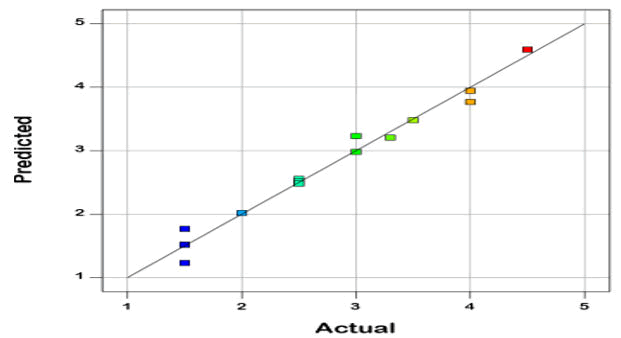
Figure 2. Predicted vs. actual graph of fabric pilling resistance.
Influence of yarn type on fabric pilling resistance: The characteristics of the weft strands in weaving affect the fabric's characteristics. Especially in air jet weaving, the complex interaction between the features of the yarn type and weaving condition results in twist loss, and this impact directly affects the fabric's use properties. As indicated in Table 1, ring, and rotor spun yarn differ in their diameter, internal structure and hairiness, and these yarn characteristics impact the degree of twist loss of the weft yarns. This is responsible for the change in pilling resistance of the fabric made on this loom. Figure 2A shows how a fabric's ability to resist pilling is influenced by the type of yarn used. According to the results of the experiment shown in Figure 3 A, rotor-spun yarn is less likely to pill than ring-spun yarn, (as coded by; -1 for ring-spun yarn and +1 for rotor-spun yarn). This could be because ring-spun yarn has a higher twist loss than rotor-spun yarn during air-jet weaving. As the weft yarn loses its twist more, the fiber-to-fiber interaction in the yarn structure becomes less, and the fabric made from this weft yarn is more susceptible to pilling. Compared to yarn diameter, yarn hairiness causes fabric to pill more severely and this result is also revealed by Can and Europe.
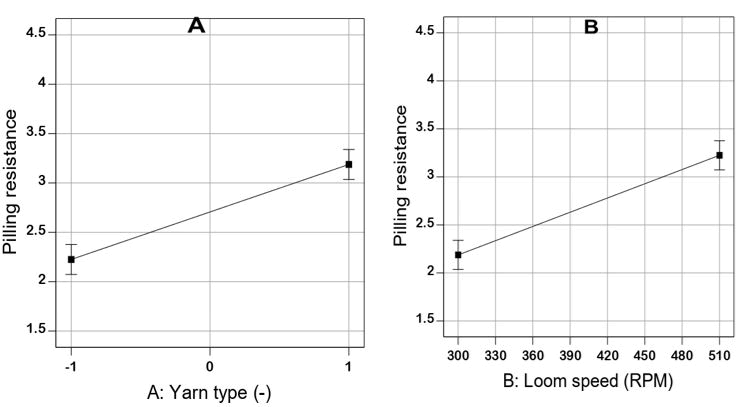
Figure 3. Impacts of yarn type (A) and loom speed (B) on fabric pilling resistance.
Influence of loom speed on fabric pilling resistance: According to Ademe, Tesema, one of the most important factors affecting cloth pilling performance is the weaving condition and this effect is highly observed, particularly in air-jet weaving. The effects of loom speed on cloth pilling resistance are depicted in Figure 3B. As indicated in this Figure, when the loom speed increases, the pilling resistance of the fabric also increases. Loom speed determines how long the weft yarn is in contact with the dragging air force for each cycle of the weaving process. This could be, high loom speed will result in reduced weft yarn waiting times and less twist loss, which results in less pilling of fabric, as is also agreed upon. At 300 RPM of loom speed, fabric has a pilling resistance of around 2.4, however, at 510 RPM of loom speed, the pilling resistance increased to about 3.4. Consequently, twist loss is a function of the fabric’s resistance to pilling.
Impacts of air-pressure on fabric pilling resistance: According to Ketema and Ayele, high air pressure is provided to the inserting yarn during the weft insertion process in an air-jet loom, and this pressurized air is one of the main causes of twist loss. The fabric's characteristics, however, are impacted by any change to the weft yarn. Figures 4 A and B show the relationship between air-pressure and fabric pilling resistance [7]. The fabric's resistance to pilling decreases as the air pressure at the right and left side relay nozzles rises, and vice versa. This is because, as the air pressure of relay nozzles increases, the twist loss also increases. The higher the twist loss of the weft yarn, the less resistance the fabric has to pilling. In contrast to the left side relay nozzles air pressure, the weft yarn is exposed to the air pressure for a longer period of time at the right side of the loom, where right-side relay nozzles are available, which results in a higher twist loss and higher pilling to the fabric [8,9]. For instance, as the left side air pressure rises from 2 bars to 4 bars, the fabric's ability to resist pilling decreases from about 2.9 to 2.5 (Figure 4A), however, as the right-side relay nozzle air pressure rises from 3 bars to 6 bars, the fabric’s ability to resist pilling decreases from about 3 to 2.4 (Figure 4B).
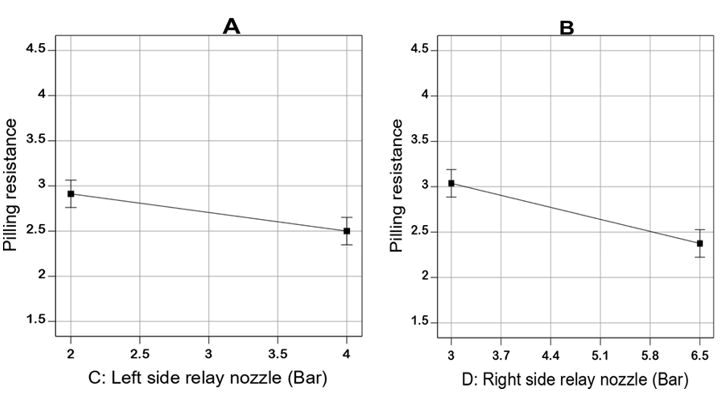
Figure 4. Impacts of applied air pressure on fabric pilling resistance.
Factors interaction effects on fabric pilling resistance: The 3D graphs shown in Figures 5A and B illustrate the interaction effects of loom speed with various combinations of left and right side relay nozzle air pressure. As shown in Figure 5A, at the highest value of the left side relay nozzle air pressure (4 bar) and the slowest loom speed (300 RPM), the highest fabric pilling has been observed. Moreover, minimal pilling resistance is observed at 2 bar and 6.5 bar for the left and right side relay nozzles, respectively, as indicated in Figure 5B. The reason for this could be that the weft yarn is exposed to high air pressure for an extended period of time.
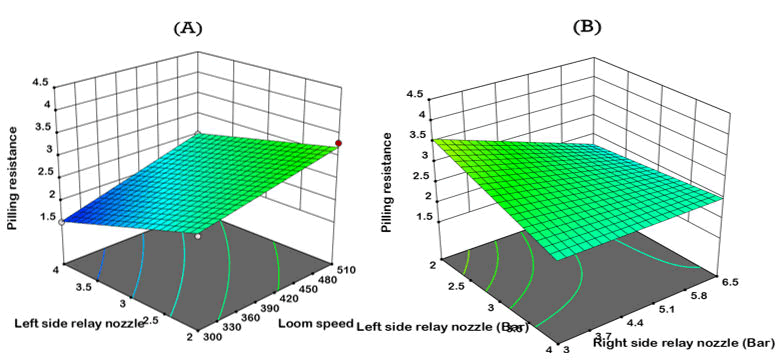
Figure 5. Interaction effect of left side relay nozzles air pressure and loom speed (A) and left and right-side relay nozzles air pressure (B) on fabric pilling resistance of fabric.
The types of raw materials utilized, yarn properties, and loom parameters all have an impact on the pilling resistance of woven fabric. This study examined the effects of ring and rotor spun weft yarns, air-jet loom speed, relay nozzle air pressure, and other factors on the pilling resistance of woven fabric. The fabric manufactured from rotor-spun weft yarn has superior pilling resistance compared to the fabric made from ring-spun weft yarn, according to the experiment's results. This can be explained by the fact that rotor-spun weft yarn loses its twist less than ring-spun weft yarn, which results in a fabric with less resilience to pilling. Additionally, the fabric produced at higher air jet loom speeds has greater pilling resistance because the twist loss of the weft yarn is reduced at higher loom speeds. When a loom speed is increased from 300 to 510 rpm, the fabric's resistance to pilling increases from 2.5 to 3.48. On the other hand, the fabric pilling resistance decreases from 2.52 to 2.49 when the air pressure in the left side relay nozzle increases from 2 to 4 bars. When the air pressure in the right-side relay nozzles is raised, the fabric's resistance to pilling drops from 3.12 to 2.47.
All data are included in the manuscript.
The authors declare that there is no conflict of interest regarding the publication of this article.
Each author made a contribution to the idea and design of the study.
This research work is self-funded.
The authors would like to acknowledge the Ethiopian Institute of Textile and Fashion Technology, Bahir Dar University, Bahir Dar, Ethiopia for the support of this project.
Industrial Engineering & Management received 739 citations as per Google Scholar report