Perspective - (2025) Volume 9, Issue 2
Received: 02-Jun-2025, Manuscript No. rrms-25-175060;
Editor assigned: 04-Jun-2025, Pre QC No. P-175060;
Reviewed: 18-Jun-2025, QC No. Q-175060;
Revised: 23-Jun-2025, Manuscript No. R-175060;
Published:
30-Jun-2025
, DOI: 10.37421/2952-8127.2025.9.222
Citation: Walid, Hassan. ”EBM: AI, Digital Health and Core Principles.” Res Rep Med Sci 09 (2025):222.
Copyright: © 2025 Walid H. This is an open-access article distributed under the terms of the Creative Commons Attribution License, which permits unrestricted use, distribution and reproduction in any medium, provided the original author and source are credited.
The landscape of Evidence-Based Medicine (EBM) is in constant flux, especially with the rapid advancements witnessed in digital health and Artificial Intelligence (AI). This dynamic environment necessitates a shift in how healthcare providers approach EBM, compelling them to critically appraise not only conventional research but also emerging digital tools and AI applications. The goal is to ensure these new technologies meet rigorous standards before they are integrated into clinical practice, meaning EBM must adapt to new data sources and technologies to maintain its relevance and effectiveness [1].
Let's break it down: the future of EBM is already here, intricately linked with digital health and AI. This evolution brings forth both incredible opportunities and significant challenges. It's imperative to consider how these technologies generate evidence, assess their validity, and understand their impact on clinical decision-making. Through all this, upholding the core principles of EBM remains paramount, even as the tools themselves undergo profound changes [2].
This commitment to EBM is not just academic; itâ??s fundamental to improving healthcare quality and patient outcomes. What this really means is that by systematically applying the best available research evidence, alongside clinical expertise and patient values, healthcare professionals can make more informed decisions. These decisions directly translate into better health for patients and more efficient healthcare systems overall [3].
When it comes to teaching EBM, it's clear that continuous refinement of methods is essential. A comprehensive review shows that effective EBM education goes beyond mere didactic lectures. It demands practical application and the development of critical appraisal skills. The pressing challenge is to integrate these practices more broadly, thereby ensuring that future healthcare professionals are truly adept at applying evidence in their clinical work [4].
The recent COVID-19 pandemic vividly brought into focus both the challenges and opportunities inherent in evidence-based public health. What we learned is that rapid evidence generation and synthesis are crucial, but equally important is the careful communication of uncertainty. Moving forward, public health policy must be incredibly agile, constantly integrating the latest evidence while skillfully navigating complex societal factors [5].
Hereâ??s the thing about evidence-based practice: it is incomplete without shared decision-making. This concept underscores that involving patients in decisions about their care, based on the best available evidence, is not merely beneficialâ??it is fundamental. This approach ensures that clinical choices align with individual patient values and preferences, thereby making care truly person-centered [6].
The role of EBM in undergraduate medical education is more critical than ever. Equipping future doctors with the essential skills to find, appraise, and apply evidence is paramount. What this really means is moving beyond simply memorizing facts to fostering a lifelong habit of critical inquiry and the ability to adapt to new medical knowledge throughout their entire careers [7].
Letâ??s consider the ethical dimensions of EBM. While EBM rightly emphasizes using the best scientific evidence, itâ??s crucial to acknowledge that ethical considerations frequently arise. This is particularly true when balancing population-level data with individual patient autonomy, justice, and beneficence. Integrating ethics ensures EBM serves not just as a scientific framework but also as a morally sound approach to healthcare [8].
Developing evidence-based clinical practice guidelines requires meticulous methodological considerations. This extends beyond simply identifying relevant studies to systematically appraising their quality, synthesizing the findings, and carefully formulating recommendations that are both clinically applicable and patient-centered. A robust methodology is undeniably the backbone of trustworthy guidelines [9].
Integrating patient values and preferences into evidence-based clinical practice is essential, not just an option. While evidence provides the 'what,' understanding patient values informs the 'how' and 'whether.' This guarantees that clinical decisions are not only scientifically sound but also align with what matters most to the individual patient, promoting truly shared decision-making and better adherence to care plans [10].
Evidence-Based Medicine (EBM) is currently navigating a significant paradigm shift, primarily driven by the rapid integration of digital health and Artificial Intelligence (AI) into healthcare. This evolution demands that healthcare providers go beyond traditional research appraisal and extend their critical evaluation to include emerging digital tools and AI applications. The core challenge here is ensuring that these innovative technologies meet stringent standards before they are incorporated into daily clinical practice. What this really means is that EBMâ??s framework must adapt to embrace new data sources and advanced technologies to remain both relevant and effective in an ever-changing medical landscape [1, 2].
The fundamental value of EBM lies in its capacity to elevate healthcare quality and significantly improve patient outcomes. By systematically applying the most reliable research evidence, integrating it with professional clinical expertise, and crucially, incorporating patient values, more informed and effective decisions can be made. This tripartite approach directly translates into better health for individuals and enhances the overall efficiency of healthcare systems. A key aspect of sustaining this is through the continuous refinement of EBM education, which must move beyond theoretical knowledge to practical application and the development of robust critical appraisal skills among future healthcare professionals [3, 4].
Recent global health crises, such as the COVID-19 pandemic, underscored the critical role of evidence-based public health. The experience highlighted the urgent need for rapid evidence generation and synthesis, combined with the delicate and clear communication of scientific uncertainty to the public and policymakers. Moving forward, public health policy frameworks must possess incredible agility, continuously integrating the latest evidence while adeptly navigating the complex societal factors that influence public health interventions. This dynamic approach is vital for effective public health responses [5].
Furthermore, evidence-based practice is inherently incomplete without the meaningful integration of shared decision-making. This critical component emphasizes the necessity of involving patients actively in discussions about their care. Basing these conversations on the best available evidence, and aligning clinical choices with individual patient values and preferences, transforms care into a truly person-centered experience. This collaborative approach enhances patient autonomy and can lead to better adherence to treatment plans. Concurrently, the ethical dimensions of EBM cannot be overlooked. While EBM champions the use of scientific evidence, it frequently encounters ethical dilemmas, particularly when balancing population-level data with individual patient rights, justice, and the principle of beneficence. Integrating ethics ensures EBM serves as not only a scientific framework but also a morally sound approach to healthcare delivery [6, 8, 10].
Finally, the development of robust, evidence-based clinical practice guidelines requires meticulous methodological rigor. This process involves more than just identifying pertinent studies; it extends to systematically appraising their quality, synthesizing complex findings, and then carefully formulating recommendations that are both clinically applicable and centered around patient needs. Such a rigorous methodology forms the bedrock of trustworthy guidelines, ensuring their credibility and utility in clinical settings. Therefore, equipping medical students with the skills to find, appraise, and apply evidence is paramount, fostering a lifelong habit of critical inquiry that allows them to adapt to new medical knowledge throughout their careers [7, 9].
Evidence-Based Medicine (EBM) is undergoing a significant transformation, driven by rapid advancements in digital health and Artificial Intelligence (AI). This shift necessitates that healthcare providers critically appraise not just traditional research, but also new digital tools and AI applications, ensuring they meet rigorous standards before integration into clinical practice. The future of EBM is deeply intertwined with these technologies, presenting both remarkable opportunities and significant challenges, requiring that the core principles of EBM are upheld as tools evolve. EBM is crucial for enhancing healthcare quality and patient outcomes. It involves systematically applying the best available research evidence, clinical expertise, and patient values to make informed decisions that benefit patients and optimize healthcare systems. This includes continuously refining EBM education to emphasize practical application and critical appraisal skills, ensuring future professionals are adept at applying evidence in their work. Recent events, like the COVID-19 pandemic, highlighted the importance of rapid evidence generation and synthesis in public health, alongside clear communication of uncertainty. Integrating shared decision-making is fundamental to evidence-based practice, ensuring clinical choices align with individual patient values and preferences. Ethical considerations are also paramount, balancing population-level data with individual autonomy and justice. Developing trustworthy, patient-centered clinical practice guidelines requires meticulous methodological considerations, from appraising study quality to synthesizing findings. Ultimately, EBMâ??s ongoing relevance relies on its adaptability to new data sources, technologies, and a holistic approach that integrates patient values, ethics, and robust methodology.
None
None
Anna VP, David TP, Peter HJ. "Evidence-Based Medicine: A Changing Paradigm in the Digital Age".J Clin Med 12 (2023):1355.
Indexed at, Google Scholar, Crossref
Steven DP, Andrew LP, Benjamin WVT. "The Future of Evidence-Based Medicine Is Here: Considerations for Digital Health and Artificial Intelligence".JAMA 329 (2023):1147-1148.
Indexed at, Google Scholar, Crossref
Mohamad AA, Mohamed AA, Adham A. "The Role of Evidence-Based Medicine in Improving Healthcare Quality and Patient Outcomes: A Systematic Review".Int J Environ Res Public Health 19 (2022):10609.
Indexed at, Google Scholar, Crossref
Rebecca FMCV, Jamiu OB, J. CM(dJ. "Teaching Evidence-Based Medicine: A Scoping Review of Current Practices and Future Directions".J Clin Med 11 (2022):352.
Indexed at, Google Scholar, Crossref
Cécile P, Catherine LG, François E. "Evidence-Based Public Health in the COVID-19 Era: Challenges and Opportunities".Int J Environ Res Public Health 18 (2021):8285.
Indexed at, Google Scholar, Crossref
Marie PBL, Ingrid MVS, Bodil L. "Shared Decision-Making as a Key Component of Evidence-Based Practice".J Holist Nurs 39 (2021):49-59.
Indexed at, Google Scholar, Crossref
Kuan-Yu P, Chung-En H, Hsiang-Fu L. "The Role of Evidence-Based Medicine in Undergraduate Medical Education".J Clin Med 10 (2021):3366.
Indexed at, Google Scholar, Crossref
Kian FL, Teck KL, Kok KL. "Ethical Considerations in Evidence-Based Medicine: A Narrative Review".J Clin Med 10 (2021):2791.
Indexed at, Google Scholar, Crossref
Stefan B, Christine MB, Markus M. "Methodological Considerations for Developing Evidence-Based Clinical Practice Guidelines".J Clin Med 9 (2020):3645.
Indexed at, Google Scholar, Crossref
Andrea SW, Katharina MK, Bettina FM. "Integrating Patient Values and Preferences into Evidence-Based Clinical Practice".J Clin Med 9 (2020):3233.
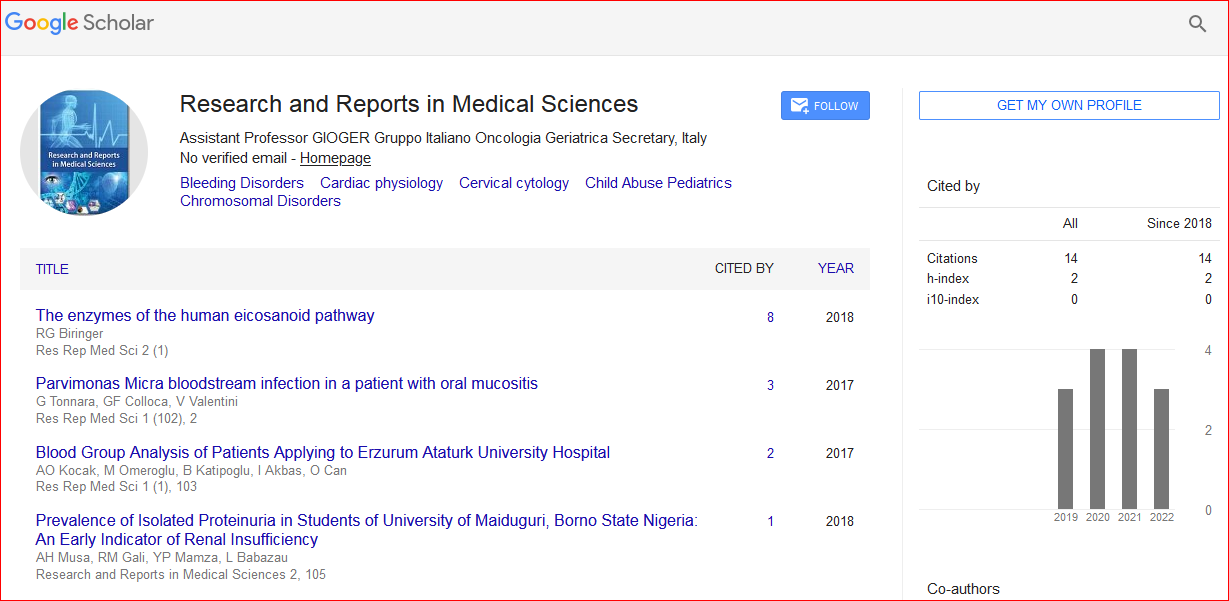
Research and Reports in Medical Sciences received 13 citations as per Google Scholar report