Brief Report - (2025) Volume 16, Issue 2
Received: 01-May-2025, Manuscript No. hgec-25-174725;
Editor assigned: 05-May-2025, Pre QC No. P-174725;
Reviewed: 19-May-2025, QC No. Q-174725;
Revised: 22-May-2025, Manuscript No. R-174725;
Published:
29-May-2025
, DOI: 10.37421/2161-0436.2025.16.281
Citation: Deshmukh, Priya K.. ”DNA Sequencing: Revolutionizing Biology, Health, Environment.” Human Genet Embryol 16 (2025):281.
Copyright: © 2025 Deshmukh K. Priya This is an open-access article distributed under the terms of the Creative Commons Attribution License, which permits unrestricted use, distribution and reproduction in any medium, provided the original author and source are credited.
Long-read DNA sequencing represents a significant leap forward in genomics, with technologies like PacBio HiFi and Oxford Nanopore fundamentally transforming the field. These methods enable the analysis of exceptionally complex genomic regions, effectively resolving structural variations and tackling highly repetitive sequences. What this means for us is a much clearer, more complete picture of how genomes are put together [1].
Here's the thing: single-cell DNA sequencing is becoming a massive deal, pushing the boundaries of genetic analysis. Recent advancements allow us to examine genetic variation cell by cell, uncovering insights into tissue heterogeneity, embryonic development, and cancer evolution that were previously hidden. It's truly a leap forward for understanding individual cellular dynamics [2].
Let's talk about genome sequencing in the clinic. There's a solid body of evidence supporting the use of genome sequencing in everyday medical practice. It's making a real difference for patient care, especially in diagnosing rare genetic conditions and guiding personalized treatments. What this really means is that genomic data is increasingly moving from research labs directly into doctors offices [3].
This piece explores the wild evolution of metagenomic sequencing, tracing its path from early 16S rRNA methods to modern single-cell metagenomics. These techniques allow us to investigate complex microbial communities without the need for culture, opening incredible avenues for understanding environmental health, human gut microbiomes, and infectious diseases. It's all about getting a complete picture of whos there and what theyre doing [4].
Getting accurate data from DNA sequencing is crucial, and the latest methods for error correction are central to this. Various computational approaches are designed to clean up raw sequencing reads, which is absolutely essential for downstream analyses like variant calling or genome assembly. The takeaway here is that better error correction means more reliable genomic insights, and thats a big deal for research and clinical applications [5].
This paper shines a light on how Artificial Intelligence (AI) is making waves in DNA sequencing. It delves into the various ways AI, especially Machine Learning (ML), is being used to enhance everything from base calling and variant detection to data analysis and experimental design. The potential for AI to speed up discovery and improve accuracy in genomics is immense, truly changing how we handle vast amounts of sequencing data [6].
When it comes to understanding how genes are turned on and off, DNA methylation plays a key role. This article provides a comprehensive overview of recent progress in DNA methylation analysis techniques, including various sequencing-based methods. These methods provide unprecedented detail into epigenetic regulation, which is vital for studying development, disease, and environmental responses. It's about looking beyond the DNA sequence itself [7].
This article discusses the incredible advances in Next-Generation Sequencing (NGS) and its application in diagnosing cancer. It covers how these sequencing methods can detect mutations, structural variants, and epigenetic changes specific to tumors, leading to earlier diagnosis and more tailored treatment plans. The idea here is that understanding a tumors genomic landscape deeply can revolutionize how we fight cancer [8].
You know, portable Next-Generation Sequencing (NGS) is a game-changer, and this review gives you the full scoop. Compact sequencing devices are enabling on-site analysis in remote locations, during outbreaks, or in resource-limited settings. We're talking about bringing the lab to the sample, accelerating diagnostics and surveillance in ways we couldnt before. This is making genomic analysis accessible to so many more people and places [9].
This article dives into environmental DNA, or eDNA, and its role in assessing biodiversity. It discusses how sequencing fragments of DNA from environmental samples like water or soil allows us to detect species without ever seeing or capturing the organism itself. This is really changing how we monitor ecosystems, identify invasive species, and track endangered populations, offering a non-invasive and powerful tool for conservation efforts [10].
Recent advancements in DNA sequencing are fundamentally reshaping our understanding of genomes. Long-read DNA sequencing, exemplified by PacBio HiFi and Oxford Nanopore technologies, is significantly changing the genomics landscape. These technologies empower researchers to analyze highly complex genomic regions, effectively resolving structural variations and tackling repetitive sequences, leading to a much clearer and more complete picture of genome assembly [1]. Here's the thing: single-cell DNA sequencing is also becoming a massive deal, with continuous advancements allowing for the detailed examination of genetic variation at a cell-by-cell level. This reveals crucial insights into tissue heterogeneity, embryonic development, and the evolution of cancer that were previously inaccessible, marking a true leap forward for understanding individual cellular dynamics [2].
The impact of genome sequencing extends significantly into clinical practice. Current evidence strongly supports its use in everyday medical settings, where it is making a real difference in patient care. This is particularly true for diagnosing rare genetic conditions and guiding personalized treatment strategies. What this really means is that genomic data is increasingly moving from specialized research laboratories into doctors offices [3]. Furthermore, next-generation sequencing offers incredible advances for cancer diagnosis, detecting mutations, structural variants, and epigenetic changes specific to tumors. This leads to earlier diagnoses and more tailored treatment plans, revolutionizing how we approach cancer treatment [8]. You know, portable Next-Generation Sequencing (NGS) is a game-changer, enabling on-site analysis in remote locations, during outbreaks, or in resource-limited settings. We are talking about bringing the lab directly to the sample, accelerating diagnostics and surveillance in ways previously unimaginable, making genomic analysis accessible to far more people and places [9].
The field also explores the evolution of metagenomic sequencing, from its early days with 16S rRNA sequencing to modern single-cell metagenomics. These techniques provide a powerful means to investigate complex microbial communities without requiring traditional culture methods. This opens up incredible avenues for understanding environmental health, human gut microbiomes, and infectious diseases, ultimately providing a complete picture of microbial composition and function [4]. Additionally, environmental DNA (eDNA) sequencing is playing a crucial role in biodiversity assessment. By sequencing DNA fragments found in environmental samples like water or soil, species can be detected without direct observation or capture. This method is changing how we monitor ecosystems, identify invasive species, and track endangered populations, offering a non-invasive and highly effective tool for conservation efforts [10].
Getting accurate data from DNA sequencing is crucial, and advances in error correction are paramount. This involves various computational approaches designed to clean up raw sequencing reads, which is absolutely essential for reliable downstream analyses such as variant calling or genome assembly. The takeaway here is that superior error correction directly translates to more trustworthy genomic insights, and that's a big deal for all applications [5]. Moreover, Artificial Intelligence (AI) is making significant waves across DNA sequencing. AI, particularly Machine Learning (ML), is being deployed to enhance processes from base calling and variant detection to comprehensive data analysis and experimental design. The potential for AI to accelerate discovery and improve the accuracy of genomic studies is immense, fundamentally altering how vast amounts of sequencing data are managed and interpreted [6].
Beyond just the DNA sequence, understanding how genes are regulated is vital. DNA methylation plays a key role in this process. Recent progress in DNA methylation analysis techniques, including various sequencing-based methods, provides comprehensive insights. These methods offer unprecedented detail into epigenetic regulation, which is essential for studying development, disease mechanisms, and responses to environmental factors. It's all about looking beyond the raw genetic code itself to understand the full picture of gene activity [7].
DNA sequencing technologies are rapidly advancing, transforming genomics and its applications. Long-read DNA sequencing, featuring technologies like PacBio HiFi and Oxford Nanopore, is now enabling analysis of complex genomic regions, resolving structural variations and highly repetitive sequences, leading to a more complete picture of genome assembly. Meanwhile, single-cell DNA sequencing offers unprecedented detail into genetic variations at the cellular level, uncovering insights into tissue heterogeneity, embryonic development, and cancer evolution. These advancements extend into clinical practice, where genome sequencing is increasingly used for diagnosing rare genetic conditions and guiding personalized treatments, effectively moving genomic data from research to patient care. The field also sees the evolution of metagenomic sequencing, from 16S rRNA to single-cell metagenomics, allowing comprehensive investigation of microbial communities without culture, crucial for understanding environmental health, human microbiomes, and infectious diseases. Ensuring data accuracy, error correction methods are vital for cleaning raw sequencing reads, improving downstream analyses like variant calling. Artificial Intelligence (AI) and Machine Learning (ML) are significantly enhancing DNA sequencing processes, from base calling and variant detection to data analysis, accelerating discovery and improving accuracy. Beyond sequence, DNA methylation analysis techniques provide deep insights into epigenetic regulation, essential for studying development and disease. Next-Generation Sequencing is revolutionizing cancer diagnosis by detecting tumor-specific mutations and epigenetic changes, enabling more tailored treatment plans. Furthermore, portable Next-Generation Sequencing is expanding access to genomic analysis, facilitating on-site diagnostics and surveillance in remote or resource-limited settings. Finally, environmental DNA (eDNA) sequencing offers a powerful, non-invasive tool for biodiversity assessment, monitoring ecosystems and endangered species. What this really means is a holistic revolution in how we understand, diagnose, and interact with the biological world, driven by continuous innovation in sequencing technologies.
None
None
Indexed at, Google Scholar, Crossref
Indexed at, Google Scholar, Crossref
Indexed at, Google Scholar, Crossref
Indexed at, Google Scholar, Crossref
Indexed at, Google Scholar, Crossref
Indexed at, Google Scholar, Crossref
Indexed at, Google Scholar, Crossref
Indexed at, Google Scholar, Crossref
Indexed at, Google Scholar, Crossref
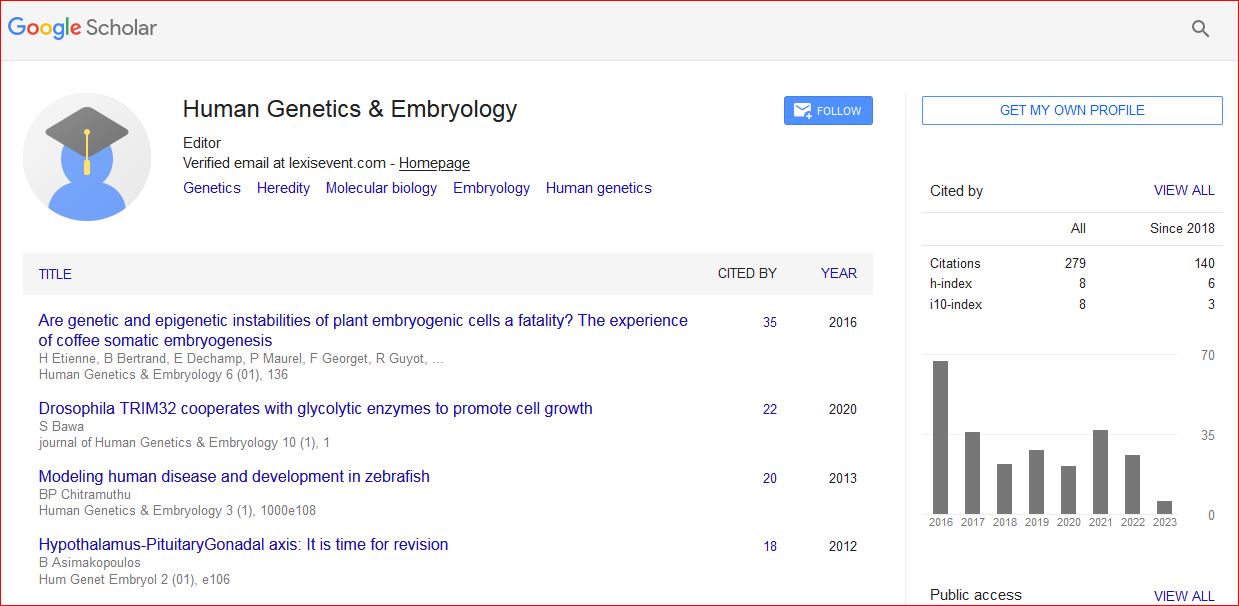
Human Genetics & Embryology received 309 citations as per Google Scholar report