Opinion - (2025) Volume 8, Issue 2
Received: 01-Apr-2025, Manuscript No. pollution-25-176593;
Editor assigned: 03-Apr-2025, Pre QC No. P-176593;
Reviewed: 17-Apr-2025, QC No. Q-176593;
Revised: 22-Apr-2025, Manuscript No. R-176593;
Published:
29-Apr-2025
, DOI: 10.37421/2684-4958.2025.8.372
Citation: Morgan, Grace. ”Diverse Global Pollution: Impacts and Solutions.” Pollution 08 (2025):372.
Copyright: © 2025 Morgan G. This is an open-access article distributed under the terms of the Creative Commons Attribution License, which permits unrestricted use,
distribution and reproduction in any medium, provided the original author and source are credited.
Emerging contaminants, like pharmaceuticals and personal care products, pose a serious threat to water quality and ecosystem health. This review highlights their widespread presence, the challenges they present in conventional water treatment, and explores advanced removal strategies like adsorption, oxidation, and membrane filtration, emphasizing the need for integrated approaches to manage these persistent pollutants [1].
Air pollution is a major global health concern, particularly in rapidly developing regions like Asia. This paper outlines how fine particulate matter and other air pollutants contribute to respiratory diseases, cardiovascular issues, and increased mortality. It stresses the urgency for effective policy interventions and technological solutions to mitigate these widespread environmental health risks [2].
While ocean microplastic pollution gets significant attention, terrestrial ecosystems are also heavily contaminated. This review examines sources like agriculture and wastewater, how microplastics move through soil, and their adverse effects on soil structure, microbial activity, and plant growth, highlighting a critical, often overlooked, environmental challenge [3].
Heavy metal contamination in agricultural soils is a serious global issue, impacting food safety and human health. This review discusses the origins of these pollutants, their accumulation in crops, and the methods used to assess the ecological and human health risks. It underscores the need for effective remediation strategies to protect agricultural productivity and public well-being [4].
Pharmaceuticals and personal care products (PPCPs) are widespread emerging contaminants in aquatic systems, posing significant risks to non-target organisms. This review details their global occurrence, complex environmental fate, and a range of ecotoxicological effects, calling for improved waste management and regulatory frameworks to mitigate their environmental footprint [5].
Persistent organic pollutants (POPs) accumulate disproportionately in the Arctic due to long-range atmospheric and oceanic transport, despite their sources being far away. This review summarizes their presence in the Arctic food web and the bioaccumulation that threatens Arctic wildlife and indigenous populations, emphasizing the need for global efforts to reduce these persistent chemicals [6].
The ubiquitous presence of microplastics in drinking water raises serious concerns about potential human health impacts. This review systematically covers global detection methods, reported concentrations, and discusses the pathways of exposure and the largely unknown health consequences, highlighting critical knowledge gaps and the urgent need for further research [7].
Per- and polyfluoroalkyl substances (PFAS) are a class of persistent chemicals found globally, raising significant environmental and health alarms. This review delves into their widespread occurrence in various environmental matrices, their mobility and persistence, and the current challenges and innovations in remediation technologies, underlining the complexity of managing these 'forever chemicals' [8].
The rapid growth of electronic waste (e-waste) presents a major environmental challenge due to its hazardous components. This review critically assesses current e-waste management practices, identifies the severe environmental and health impacts of improper disposal, and explores sustainable solutions like circular economy models and advanced recycling technologies to mitigate these risks [9].
Beyond aquatic systems, microplastics are prevalent in the atmosphere, representing an overlooked pathway for environmental and human exposure. This review synthesizes current understanding on their airborne sources, long-range transport, deposition patterns, and discusses the implications for respiratory health and other potential human health risks, underscoring a newly recognized global pollutant [10].
Environmental pollution presents a significant and growing threat to ecosystems and human health worldwide. One critical area of concern involves emerging contaminants, particularly pharmaceuticals and personal care products (PPCPs), which are increasingly prevalent in aquatic systems [1, 5]. These substances pose serious risks to water quality and the health of non-target organisms. Challenges in conventional water treatment necessitate the exploration of advanced removal strategies, such as adsorption, oxidation, and membrane filtration. An integrated approach is crucial for effectively managing these persistent pollutants and mitigating their environmental footprint [1, 5].
Air pollution remains a major global health concern, with fine particulate matter and other pollutants contributing to severe respiratory diseases, cardiovascular issues, and increased mortality, especially in rapidly developing regions like Asia [2]. Beyond industrial emissions, microplastics have also emerged as atmospheric pollutants. They represent an often-overlooked pathway for environmental and human exposure, with studies synthesizing current understanding on their airborne sources, long-range transport, deposition patterns, and potential implications for respiratory health [10]. This highlights a newly recognized global pollutant demanding attention alongside more traditional air quality issues.
While oceanic microplastic contamination receives considerable focus, terrestrial ecosystems are also heavily affected, with sources including agriculture and wastewater [3]. These microplastics move through soil, exerting adverse effects on soil structure, microbial activity, and plant growth, presenting a critical environmental challenge often overlooked. Furthermore, the ubiquitous presence of microplastics in drinking water raises serious concerns regarding potential human health impacts [7]. Reviews on this topic systematically cover global detection methods, reported concentrations, and discuss exposure pathways, emphasizing significant knowledge gaps and the urgent need for further research into their health consequences [7].
Contamination by persistent chemicals is another widespread problem. Heavy metal contamination in agricultural soils, for instance, is a serious global issue directly impacting food safety and human health [4]. Understanding their origins, accumulation in crops, and assessing ecological and human health risks is vital for developing effective remediation strategies. Similarly, Persistent Organic Pollutants (POPs) accumulate disproportionately in remote regions like the Arctic due to long-range atmospheric and oceanic transport [6]. Their presence in the Arctic food web and subsequent bioaccumulation threaten wildlife and indigenous populations, necessitating global efforts to reduce these chemicals. Per- and polyfluoroalkyl substances (PFAS), also known as 'forever chemicals,' are another class of persistent substances found globally across various environmental matrices [8]. Their mobility, persistence, and the challenges they present demand innovative remediation technologies [8].
The burgeoning issue of electronic waste (e-waste) represents a significant environmental challenge due to its hazardous components [9]. Current e-waste management practices are critically assessed, revealing severe environmental and health impacts from improper disposal. Exploring sustainable solutions, such as circular economy models and advanced recycling technologies, is essential to mitigate these growing risks [9].
In essence, the array of pollutants discussed—from pharmaceuticals and microplastics to heavy metals and persistent organic compounds—underscores a complex web of environmental degradation. Each type of contaminant presents unique challenges in terms of detection, removal, and impact assessment. A common thread across these studies is the urgent call for improved waste management, effective policy interventions, and the development of integrated, innovative solutions to safeguard both ecological balance and public well-being.
Environmental pollution represents a multifaceted global crisis, manifesting in various forms and impacting ecosystems and human health alike. Emerging contaminants, such as pharmaceuticals and personal care products, are widely detected in aquatic systems, posing risks to water quality and non-target organisms, necessitating advanced removal and integrated management strategies. Air pollution, particularly fine particulate matter, is a major concern, especially in rapidly developing regions like Asia, contributing to severe respiratory and cardiovascular diseases and increased mortality, underscoring the need for effective policy interventions. Microplastic pollution is ubiquitous, extending beyond oceans to terrestrial ecosystems through agriculture and wastewater, affecting soil structure, microbial activity, and plant growth. Their presence in drinking water raises significant human health concerns, highlighting detection challenges and knowledge gaps. Atmospheric microplastics represent another overlooked pathway for exposure and potential respiratory risks. Beyond these, heavy metal contamination in agricultural soils is a serious global issue, threatening food safety and requiring effective remediation strategies. Persistent organic pollutants (POPs) disproportionately accumulate in the Arctic food web through long-range transport, endangering wildlife and indigenous populations, thus demanding global reduction efforts. Per- and polyfluoroalkyl substances (PFAS), or 'forever chemicals,' are globally pervasive, necessitating innovative remediation and management due to their persistence. Lastly, the rapid growth of electronic waste (e-waste) and its hazardous components call for sustainable solutions like circular economy models and advanced recycling to mitigate severe environmental and health impacts. Addressing these diverse, persistent pollutants collectively requires a concerted global effort.
None
None
Indexed at, Google Scholar, Crossref
Indexed at, Google Scholar, Crossref
Indexed at, Google Scholar, Crossref
Indexed at, Google Scholar, Crossref
Indexed at, Google Scholar, Crossref
Indexed at, Google Scholar, Crossref
Indexed at, Google Scholar, Crossref
Indexed at, Google Scholar, Crossref
Indexed at, Google Scholar, Crossref
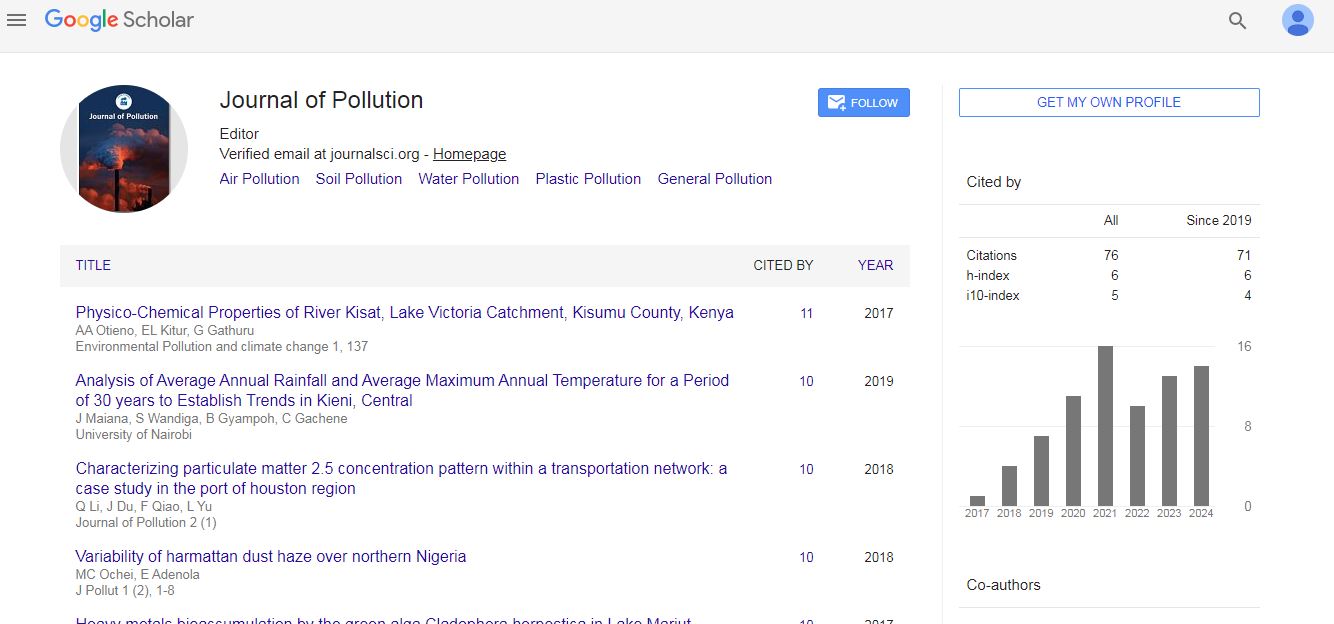
Journal of Pollution received 64 citations as per Google Scholar report