Short Communication - (2025) Volume 16, Issue 2
Received: 28-Mar-2025, Manuscript No. gjto-25-175402;
Editor assigned: 31-Mar-2025, Pre QC No. P-175402;
Reviewed: 14-Apr-2025, QC No. QC-175402;
Revised: 21-Apr-2025, Manuscript No. R-175402;
Published:
28-Apr-2025
, DOI: 10.37421/2229-8711.2025.16.442
Citation: Szalai, Viktor. ”Digitalizing Manufacturing: Technologies, Systems, Skills.” Global J Technol Optim 16 (2025):442.
Copyright: © 2025 Szalai V. This is an open-access article distributed under the terms of the Creative Commons Attribution License, which permits unrestricted use, distribution
and reproduction in any medium, provided the original author and source are credited.
This article maps the current status and future trajectory of additive manufacturing within advanced industrial settings. It highlights critical challenges and opportunities in integrating 3D printing technologies across various sectors, pointing towards increased automation and digital transformation. This integration signifies a major step towards intelligent automation and optimized production flows [1]. This comprehensive review explores the foundational concepts and applications of digital twins within smart manufacturing environments. It covers the architecture, enabling technologies, and challenges associated with deploying digital twin systems for real-time monitoring, simulation, and optimization of manufacturing processes. Such systems are vital for maintaining competitive edge and operational excellence in complex manufacturing scenarios [2]. This review delves into the growing role of artificial intelligence in transforming various aspects of manufacturing, from design and production to quality control and supply chain management. It outlines current applications, challenges, and offers insights into future research directions for intelligent manufacturing systems. The influence of AI spans the entire manufacturing value chain, making processes more adaptable and predictive [3].
This article reviews the intersection of sustainable manufacturing practices and Industry 4.0 technologies. It highlights how digital technologies can drive environmental efficiency, resource optimization, and economic viability in modern production systems, identifying key drivers and barriers. Incorporating these digital tools helps companies meet environmental goals while maintaining economic viability [4]. This review examines the latest advancements and practical implementations of human-robot collaboration in sophisticated manufacturing environments. It covers various aspects, including safety protocols, intuitive interfaces, and the ergonomic benefits of integrating collaborative robots to enhance productivity and flexibility on the factory floor. These collaborative setups lead to more efficient production lines and safer working environments [5].
This systematic review provides a comprehensive overview of cyber-physical production systems (CPPS) within the context of Industry 4.0. It examines the architecture, key technologies, and implementation challenges of CPPS, highlighting their role in achieving intelligent and connected manufacturing operations through real-time data integration and control. Real-time data integration and control are the cornerstones of these systems, enabling responsive and adaptive production [6]. This systematic review explores the integration of blockchain technology within supply chain management in the context of Industry 4.0. It investigates how blockchain can enhance transparency, security, and traceability across manufacturing supply chains, outlining current applications and proposing future research directions. Enhanced transparency and security are critical for building trust and efficiency in modern, dispersed supply chains [7]. This review focuses on the latest progress in process control and monitoring techniques for additive manufacturing. It explores how real-time sensing, data analytics, and closed-loop control systems are being developed to ensure quality, consistency, and reliability in 3D printing processes, addressing common defects and variations. By leveraging advanced analytics, manufacturers can significantly reduce defects and improve product consistency [8].
This systematic review investigates the evolving skill sets necessary for success in the advanced manufacturing sector. It identifies critical competencies, including digital literacy, data analytics, and interdisciplinary problem-solving, highlighting the urgent need for updated education and training programs to address the skills gap. Bridging this skills gap is essential for workforce readiness and sustained growth in the manufacturing sector [9]. This review provides an overview of cloud manufacturing, detailing its recent advancements, inherent challenges, and potential future trajectories. It explores how leveraging cloud computing can enable flexible, on-demand, and resource-efficient manufacturing services, fostering collaboration and innovation across global production networks. Cloud platforms enable businesses to scale operations efficiently and respond dynamically to market demands [10].
The landscape of advanced manufacturing is rapidly evolving, with additive manufacturing at the forefront of this transformation. It involves the integration of 3D printing technologies across various industrial sectors, focusing on enhanced automation and digital transformation [1]. Crucially, ensuring the quality and reliability of 3D printing processes demands sophisticated process control and monitoring techniques. This includes real-time sensing, data analytics, and closed-loop control systems designed to address common defects and variations, ultimately delivering consistent results [8]. These advancements signify a concerted effort to refine additive manufacturing for broader industrial application.
A core component of smart manufacturing environments is the implementation of digital twins. These foundational concepts involve creating virtual replicas that enable real-time monitoring, simulation, and optimization of complex manufacturing processes [2]. Parallel to this, cyber-physical production systems (CPPS) are integral to the Industry 4.0 paradigm. CPPS encompasses advanced architectures and key technologies, tackling implementation challenges to achieve intelligent and connected manufacturing operations through robust real-time data integration and control [6]. Together, digital twins and CPPS form the backbone for highly responsive and data-driven production systems.
Artificial Intelligence is increasingly vital in transforming numerous facets of manufacturing, from initial design and production workflows to stringent quality control and intricate supply chain management. AI offers profound insights into future research directions, propelling the development of intelligent manufacturing systems [3]. This technological push coincides with a heightened focus on sustainability within Industry 4.0. Digital technologies are instrumental in promoting environmental efficiency, optimizing resource use, and ensuring economic viability in modern production, addressing both key drivers and barriers in achieving greener manufacturing [4].
The integration of human-robot collaboration marks a significant advancement in sophisticated manufacturing environments. This involves carefully developed safety protocols, intuitive interfaces, and ergonomic considerations, all aimed at enhancing productivity and flexibility on the factory floor through collaborative robots [5]. Simultaneously, blockchain technology is making its mark on supply chain management within the Industry 4.0 framework. It significantly boosts transparency, security, and traceability across complex manufacturing supply chains, offering a robust solution for tracking goods and information from origin to delivery [7]. These innovations represent a dual effort to enhance both operational efficiency and supply chain integrity.
Looking ahead, cloud manufacturing presents an innovative approach, leveraging cloud computing to provide flexible, on-demand, and highly resource-efficient manufacturing services. This paradigm fosters greater collaboration and innovation across global production networks, addressing the challenges and exploring future trajectories of interconnected production [10]. This dynamic shift in manufacturing methodologies inherently requires a parallel evolution of workforce skills. Advanced manufacturing demands critical competencies such as digital literacy, advanced data analytics, and interdisciplinary problem-solving, underscoring the pressing need for updated educational and training programs to bridge the existing skills gap [9]. The future success of advanced manufacturing relies heavily on both technological adoption and a prepared human workforce.
Advanced manufacturing is undergoing significant transformation, driven by technologies like additive manufacturing, or 3D printing. This technology is seeing increased automation and digital integration, with ongoing developments in process control and monitoring to ensure quality and reliability. Digitalization extends to smart manufacturing environments through digital twins, which offer real-time monitoring and optimization, and cyber-physical production systems (CPPS) for intelligent, connected operations. Artificial Intelligence plays a crucial role across design, production, quality control, and supply chain management, driving intelligent manufacturing systems. Industry 4.0 also intersects with sustainable manufacturing, where digital tools enhance environmental efficiency and resource optimization. Human-robot collaboration is advancing, improving productivity and flexibility with ergonomic and safety considerations. Beyond the factory floor, blockchain technology is being integrated into supply chain management to boost transparency and security. Furthermore, cloud manufacturing leverages cloud computing for flexible, on-demand, and resource-efficient manufacturing services, fostering collaboration and innovation across global production networks. The evolving landscape necessitates new skill sets, emphasizing digital literacy, data analytics, and interdisciplinary problem-solving to address emerging skills gaps.
None
None
P. P, S. H, P. HR. "Roadmap for additive manufacturing in advanced industries: A review of the current state and future directions".Mater. Today Proc. 92 (2023):161-167.
Indexed at, Google Scholar, Crossref
F. T, M. L, J. X. "Digital twin for smart manufacturing: a comprehensive review".J. Manuf. Syst. 62 (2022):265-292.
Indexed at, Google Scholar, Crossref
J. W, S. C, X. Y. "Artificial intelligence in manufacturing: a comprehensive review and future perspectives".Appl. Sci. 11 (2021):2069.
Indexed at, Google Scholar, Crossref
L. F, T. TDN, C. VPN. "Sustainable manufacturing in Industry 4.0: a review".J. Clean. Prod. 254 (2020):120041.
Indexed at, Google Scholar, Crossref
P. KS, V. KJ, S. RS. "Human–robot collaboration in advanced manufacturing: A review of recent developments and applications".Int. J. Adv. Manuf. Technol. 129 (2023):3237-3259.
Indexed at, Google Scholar, Crossref
M. AW, S. KAH, M. JH. "Cyber-physical production systems in the Industry 4.0 era: A systematic literature review".IEEE Access 10 (2022):43292-43315.
Indexed at, Google Scholar, Crossref
H. KK, J. HP, S. GK. "Blockchain technology in supply chain management for Industry 4.0: a systematic review and future research agenda".Comput. Ind. Eng. 154 (2021):107024.
Indexed at, Google Scholar, Crossref
D. KK, S. KS, A. KR. "Process control and monitoring in additive manufacturing: A review of recent advancements".J. Manuf. Process. 92 (2023):736-758.
Indexed at, Google Scholar, Crossref
G. SNO, E. KKG, R. KM. "Skills requirements for advanced manufacturing: A systematic review".Eur. J. Train. Dev. 44 (2020):631-654.
Indexed at, Google Scholar, Crossref
D. W, S. R, P. ZL. "Cloud manufacturing: A review of recent advances, challenges, and future directions".Robot. Comput. Integr. Manuf. 59 (2019):173-191.
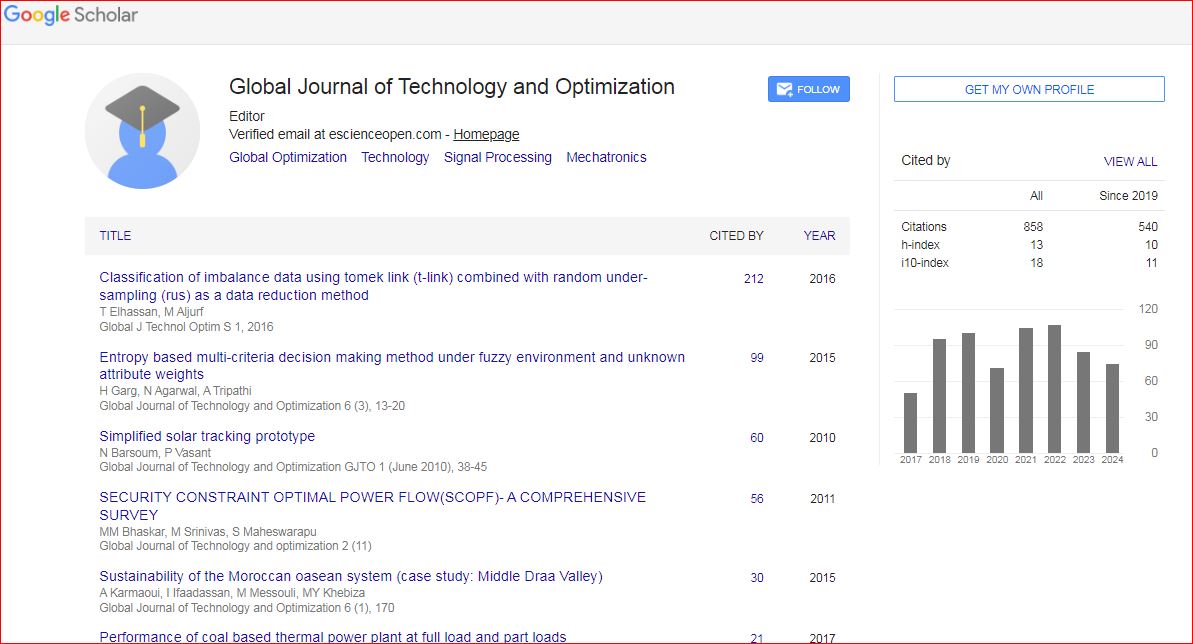
Global Journal of Technology and Optimization received 847 citations as per Google Scholar report