Opinion - (2025) Volume 7, Issue 4
Received: 02-Nov-2025, Manuscript No. jspd-25-174869;
Editor assigned: 04-Nov-2025, Pre QC No. P-174869;
Reviewed: 18-Nov-2025, QC No. Q-174869;
Revised: 24-Nov-2025, Manuscript No. R-174869;
Published:
29-Nov-2025
, DOI: 10.37421/2684-4575.2025.6.034
Citation: Ofori, Samuel. ”Digital Pathology, AI Drive Anatomic Transformation.” J Surg Path Diag 07 (2025):34.
Copyright: © 2025 Ofori S. This is an open-access article distributed under the terms of the Creative Commons Attribution License, which permits unrestricted use, distribution and reproduction in any medium, provided the original author and source are credited.
Digital pathology fundamentally reshapes the surgical pathology workflow by replacing glass slides with whole-slide images. What this really means for labs is better efficiency in slide management, easier remote consultations, and the foundation for AI integration. It can shorten turnaround times and enhance diagnostic capabilities, though initial investment and technological adoption hurdles are real concerns for many practices [1].
Artificial intelligence tools are moving beyond hype and into practical applications for diagnostic surgical pathology. We are seeing AI support in areas like pre-screening, image analysis for specific biomarkers, and even quality control checks. The goal is to augment pathologists' capabilities, helping them become more efficient and precise, especially with high-volume tasks [2].
Applying Lean principles helps identify and eliminate waste throughout the anatomic pathology laboratory. This means looking at every step, from specimen accessioning to final reporting, and figuring out where value isn't being added. It's about streamlining processes, reducing unnecessary steps, and ultimately improving efficiency and quality by focusing on what truly matters [3].
Quality assurance in anatomic pathology is crucial for patient safety and accurate diagnoses. It involves systematic monitoring and evaluation across all phases of the workflowâ??pre-analytical, analytical, and post-analytical. This structured approach helps identify potential errors early, implements corrective actions, and ensures consistent high standards in diagnostic reporting [4].
Automation in anatomic pathology is evolving rapidly, impacting everything from specimen processing to slide staining and imaging. The driving force here is reducing manual errors, increasing throughput, and ensuring standardization. While full automation is still a journey, targeted robotic solutions are already making significant contributions to workflow efficiency and consistency in many labs [5].
Accurate specimen tracking is paramount in anatomic pathology to prevent misidentification and ensure diagnostic integrity. This means implementing robust systems, often leveraging barcoding and LIS integration, from the moment a specimen enters the lab until the final report is issued. The constant goal is to maintain a clear audit trail and mitigate the risk of errors throughout the entire complex workflow [6].
Telepathology has become an increasingly vital component of surgical pathology, especially for primary diagnoses and remote consultations. It allows pathologists to review digital slides from anywhere, overcoming geographical barriers and enabling access to subspecialty expertise. What this really means is improved access to care, faster second opinions, and a more flexible diagnostic environment, particularly in underserved areas [7].
Optimizing the anatomic pathology laboratory workflow is an ongoing challenge, driven by increasing case volumes, staffing shortages, and demands for faster turnaround times. Here's the thing: it requires a holistic approach, integrating process improvements, technology adoption like digital pathology and AI, and effective resource management. The goal is creating a more efficient, high-quality, and sustainable diagnostic service [8].
Predictive analytics offers a powerful new approach to workflow optimization in anatomic pathology. By analyzing historical data, it can forecast workload, identify bottlenecks, and even predict potential resource needs. What this really means is that labs can proactively adjust staffing, equipment, and processes, leading to smoother operations and reduced turnaround times, moving beyond reactive problem-solving [9].
Turnaround time (TAT) is a critical performance metric in surgical pathology, directly impacting patient care and clinical decision-making. Factors like specimen complexity, staffing levels, technology, and reporting requirements all play a role. Improving TAT often involves a combination of workflow redesign, automation, and clear communication, aiming for that sweet spot of speed and diagnostic accuracy [10].
The landscape of anatomic pathology is rapidly evolving, with digital pathology at its core. This transformation replaces traditional glass slides with whole-slide images, fundamentally reshaping surgical pathology workflows [1]. This transition brings several benefits to laboratories, including enhanced efficiency in slide management, easier remote consultations, and establishing a solid foundation for the integration of Artificial Intelligence (AI). Ultimately, this can lead to shorter turnaround times and improved diagnostic capabilities, though practices must contend with initial investment and adoption hurdles [1]. Beyond just digitizing slides, Artificial Intelligence tools are moving past theoretical discussions into practical applications within diagnostic surgical pathology. AI is now supporting critical areas such as pre-screening, detailed image analysis for specific biomarkers, and robust quality control checks [2]. The overarching aim is to extend pathologists' capabilities, helping them work more efficiently and precisely, especially when faced with high-volume tasks [2]. Alongside these advancements, telepathology has become an increasingly vital component, especially for primary diagnoses and remote consultations [7]. It empowers pathologists to review digital slides from any location, effectively overcoming geographical barriers and providing access to specialized expertise. What this really means is improved access to patient care, quicker second opinions, and a more adaptable diagnostic environment, which is particularly beneficial in underserved regions [7].
Improving operational efficiency is another major focus in anatomic pathology. Applying Lean principles, for instance, is a powerful strategy to identify and eliminate waste throughout the laboratory workflow [3]. This involves meticulously examining every single step, from specimen accessioning to the final reporting stage, to pinpoint where value isn't being added. Itâ??s essentially about streamlining processes, cutting down unnecessary steps, and ultimately boosting both efficiency and quality by concentrating on what truly matters [3]. Automation is quickly advancing in anatomic pathology, influencing everything from initial specimen processing to slide staining and advanced imaging [5]. The primary drivers for this are reducing manual errors, significantly increasing throughput, and ensuring greater standardization across procedures. While a fully automated lab remains a long-term goal, specific robotic solutions are already making substantial contributions to workflow efficiency and consistency in many labs today [5].
Ensuring quality and patient safety is paramount. Quality assurance in anatomic pathology is crucial for both accurate diagnoses and patient well-being [4]. This involves systematic monitoring and evaluation across all three phases of the workflow: pre-analytical, analytical, and post-analytical. This structured approach helps detect potential errors early, allows for the implementation of swift corrective actions, and guarantees consistent high standards in diagnostic reporting [4]. Accurate specimen tracking is equally critical to prevent misidentification and uphold diagnostic integrity [6]. This means implementing robust systems, often utilizing barcoding and integration with Laboratory Information Systems (LIS), from the moment a specimen enters the lab until the final report is issued. The consistent objective is to maintain a clear audit trail and significantly reduce the risk of errors throughout the entire complex workflow [6].
Optimizing the anatomic pathology laboratory workflow is an ongoing, multifaceted challenge, driven by factors like increasing case volumes, persistent staffing shortages, and continuous demands for faster turnaround times [8]. Let's break it down: this truly demands a holistic approach, carefully integrating process improvements, adopting advanced technologies like digital pathology and Artificial Intelligence, and implementing effective resource management strategies [8]. The ultimate goal is to establish a more efficient, high-quality, and sustainable diagnostic service [8]. Predictive analytics offers an innovative way to achieve this workflow optimization [9]. By thoroughly analyzing historical data, it can accurately forecast future workloads, pinpoint potential bottlenecks, and even anticipate specific resource requirements. What this really means is that labs can proactively adjust staffing levels, equipment allocation, and operational processes, leading to much smoother operations and significantly reduced turnaround times, effectively shifting from reactive problem-solving to proactive strategic planning [9]. Turnaround Time (TAT) itself is a crucial performance metric in surgical pathology, directly influencing patient care and clinical decision-making [10]. Numerous factors contribute to TAT, including specimen complexity, available staffing levels, implemented technology, and specific reporting requirements. Improving TAT often necessitates a strategic combination of workflow redesign, targeted automation, and clear, consistent communication, always aiming for that ideal balance of speed and diagnostic accuracy [10].
The field of anatomic pathology is undergoing significant transformation, driven by advancements aimed at enhancing efficiency, accuracy, and patient safety. Digital pathology is at the forefront, replacing traditional glass slides with whole-slide images, which streamlines slide management, facilitates remote consultations, and lays the groundwork for Artificial Intelligence (AI) integration. This shift promises to shorten turnaround times and improve diagnostic capabilities, despite initial investment challenges. AI tools are becoming practical for diagnostic surgical pathology, assisting with pre-screening, biomarker analysis, and quality control, thereby augmenting pathologists' precision and efficiency, especially in high-volume tasks. Parallel efforts focus on operational optimization. Applying Lean principles helps eliminate waste and streamline processes from specimen accessioning to final reporting, focusing on value-added activities. Quality assurance is indispensable, systematically monitoring all workflow phasesâ??pre-analytical, analytical, and post-analyticalâ??to prevent errors and maintain consistent diagnostic standards. Automation is also playing a key role, reducing manual errors, boosting throughput, and standardizing procedures across labs. Critical to all these improvements is accurate specimen tracking, essential for preventing misidentification and ensuring diagnostic integrity through systems like barcoding. Telepathology is expanding access to care and subspecialty expertise by enabling remote digital slide review. Optimizing the overall laboratory workflow remains a complex challenge, requiring a holistic strategy that combines process improvements, technology adoption, and smart resource management to create efficient, high-quality services. Predictive analytics further supports this by using historical data to forecast workloads and identify bottlenecks, enabling proactive adjustments to staffing and equipment. All these strategies ultimately aim to improve Turnaround Time (TAT), a crucial metric in surgical pathology that impacts patient care, by balancing speed with diagnostic accuracy through redesign, automation, and clear communication.
None
None
Kunal B, Kurt AS, David LR. "The Impact of Digital Pathology on Surgical Pathology Workflow: A Systematic Review".Mod Pathol 34 (2021):153-167.
Indexed at, Google Scholar, Crossref
Federica S, Liron P, Peter JS. "Artificial intelligence in diagnostic surgical pathology: a practical guide".J Clin Pathol 75 (2022):586-591.
Indexed at, Google Scholar, Crossref
Dinesh P, Garima S, Pallavi M. "Lean Principles and Waste Reduction in Anatomic Pathology".J Pathol Inform 11 (2020):7.
Indexed at, Google Scholar, Crossref
Hayfa E, Mohamed E, Ibrahim E. "Quality Assurance in Anatomic Pathology: A Practical Approach".Cureus 15 (2023):e36980.
Indexed at, Google Scholar, Crossref
Liron P, Kurt AS, Peter JS. "Automation in Anatomic Pathology: An Update".Adv Anat Pathol 27 (2020):211-218.
Indexed at, Google Scholar, Crossref
Hanan A, Hisham A, Sarah A. "The importance of tracking specimens in anatomic pathology: a comprehensive review".J Clin Pathol 74 (2021):279-283.
Indexed at, Google Scholar, Crossref
Maxwell GH, Liron P, Stacey EM. "Telepathology for primary diagnosis: a practical implementation guide and a systematic review of the literature".Virchows Arch 478 (2021):3-16.
Indexed at, Google Scholar, Crossref
Stacey EM, Liron P, Maxwell GH. "Optimizing the Anatomic Pathology Laboratory Workflow: Challenges and Opportunities".Arch Pathol Lab Med 146 (2022):328-336.
Indexed at, Google Scholar, Crossref
Stacey EM, Anil VP, Liron P. "Applying predictive analytics to optimize workflow in anatomic pathology: challenges and opportunities".Hum Pathol 110 (2021):29-37.
Indexed at, Google Scholar, Crossref
Muhammad SS, Abdulrahman RAH, Jassim AM. "Turnaround Time in Surgical Pathology: A Review of Influencing Factors and Improvement Strategies".J Appl Lab Med 7 (2022):1001-1006.
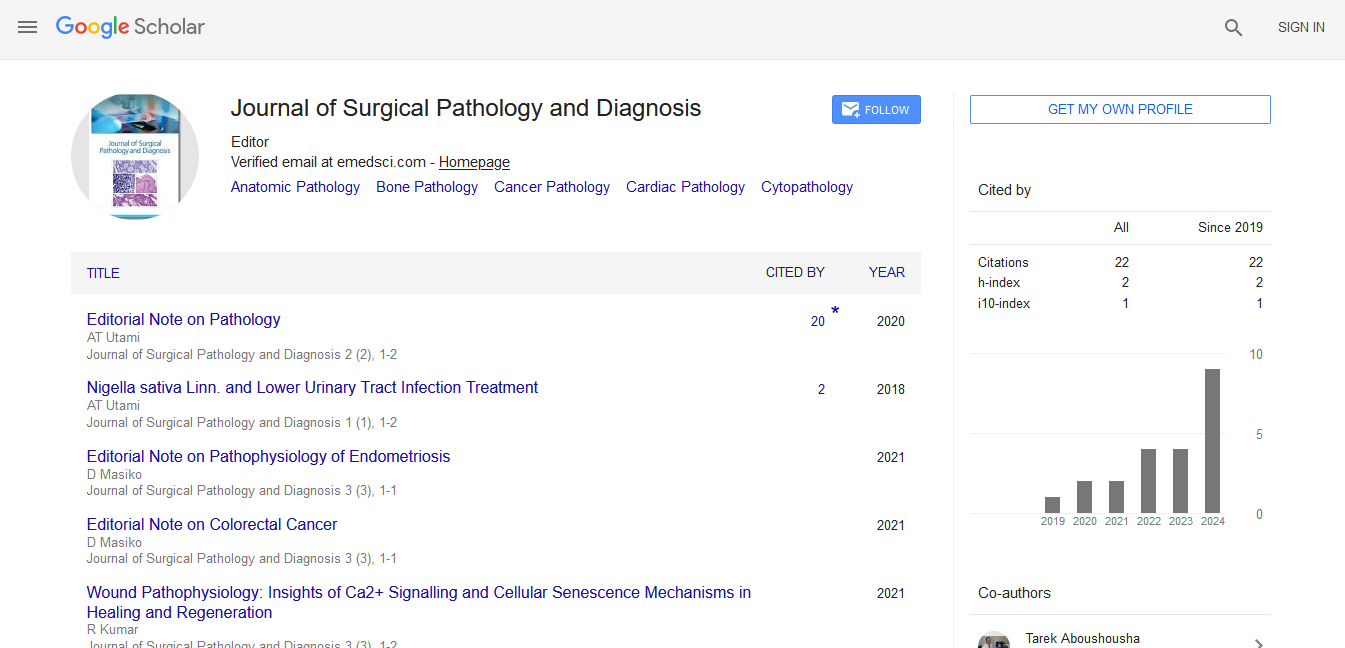
Journal of Surgical Pathology and Diagnosis received 15 citations as per Google Scholar report