Commentary - (2025) Volume 16, Issue 2
Received: 03-Mar-2025, Manuscript No. jch-26-178744;
Editor assigned: 05-Mar-2025, Pre QC No. P-178744;
Reviewed: 19-Mar-2025, QC No. Q-178744;
Revised: 24-Mar-2025, Manuscript No. R-178744;
Published:
31-Mar-2025
, DOI: 10.37421/2157-7099.2025.16.782
Citation: Johnson, Amelia R.. ”Cytology Innovations: Revolutionizing Early Disease Detection with AI.” J Cytol Histol 16 (2025):782.
Copyright: © 2025 Johnson R. Amelia This is an open-access article distributed under the terms of the Creative Commons Attribution License, which permits unrestricted use, distribution and reproduction in any medium, provided the original author and source are credited.
Recent advancements in cytological techniques are ushering in a new era of early disease detection, significantly enhancing diagnostic capabilities. Breakthroughs in liquid-based cytology (LBC) and the integration of advanced imaging with artificial intelligence (AI) are at the forefront of this revolution, improving sample quality and diagnostic accuracy for subtle morphological changes indicative of malignancy or pre-malignant conditions. The application of AI in this field promises to standardize interpretation, reduce inter-observer variability, and accelerate diagnostic workflows, leading to earlier and more effective patient interventions. [1] The development of high-resolution imaging technologies and digital pathology platforms has profoundly advanced cytological analysis, enabling detailed examination of cellular morphology, nuclear features, and subtle architectural patterns that might be missed with conventional microscopy. These tools are particularly valuable in fine-needle aspiration (FNA) cytology, allowing for more precise diagnoses and reducing the need for invasive biopsies, thus offering a less burdensome diagnostic pathway for patients. [2] Liquid-based cytology (LBC) continues to undergo refinement, offering improved sample preservation and a reduction in obscuring factors such as blood and debris. This enhancement results in better cellularity and clearer visualization of cellular features, which is critical for detecting subtle cytological abnormalities, especially in gynecological screening and non-gynecological sample analysis. The standardization of LBC protocols further contributes to its reliability in early disease detection. [3] The integration of machine learning algorithms into cytological image analysis is fundamentally transforming the field by enabling AI models to be trained to identify specific cellular patterns associated with early-stage cancers. This capability aids in screening large volumes of samples and assists cytotechnologists and pathologists in focusing on potentially abnormal cases, thereby improving efficiency and diagnostic accuracy. [4] Molecular markers and ancillary techniques, such as immunocytochemistry and fluorescence in situ hybridization (FISH), are increasingly being applied to cytological specimens. These methods provide crucial molecular and genetic information that can refine diagnoses, predict treatment response, and identify specific cancer subtypes, particularly when conventional morphology is equivocal. This multiparametric approach significantly enhances the diagnostic power of cytology for early disease detection and characterization. [5] Point-of-care cytology is emerging as a vital tool for rapid preliminary diagnosis, especially in resource-limited settings or during surgical procedures. The combination of portable microscopes, simplified staining techniques, and AI-driven analysis can provide prompt diagnostic information, facilitating immediate clinical decisions and potentially improving patient outcomes by minimizing delays in diagnosis and treatment initiation. [6] Automated slide scanners and whole-slide imaging (WSI) have played a pivotal role in facilitating digital archiving and remote consultation in cytology. This technology enables standardized image acquisition, quantitative analysis, and improved collaborative diagnostics, proving instrumental in the development and deployment of AI algorithms for cytological interpretation and advancing early disease detection. [7] Advances in high-throughput screening and omics technologies are beginning to be integrated with cytological analysis, offering the potential for unprecedented insights into disease at the molecular level. Combining cellular morphology with proteomic or transcriptomic data from residual cellular material could enable even earlier detection and more personalized diagnostic approaches. [8] The development of more sensitive and specific staining techniques, coupled with advanced microscopy such as confocal and multiphoton microscopy, allows for the precise visualization of cellular structures and their dynamics. This enhanced morphological detail is critical for identifying pre-neoplastic lesions and distinguishing benign from malignant cellular changes at their earliest stages. [9] Quality assurance and standardization in cytological diagnostics are being significantly enhanced through digital platforms and AI. These advancements ensure consistent performance across different laboratories and cytopathologists, leading to more reliable and reproducible results in early disease detection. Standardization of specimen preparation, staining, and interpretation protocols is paramount for maximizing the benefits of these emerging technologies. [10]
Recent breakthroughs in cytological techniques, including liquid-based cytology (LBC) and advanced imaging coupled with artificial intelligence (AI), are revolutionizing early disease detection. These methods enhance cellular sample quality, improve diagnostic accuracy, and facilitate the identification of subtle morphological changes indicative of malignancy or pre-malignant conditions. The integration of AI, in particular, promises to standardize interpretation, reduce inter-observer variability, and accelerate diagnostic workflows, ultimately leading to earlier and more effective patient interventions. [1] The development of high-resolution imaging technologies and digital pathology platforms has significantly advanced cytological analysis. These tools enable detailed examination of cellular morphology, nuclear features, and subtle architectural patterns often missed in conventional microscopy. Their application in areas like fine-needle aspiration (FNA) cytology allows for more precise diagnoses and reduces the need for invasive biopsies, offering a less burdensome diagnostic pathway for patients. [2] Liquid-based cytology (LBC) continues to be refined, offering improved sample preservation and reduced obscuring factors like blood and debris. This leads to better cellularity and clearer visualization of cellular features, which is crucial for detecting subtle cytological abnormalities, particularly in gynecological screening and non-gynecological sample analysis. Standardization of LBC protocols further enhances its reliability for early disease detection. [3] The integration of machine learning algorithms into cytological image analysis is transforming the field. These AI models can be trained to identify specific cellular patterns associated with early-stage cancers, such as lung, breast, and cervical cancers. This not only aids in screening large volumes of samples but also helps cytotechnologists and pathologists focus on potentially abnormal cases, improving efficiency and diagnostic accuracy. [4] Molecular markers and ancillary techniques, such as immunocytochemistry and fluorescence in situ hybridization (FISH), are increasingly being applied to cytological specimens. These methods provide molecular and genetic information that can refine diagnoses, predict treatment response, and identify specific subtypes of cancer, especially when conventional morphology is equivocal. This multiparametric approach enhances the diagnostic power of cytology for early disease detection and characterization. [5] Point-of-care cytology is emerging as a valuable tool for rapid preliminary diagnosis in resource-limited settings or during surgical procedures. Portable microscopes and simplified staining techniques, combined with AI-driven analysis, can provide prompt diagnostic information, enabling immediate clinical decisions and potentially improving patient outcomes by reducing delays in diagnosis and treatment initiation. [6] The application of automated slide scanners and whole-slide imaging (WSI) has facilitated digital archiving and remote consultation in cytology. This technology allows for standardized image acquisition, quantitative analysis, and improved collaborative diagnostics. WSI platforms are instrumental in the development and deployment of AI algorithms for cytological interpretation, paving the way for more efficient and accurate early disease detection. [7] Advances in high-throughput screening and omics technologies are beginning to be integrated with cytological analysis. While still in early stages, combining cellular morphology with proteomic or transcriptomic data from residual cellular material could offer unprecedented insights into disease at the molecular level, enabling even earlier detection and more personalized diagnostic approaches. [8] The development of more sensitive and specific staining techniques, alongside advanced microscopy like confocal and multiphoton microscopy, allows for the visualization of cellular structures and their dynamics with greater precision. This enhanced morphological detail is critical for identifying pre-neoplastic lesions and distinguishing benign from malignant cellular changes at their earliest stages. [9] Quality assurance and standardization in cytological diagnostics are being significantly improved through digital platforms and AI. This ensures consistent performance across different laboratories and cytopathologists, leading to more reliable and reproducible results in early disease detection. Standardization of specimen preparation, staining, and interpretation protocols is paramount for maximizing the benefits of these new technologies. [10]
Recent advancements in cytology, including liquid-based cytology (LBC) and AI-powered imaging, are revolutionizing early disease detection. High-resolution imaging and digital pathology enhance morphological analysis, while machine learning algorithms identify cancer patterns. Molecular markers and ancillary techniques provide crucial genetic information for refined diagnoses. Point-of-care cytology offers rapid preliminary diagnoses, and automated slide scanners and whole-slide imaging facilitate digital archiving and remote consultations. Emerging integrations with high-throughput screening and omics technologies promise deeper molecular insights. Enhanced microscopy and staining techniques improve visualization of cellular details for early lesion identification. Overall, digital platforms and AI are improving quality assurance and standardization, leading to more reliable early disease detection.
None
None
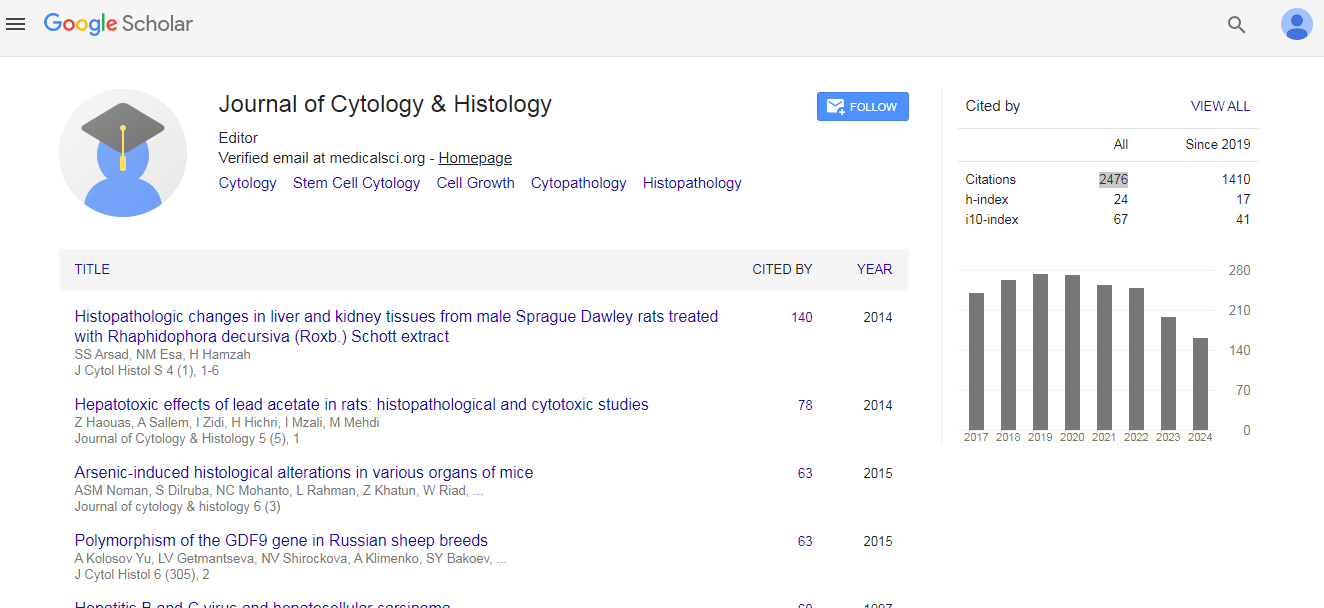
Journal of Cytology & Histology received 2476 citations as per Google Scholar report