Commentary - (2025) Volume 16, Issue 5
Received: 01-Sep-2025, Manuscript No. jch-26-178781;
Editor assigned: 03-Sep-2025, Pre QC No. P-178781;
Reviewed: 17-Sep-2025, QC No. Q-178781;
Revised: 22-Sep-2026, Manuscript No. R-178781;
Published:
29-Sep-2025
, DOI: 10.37421/2157-7099.2025.16.813
Citation: Osei, James. ”Cytology and Histology: Diagnosing Breast Lesions.” J Cytol Histol 16 (2025):813.
Copyright: © 2025 Osei J. This is an open-access article distributed under the terms of the Creative Commons Attribution License, which permits unrestricted use, distribution and reproduction in any medium, provided the original author and source are credited.
The accurate diagnosis of breast lesions is a cornerstone of effective patient management, and the interplay between cytological and histological findings plays a pivotal role in this process. Initial fine-needle aspiration (FNA) cytology serves as a crucial first step, guiding subsequent diagnostic procedures such as surgical biopsies. Histological examination then provides the definitive confirmation and refinement of the cytological assessment, underscoring the importance of standardized reporting and multidisciplinary team discussions to enhance diagnostic accuracy and improve patient outcomes [1].
The nuances of distinguishing between ductal carcinoma in situ (DCIS) and invasive ductal carcinoma (IDC) are meticulously addressed by comparing cytological features with definitive histological classifications. Subtle cytological variations, when carefully correlated with histological findings, can significantly influence treatment decisions and prognostication, with evolving ancillary techniques in cytology aimed at improving discriminatory power [2].
Significant challenges exist in differentiating benign from malignant breast lesions using solely cytological methods. Advanced cytological techniques, such as liquid-based cytology, have contributed to better correlation with histological outcomes, emphasizing the critical role of accurate sampling and interpretation. Continuous education and robust quality control measures are advocated to further refine these diagnostic capabilities [3].
Studies exploring the concordance and discordance rates between fine-needle aspiration biopsy (FNAB) and histopathology in specific breast neoplasms are vital. Factors contributing to discrepancies, including sampling error and inherent limitations of cytological assessment, are identified, with strategies proposed to minimize these issues, reinforcing the indispensable nature of histology for definitive diagnoses [4].
The utility of core needle biopsy (CNB) as an intermediate step between FNA and excisional biopsy is a subject of ongoing research. CNB offers improved tissue architecture and cellularity, leading to enhanced diagnostic accuracy and better concordance with subsequent histological diagnoses for breast lesions, thus bridging a gap in the diagnostic pathway [5].
Diagnostic challenges posed by atypical ductal hyperplasia (ADH) and lobular carcinoma in situ (LCIS) at the cytological level necessitate definitive histological assessment for accurate classification and subsequent management. Distinguishing these entities from invasive disease relies heavily on the combined evidence from both cytological and histological examinations [6].
The diagnostic accuracy of fine-needle aspiration (FNA) in evaluating breast masses is critically examined through its correlation with histopathology. The sensitivity, specificity, and predictive values of FNA cytology are discussed, highlighting the indispensable roles of experienced cytopathologists and the correlation with histological findings for optimal patient care [7].
Molecular markers are increasingly being integrated with cytological and histological assessments to improve the classification and management of breast lesions. This synergy between morphology and molecular profiling offers the potential for more precise diagnoses and personalized treatment strategies, advancing the field of breast pathology [8].
Interobserver variability in the cytological diagnosis of breast lesions can impact the correlation with histology, necessitating standardized training and quality assurance programs. Ensuring consistent and accurate cytological interpretations that align with histological findings is paramount for reliable diagnoses [9].
The evolution of breast lesion assessment involves the continuous refinement of both cytology and histology techniques. Advancements in imaging, molecular diagnostics, and a deeper understanding of cellular morphology collectively contribute to a more robust correlation between these disciplines, ultimately benefiting patient outcomes and enhancing diagnostic precision [10].
The critical interplay between cytological and histological findings is fundamental in the diagnosis of breast lesions. Fine-needle aspiration (FNA) cytology often serves as an initial guide for subsequent surgical biopsies, with histological examination then confirming and refining these initial cytological assessments. The emphasis on standardized reporting and multidisciplinary team discussions is crucial for improving diagnostic accuracy and optimizing patient management strategies [1].
The meticulous comparison of cytological features with definitive histological classifications is essential for understanding the nuances of conditions like ductal carcinoma in situ (DCIS) and invasive ductal carcinoma (IDC). Subtle variations observed in cytology, when correlated with histology, can significantly influence treatment decisions and impact prognostication. The ongoing development of ancillary techniques in cytology aims to enhance its discriminatory power in these complex cases [2].
Differentiating benign from malignant breast lesions presents challenges that are actively being addressed by advancements in cytological interpretation and techniques. The development and widespread adoption of methods like liquid-based cytology have demonstrably improved the correlation between cytological findings and subsequent histological outcomes. This highlights the persistent need for meticulous sampling techniques and accurate interpretation, alongside robust quality control measures [3].
Studies meticulously investigating the concordance and discordance rates between fine-needle aspiration biopsy (FNAB) and histopathology are crucial for refining diagnostic protocols. These investigations identify key factors contributing to discrepancies, such as sampling errors and the inherent limitations of cytological assessment. The findings often underscore the indispensable role of histology for establishing definitive diagnoses, prompting the development of strategies to minimize diagnostic discrepancies [4].
The role of core needle biopsy (CNB) as an intermediate diagnostic step between FNA and excisional biopsy is increasingly recognized. CNB provides a greater quantity of tissue with preserved architectural context compared to FNA, leading to enhanced diagnostic accuracy and a higher degree of concordance with definitive histological diagnoses for a wide spectrum of breast lesions [5].
The accurate classification and subsequent management of lesions like atypical ductal hyperplasia (ADH) and lobular carcinoma in situ (LCIS) often pose diagnostic challenges at the cytological level. Definitive histological assessment is paramount for distinguishing these entities from invasive breast cancer, underscoring the critical need for integrated cytological and histological evidence in such cases [6].
The diagnostic accuracy of fine-needle aspiration (FNA) in the evaluation of palpable breast masses is consistently assessed through its correlation with histopathology. Key performance indicators such as sensitivity, specificity, and predictive values are analyzed, emphasizing the necessity of experienced cytopathologists and the crucial correlation with histological findings for achieving optimal patient care [7].
The integration of molecular markers with traditional cytological and histological assessments is emerging as a powerful tool for improving the classification and management of breast lesions. This synergistic approach, combining morphological data with molecular profiling, holds significant promise for achieving more precise diagnoses and tailoring personalized treatment strategies for individual patients [8].
Addressing interobserver variability in the cytological diagnosis of breast lesions is critical to ensure consistent and reliable diagnostic correlations with histology. The implementation of standardized training programs and comprehensive quality assurance initiatives are essential for minimizing variability and maintaining high standards in cytological interpretation [9].
The field of breast pathology is characterized by continuous evolution, with ongoing refinements in both cytological and histological techniques. Advancements in related areas, including imaging modalities, molecular diagnostics, and a deeper understanding of cellular morphology, collectively contribute to a more robust correlation between cytology and histology, ultimately leading to improved patient outcomes and more precise diagnostic capabilities [10].
This collection of research highlights the critical relationship between cytological and histological evaluations in diagnosing breast lesions. FNA cytology serves as an initial diagnostic tool, often guiding subsequent biopsies, while histology provides definitive confirmation. Studies emphasize the importance of standardized reporting, multidisciplinary approaches, and the role of techniques like liquid-based cytology and core needle biopsy in improving diagnostic accuracy. Challenges such as distinguishing between in situ and invasive carcinomas, and managing atypical hyperplasias, rely heavily on accurate histological correlation. The integration of molecular markers and addressing interobserver variability are also key areas of focus for enhancing diagnostic precision and patient management in breast pathology.
None
None
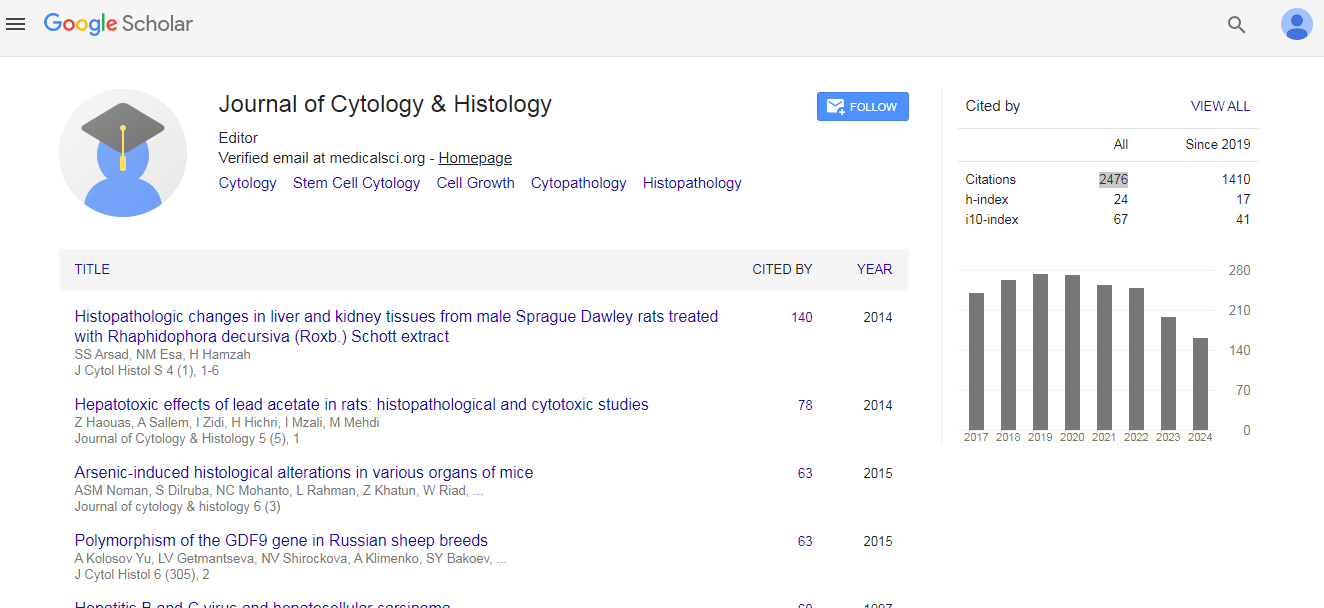
Journal of Cytology & Histology received 2476 citations as per Google Scholar report