Short Communication - (2025) Volume 10, Issue 2
Received: 01-Apr-2025, Manuscript No. jomp-26-185084;
Editor assigned: 03-Apr-2025, Pre QC No. P-185084;
Reviewed: 17-Apr-2025, QC No. Q-185084;
Revised: 22-Apr-2025, Manuscript No. R-185084;
Published:
29-Apr-2025
, DOI: 10.37421/2576-3857.2025.10.302
Citation: Johnson, Emily. ”ctDNA: A Non-Invasive Biomarker for Melanoma Management.” J Oncol Med and Pract 10 (2025):302.
*
Copyright: © 2025 Johnson E. This is an open-access article distributed under the terms of the Creative Commons Attribution License, which permits unrestricted use, distribution and reproduction in any medium, provided the original author and source are credited.
Longitudinal monitoring of circulating tumor DNA (ctDNA) in melanoma patients represents a significant advancement in non-invasive cancer management, offering a dynamic approach to track treatment response, detect minimal residual disease (MRD), and anticipate relapse. This methodology holds the potential to guide therapeutic decisions, facilitating earlier interventions and ultimately improving patient outcomes. A comprehensive understanding of ctDNA dynamics, encompassing its clearance, rebound, and the emergence of resistance mutations, is paramount for achieving personalized melanoma care. [1] The analysis of ctDNA in melanoma has demonstrably established its significant prognostic value, with detectable ctDNA often correlating with poorer survival rates. The presence of ctDNA at baseline and its subsequent clearance following treatment initiation serve as key indicators of therapeutic efficacy. This molecular information can effectively supplement traditional imaging techniques used for disease assessment. [2] Detecting resistance mutations, such as those found in BRAF or NRAS genes, through ctDNA analysis can profoundly inform treatment strategies for melanoma patients who are progressing on existing targeted therapies. The early identification of these specific mutations enables timely switching to alternative treatment regimens, thereby potentially overcoming acquired resistance mechanisms. [3] The sensitivity and specificity of ctDNA assays are critical determinants of their clinical utility in melanoma management. Substantial progress in next-generation sequencing (NGS) and digital PCR technologies has markedly enhanced the ability to detect low-abundance ctDNA, paving the way for broader adoption in clinical practice. [4] Minimal residual disease (MRD) detection using ctDNA after definitive therapy for melanoma demonstrates considerable promise in stratifying patients who are at a high risk of recurrence. The identification of MRD can inform decisions regarding adjuvant therapy and the implementation of closer surveillance protocols. [5] Integrating ctDNA monitoring with conventional imaging and clinical assessments provides a more comprehensive approach to melanoma patient management. Serial ctDNA measurements can offer earlier indications of treatment failure compared to traditional imaging modalities, thereby allowing for more prompt therapeutic adjustments. [6] Challenges inherent in ctDNA monitoring for melanoma include the need for standardization of pre-analytical and analytical methods, a deeper understanding of tumor clonal heterogeneity, and the definition of optimal sampling frequencies. Addressing these critical issues is essential to enhance the reliability and clinical utility of this technology. [7] The evolution of resistance mechanisms within melanoma can be effectively tracked longitudinally using ctDNA analysis. Identifying specific resistance mutations allows for the potential development of rational drug combinations or strategic switches in therapy, aimed at overcoming acquired resistance and prolonging patient survival. [8] The development of ultrasensitive ctDNA assays, including those employing single-molecule enrichment technologies, is significantly improving detection limits for early-stage melanoma and minimal residual disease. This enhancement offers the potential for earlier therapeutic intervention and more accurate prognostication. [9] Personalized medicine in melanoma is increasingly reliant on molecular profiling, and ctDNA serves as a dynamic window into a patient's tumor biology. Longitudinal ctDNA monitoring enables real-time assessment of treatment effectiveness and facilitates the timely adaptation of therapeutic strategies to individual patient needs. [10]
The longitudinal monitoring of circulating tumor DNA (ctDNA) in melanoma patients provides a non-invasive means to track treatment response, identify minimal residual disease (MRD), and predict relapse. This approach can inform treatment decisions, enabling earlier interventions and potentially enhancing patient outcomes. Understanding the dynamic changes in ctDNA, including its clearance, rebound, and the emergence of resistance mutations, is crucial for tailoring melanoma management strategies. [1] Analysis of ctDNA in melanoma has revealed significant prognostic value, with the detection of ctDNA often associated with poorer survival outcomes. The baseline presence of ctDNA and its clearance after initiating treatment are key indicators of treatment effectiveness, offering supplementary information to traditional imaging techniques for disease assessment. [2] Through ctDNA analysis, resistance mutations in genes such as BRAF or NRAS can be identified, guiding treatment decisions for melanoma patients experiencing progression on targeted therapies. Early detection of these mutations facilitates timely adjustments to treatment, potentially overcoming acquired resistance. [3] The clinical utility of ctDNA assays is heavily dependent on their sensitivity and specificity. Advances in technologies like next-generation sequencing (NGS) and digital PCR have improved the detection of low-abundance ctDNA, promoting its wider use in melanoma management. [4] Detecting minimal residual disease (MRD) using ctDNA following definitive melanoma therapy shows promise for identifying patients at high risk of recurrence. Identifying MRD can aid in decisions regarding adjuvant treatments and the need for more frequent surveillance. [5] Combining ctDNA monitoring with imaging and clinical evaluations offers a comprehensive strategy for managing melanoma patients. Serial ctDNA measurements can provide earlier signals of treatment failure than conventional imaging, allowing for quicker therapeutic modifications. [6] Several challenges affect ctDNA monitoring in melanoma, including the need for standardized pre-analytical and analytical methods, a better understanding of tumor heterogeneity, and defining optimal sampling frequencies. Overcoming these hurdles is key to improving the reliability and clinical application of this technology. [7] Longitudinal ctDNA tracking can reveal the evolution of resistance mechanisms in melanoma. Identifying specific resistance mutations allows for targeted interventions, such as novel drug combinations or treatment switches, to overcome resistance and extend patient survival. [8] Development of highly sensitive ctDNA assays, including those utilizing single-molecule enrichment techniques, is enhancing the ability to detect low levels of ctDNA in early-stage melanoma and MRD. This improvement supports earlier interventions and more precise prognostication. [9] Personalized melanoma treatment increasingly relies on molecular profiling, with ctDNA offering real-time insights into tumor biology. Longitudinal monitoring of ctDNA enables continuous assessment of treatment efficacy and the adaptive modification of therapeutic plans. [10]
Circulating tumor DNA (ctDNA) monitoring offers a non-invasive method for managing melanoma, enabling tracking of treatment response, detection of minimal residual disease (MRD), and prediction of relapse. Its presence is a significant prognostic indicator, and its clearance suggests treatment efficacy. ctDNA analysis can identify resistance mutations, guiding therapeutic adjustments and potentially overcoming acquired resistance. Advances in assay sensitivity, particularly with next-generation sequencing and digital PCR, are improving its clinical utility. Integrating ctDNA with other monitoring methods provides a comprehensive approach, allowing for earlier detection of treatment failure than imaging alone. While challenges like standardization and understanding tumor heterogeneity exist, ultrasensitive assays and longitudinal monitoring are enhancing its role in personalized melanoma therapy.
None
None
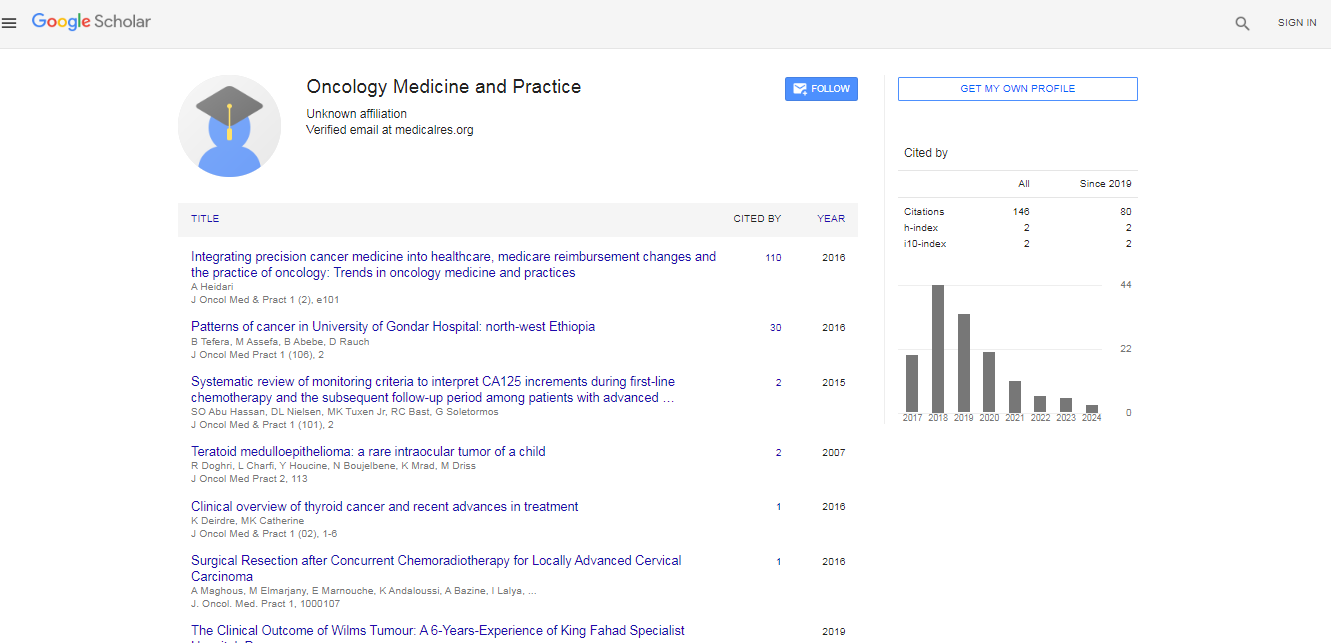
Journal of Oncology Medicine & Practice received 142 citations as per Google Scholar report