Brief Report - (2025) Volume 10, Issue 4
Received: 01-Jul-2025, Manuscript No. PE-26-179289;
Editor assigned: 03-Jul-2025, Pre QC No. P-179289;
Reviewed: 17-Jul-2025, QC No. Q-179289;
Revised: 22-Jul-2025, Manuscript No. R-179289;
Published:
29-Jul-2025
, DOI: 10.37421/2472-1042.2025.10.292
Citation: Silva, Renata. ”Cost-Effectiveness of Cardiovascular Pharmacotherapy: Optimizing Decisions.” Pharmacoeconomics 10 (2025):292.
Copyright: © 2025 Silva R. This is an open-access article distributed under the terms of the Creative Commons Attribution License, which permits unrestricted use, distribution and reproduction in any medium, provided the original author and source are credited.
Cost-effectiveness modeling in cardiovascular pharmacotherapy is an essential discipline for optimizing the allocation of healthcare resources and providing evidence-based guidance for clinical decision-making processes. These sophisticated models commonly employ frameworks such as decision trees or Markov models to meticulously compare the associated costs and projected outcomes of various therapeutic strategies over extended time horizons. Several critical factors are integral to these analyses, including the specific characteristics of the patient population under consideration, the demonstrated efficacy and safety profiles of different treatments, patient adherence rates to prescribed regimens, and the long-term incidence of cardiovascular events. Economic evaluations, exemplified by metrics like cost-effectiveness ratios (CERs) and incremental cost-effectiveness ratios (ICERs), are instrumental in identifying interventions that offer the most favorable value for money, thereby informing formulary decisions and contributing to the development of clinical guidelines [1].
The application of economic modeling principles to the evaluation of novel antithrombotic therapies, specifically direct oral anticoagulants (DOACs) used in the management of atrial fibrillation, effectively highlights their transformative potential to shift patient care from inpatient settings to more cost-effective outpatient environments, ultimately contributing to a reduction in overall healthcare expenditures. These models typically undertake a comparative analysis of DOACs against traditional anticoagulants such as warfarin, carefully considering key clinical events including bleeding occurrences, the prevention of stroke, and patient-related convenience factors. The economic advantages conferred by DOACs are frequently substantiated when the models account for diminished monitoring requirements and a lower incidence of intracranial hemorrhages, positioning these agents as having a more favorable cost-effectiveness profile across a broad spectrum of patient demographics [2].
The economic implications stemming from the utilization of lipid-lowering therapies, encompassing both established agents like statins and newer pharmacologic classes such as PCSK9 inhibitors, represent a particularly significant area for the application of cost-effectiveness modeling. These analytical frameworks are designed to meticulously assess the inherent trade-offs between the drug acquisition costs of these therapies and their demonstrable capacity to reduce the incidence of major cardiovascular events, including myocardial infarction and stroke. When PCSK9 inhibitors are incorporated into these models, their relatively high upfront acquisition cost is often found to be offset by a substantial reduction in the occurrence of major adverse cardiovascular events, thereby leading to a favorable long-term cost-effectiveness outcome, particularly within high-risk patient populations [3].
Modeling the cost-effectiveness of antiplatelet therapy is of paramount importance for ensuring optimal secondary prevention strategies in patients who have experienced cardiovascular events. These detailed analyses meticulously compare the economic and clinical implications of various drug combinations and treatment durations, while also factoring in the inherent risks of bleeding complications and the potential for recurrent ischemic events. The economic balance derived from such models frequently supports the use of dual antiplatelet therapy for specific, defined durations following an acute event, often followed by a de-escalation to single antiplatelet therapy. This strategy aims to mitigate bleeding complications and their associated costs while concurrently maintaining therapeutic efficacy [4].
Cost-effectiveness modeling for heart failure pharmacotherapy necessitates the evaluation of intricate and often complex treatment regimens. These models typically assess the impact of a wide range of therapeutic agents, including but not limited to ACE inhibitors, beta-blockers, angiotensin receptor-neprilysin inhibitors (ARNIs), and sodium-glucose cotransporter-2 (SGLT2) inhibitors. Key outcomes considered include reductions in hospitalization rates, modulation of disease progression, and improvements in overall mortality. Notably, SGLT2 inhibitors, which were initially developed for glycemic control in diabetes, have shown significant cardiovascular benefits, and economic models are increasingly confirming their cost-effectiveness in the comprehensive management of heart failure, primarily through substantial reductions in hospitalizations and improvements in patient survival [5].
The emergence of precision medicine within the realm of cardiovascular pharmacotherapy, particularly the application of pharmacogenomics to guide treatment selection, introduces novel challenges and presents unique opportunities for the refinement of cost-effectiveness modeling. These advanced models are increasingly required to integrate the costs associated with genetic testing alongside the anticipated benefits derived from tailored therapeutic approaches, with the ultimate goal of enhancing drug response and minimizing the occurrence of adverse events. Although the initial investment in genetic testing may be higher, personalized treatment strategies have the potential to yield improved clinical outcomes and, consequently, lower long-term healthcare costs by circumventing the use of ineffective or potentially harmful medications [6].
The ongoing assessment of the economic impact associated with various hypertension management strategies remains a critical area of research and modeling. This comprehensive evaluation encompasses a diverse array of interventions, including different drug classes, the judicious use of combination therapies, and the implementation of adherence-enhancing interventions. Cost-effectiveness analyses in this domain consistently demonstrate that achieving aggressive blood pressure control, even when employing more expensive therapeutic agents or multifaceted combination therapies, can lead to significant and sustained reductions in the incidence of cardiovascular events and the associated healthcare expenditures, thereby robustly justifying the initial therapeutic investment [7].
The cost-effectiveness of novel oral anticoagulants in specific clinical contexts, such as the management of valvular atrial fibrillation, is a subject of continuous investigation and detailed modeling. These research endeavors meticulously compare the economic and clinical profiles of agents like apixaban or rivaroxaban against established therapies like warfarin. The evaluations not only consider drug efficacy and safety parameters but also incorporate crucial factors such as patient quality of life and the reduced requirement for frequent anticoagulation monitoring, all of which contribute to a demonstrably favorable economic profile for these newer agents within this particular patient population [8].
Cost-effectiveness modeling serves a fundamentally vital role in the rigorous evaluation of interventions specifically designed to prevent the occurrence of primary cardiovascular events. This encompasses the critical assessment of strategies that combine lifestyle modifications with appropriate pharmacotherapy. Such models frequently illustrate that the early and sustained application of evidence-based pharmacotherapies, for instance, the use of statins in primary cardiovascular disease prevention, can significantly decrease the incidence of major cardiovascular events, thereby offering a substantial return on investment for healthcare systems [9].
The development and subsequent application of pharmacoeconomic models tailored for novel cardiovascular drugs necessitate the use of rigorously validated data inputs and the adherence to transparent and reproducible methodologies. These models are of paramount importance for both payers and policymakers in understanding the true value proposition of emerging treatments, especially within the prevailing constraints of healthcare budgets. Ensuring that these models accurately reflect real-world treatment pathways, patient adherence patterns, and the heterogeneity of patient subgroups is absolutely crucial for generating reliable and actionable insights that can effectively guide decision-making in cardiovascular pharmacotherapy [10].
Cost-effectiveness modeling in cardiovascular pharmacotherapy is a critical tool for optimizing resource allocation and guiding clinical decisions. These models, often employing decision trees or Markov models, compare the costs and outcomes of different treatments over time, considering patient characteristics, efficacy, safety, adherence, and long-term event rates. Metrics like CERs and ICERs help identify interventions offering the best value, influencing formulary decisions and guidelines [1].
The application of economic modeling to novel antithrombotic therapies, such as direct oral anticoagulants (DOACs) for atrial fibrillation, demonstrates their potential to shift care to outpatient settings, reducing overall costs. Models comparing DOACs to warfarin consider bleeding events, stroke prevention, and patient convenience, often showing DOACs to be more cost-effective due to reduced monitoring and fewer intracranial hemorrhages [2].
Economic modeling is extensively applied to lipid-lowering therapies, including statins and PCSK9 inhibitors. These models analyze the balance between drug acquisition costs and the reduction in cardiovascular events like myocardial infarction and stroke. For PCSK9 inhibitors, their high upfront cost is often offset by significant reductions in major adverse cardiovascular events, leading to favorable long-term cost-effectiveness in high-risk groups [3].
Modeling the cost-effectiveness of antiplatelet therapy is essential for secondary cardiovascular prevention. These analyses compare different drug combinations and durations, weighing the risks of bleeding against the benefits of preventing recurrent ischemic events. The economic evidence often favors dual antiplatelet therapy for specific durations post-event, followed by de-escalation to single therapy to manage bleeding risks while maintaining efficacy [4].
Cost-effectiveness modeling for heart failure pharmacotherapy involves evaluating complex regimens. Models assess therapies like ACE inhibitors, beta-blockers, ARNIs, and SGLT2 inhibitors, considering their impact on hospitalizations, disease progression, and mortality. SGLT2 inhibitors, with their proven cardiovascular benefits beyond diabetes, are increasingly shown to be cost-effective by reducing heart failure hospitalizations and improving survival [5].
The integration of precision medicine, such as pharmacogenomic testing in cardiovascular pharmacotherapy, presents new challenges for cost-effectiveness modeling. Models must incorporate genetic testing costs alongside the benefits of tailored therapy in improving drug response and reducing adverse events. While initial costs may be higher, personalized approaches can lead to better long-term outcomes and potentially lower overall costs by avoiding ineffective treatments [6].
Economic modeling is actively used to assess hypertension management strategies, including different drug classes, combination therapies, and adherence interventions. Cost-effectiveness analyses frequently indicate that aggressive blood pressure control, even with more expensive agents or combinations, leads to significant reductions in cardiovascular events and related healthcare costs, justifying the initial investment [7].
The cost-effectiveness of novel oral anticoagulants in specific cardiovascular conditions, like valvular atrial fibrillation, is an active area of research. Studies compare agents such as apixaban and rivaroxaban against warfarin, considering not only efficacy and safety but also patient quality of life and reduced monitoring needs, contributing to their favorable economic profile [8].
Cost-effectiveness modeling plays a crucial role in evaluating interventions for primary cardiovascular event prevention, including the combined effects of lifestyle modifications and pharmacotherapy. Models often demonstrate that early and consistent use of evidence-based pharmacotherapies, such as statins in primary prevention, significantly reduces the incidence of major cardiovascular events, yielding a good return on investment for healthcare systems [9].
Developing and applying pharmacoeconomic models for novel cardiovascular drugs require robust data and transparent methodologies. These models are vital for payers and policymakers to understand the value of new treatments amidst budget constraints. Accurately reflecting real-world pathways, patient adherence, and diverse patient subgroups is key to generating reliable and actionable insights for cardiovascular pharmacotherapy [10].
Cost-effectiveness modeling is crucial in cardiovascular pharmacotherapy for optimizing resource allocation and informing clinical decisions. These models analyze various treatments, considering costs, outcomes, patient factors, and long-term event rates. Metrics like CERs and ICERs help identify valuable interventions. Novel therapies, such as DOACs for atrial fibrillation and PCSK9 inhibitors for lipid management, are often found to be cost-effective, offering benefits like reduced hospitalizations and fewer adverse events, particularly in high-risk populations. Precision medicine approaches and aggressive hypertension control also demonstrate economic advantages. Evaluating antiplatelet therapies and heart failure pharmacotherapies, including SGLT2 inhibitors, highlights their cost-effectiveness in preventing events and improving outcomes. Robust data and transparent methodologies are essential for reliable pharmacoeconomic models to guide healthcare decision-making.
None
None
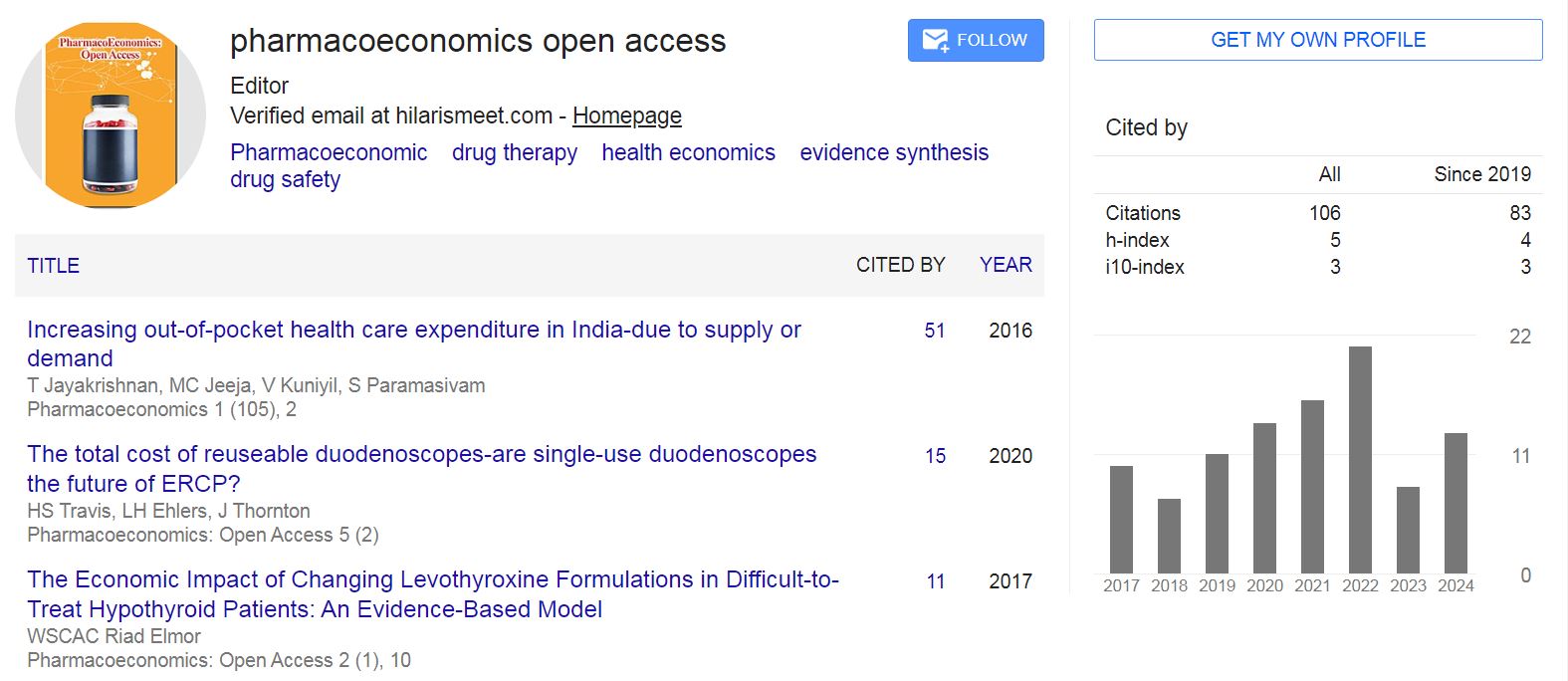
Pharmacoeconomics: Open Access received 106 citations as per Google Scholar report