Commentary - (2025) Volume 9, Issue 3
Received: 01-Sep-2025, Manuscript No. rrms-25-175070;
Editor assigned: 03-Sep-2025, Pre QC No. P-175070;
Reviewed: 17-Sep-2025, QC No. Q-175070;
Revised: 22-Sep-2025, Manuscript No. R-175070;
Published:
29-Sep-2025
, DOI: 10.37421/2952-8127.2025.9.232
Citation: Santos, Nuria. ”Comprehensive Health: SDOH, Digital, Community, Prevention.” Res Rep Med Sci 09 (2025):232.
Copyright: © 2025 Santos N. This is an open-access article distributed under the terms of the Creative Commons Attribution License, which permits unrestricted use, distribution and reproduction in any medium, provided the original author and source are credited.
The landscape of public health and individual well-being is shaped by a complex interplay of factors, from societal structures to technological advancements and personal choices. Understanding these diverse influences is critical for developing effective interventions and fostering healthier communities. For instance, the significant role social determinants of health play in shaping overall health outcomes is undeniable. Factors like socioeconomic status, education, environment, and access to healthcare services are critical in understanding and addressing health disparities across populations. Addressing these underlying social factors is essential for improving public health [1].
In recent years, the rapid evolution of technology has introduced new avenues for health improvement. Digital health interventions, including mobile apps and telehealth, show promise in enhancing health outcomes for individuals with chronic diseases. These technologies can improve medication adherence, self-management, and clinical markers, suggesting their potential to complement traditional care models and broaden access to health support [2].
However, while technology offers solutions, environmental threats pose substantial challenges. Climate change significantly impacts various health outcomes, ranging from respiratory and cardiovascular diseases to mental health issues and infectious disease spread. This reality underscores the urgency of addressing environmental factors to mitigate adverse health effects and calls for integrated public health strategies that consider both climate resilience and adaptation [3].
Individual participation and empowerment are also central to achieving better health. Patient engagement, characterized by active participation in decision-making and self-management, is strongly associated with improved health outcomes. Engaged patients often experience better adherence to treatment plans, increased satisfaction, and ultimately, better clinical results across various health conditions. Fostering patient engagement is, therefore, a vital component of effective healthcare [4].
The promise of advanced technologies continues to expand, with Artificial Intelligence (AI) holding considerable potential to transform chronic disease management and subsequently improve health outcomes. AI applications, such as predictive analytics for early diagnosis, personalized treatment plans, and remote monitoring, show ability to enhance efficiency and effectiveness in long-term care for various conditions [5].
On a community level, targeted support systems have proven invaluable. Community Health Worker (CHW) interventions are highly effective in advancing health equity and improving health outcomes, particularly among underserved populations. CHWs, by providing culturally sensitive support, education, and navigation services, actively reduce health disparities and enhance access to care, leading to better health for vulnerable groups [6].
Looking at fundamental human needs, nutrition plays a foundational role in determining a wide spectrum of health outcomes. Balanced diets and targeted nutritional interventions can prevent and manage chronic diseases, support immune function, and promote overall well-being. This highlights the profound impact of dietary choices on public health and disease progression [7].
Mental well-being is another crucial dimension of overall health. Effective mental health promotion and prevention strategies are crucial for improving overall health outcomes. Various interventions, such as school-based programs and workplace initiatives, reduce the incidence and impact of mental health conditions. Investing in early prevention and promotion can lead to significant long-term health benefits across the lifespan [8].
Furthermore, an individual's capacity to engage with health information is a powerful determinant. Health literacy significantly influences an individual's ability to make informed health decisions and navigate the healthcare system, directly affecting health outcomes. Higher health literacy is associated with better self-management of chronic diseases, improved preventive care practices, and reduced healthcare utilization. Enhancing health literacy is thus a key strategy for public health [9].
Finally, the importance of proactive health measures cannot be overstated. Preventive care is a cornerstone of public health, demonstrating a substantial positive impact on global health outcomes. Proactive measures like vaccinations, screenings, and lifestyle counseling contribute to reducing disease burden, extending life expectancy, and improving quality of life. Emphasizing preventive strategies is critical for sustainable healthcare systems [10].
This comprehensive perspective illustrates that advancing health outcomes requires an integrated understanding and application of social, technological, environmental, individual, and preventive strategies.
The pursuit of improved health outcomes is a complex endeavor, deeply intertwined with social, environmental, and personal factors. One fundamental aspect involves recognizing the pervasive influence of social determinants of health. These factors, encompassing socioeconomic status, educational attainment, environmental conditions, and access to essential healthcare services, are not merely peripheral but are central to understanding and addressing the profound health disparities that exist across populations. Effectively tackling these underlying social elements is a prerequisite for achieving widespread public health improvements [1]. Moreover, the environment itself plays a critical role, as climate change increasingly manifests its impact on human health. This includes a spectrum of issues, from respiratory and cardiovascular diseases to mental health challenges and the accelerated spread of infectious diseases. What this really means is that addressing environmental factors isn't just an ecological concern; it's an urgent public health imperative that demands integrated strategies focusing on both climate resilience and adaptation [3].
Innovation through technology presents compelling opportunities for enhancing health. Digital health interventions, encompassing mobile applications and telehealth platforms, show significant promise in elevating health outcomes for individuals grappling with chronic diseases. Research indicates that these technologies effectively boost medication adherence, foster better self-management practices, and improve crucial clinical markers. Ultimately, they represent a powerful complement to traditional care models, offering the potential to dramatically broaden access to vital health support for many [2]. In a similar vein, Artificial Intelligence (AI) stands out with its considerable potential to revolutionize chronic disease management. From leveraging predictive analytics for early diagnosis to crafting personalized treatment plans and facilitating remote monitoring, AI applications demonstrate a clear capacity to enhance both the efficiency and effectiveness of long-term care for a diverse range of conditions [5].
Beyond technology and broad societal influences, the individual's role and empowerment within the healthcare system are crucial. Patient engagement, defined by an individual's active participation in their healthcare decisions and a commitment to self-management, is consistently linked to superior health outcomes. When patients are engaged, they exhibit better adherence to their prescribed treatment plans, report higher satisfaction with their care, and ultimately achieve better clinical results across various health conditions. Fostering this kind of patient engagement is not merely beneficial; it is an absolutely vital component of truly effective healthcare delivery [4]. Complementing individual efforts, community-based interventions often bridge gaps in care. Community Health Worker (CHW) interventions are remarkably effective in advancing health equity and improving health outcomes, particularly among populations that have historically been underserved. By offering culturally sensitive support, crucial health education, and navigation services, CHWs actively work to reduce health disparities, making healthcare more accessible and leading to better health for vulnerable groups [6].
What this really comes down to is a holistic view of well-being. Nutrition, for example, is foundational, influencing a vast array of health outcomes. Comprehensive reviews highlight how balanced diets and targeted nutritional interventions are powerful tools for preventing and managing chronic diseases, supporting robust immune function, and promoting overall well-being. This underscores the profound and undeniable impact of dietary choices on both public health and the progression of disease [7]. Similarly, the promotion of mental health and the implementation of effective prevention strategies are paramount for improving overall health. Systematic reviews identify various interventions, from school-based initiatives to workplace programs, that demonstrably reduce the incidence and impact of mental health conditions. Investing in early prevention and promotion, therefore, offers significant long-term health benefits across the entire lifespan [8].
Finally, an individual's understanding of health information, or health literacy, directly impacts their ability to make informed health decisions and navigate the complex healthcare system. Higher health literacy correlates with improved self-management of chronic diseases, better preventive care practices, and reduced unnecessary healthcare utilization. Enhancing health literacy emerges as a key strategic pillar for public health efforts [9]. Ultimately, the global perspective underscores the critical importance of preventive careâ??proactive measures such as vaccinations, screenings, and lifestyle counselingâ??in reducing disease burden, extending life expectancy, and enhancing overall quality of life. Emphasizing these strategies is not just good practice; it's essential for building sustainable healthcare systems for the future [10].
Improving health outcomes relies on a multifaceted approach, addressing both upstream and direct health interventions. Social determinants of health, including socioeconomic status, education, and environmental factors, significantly shape population health and disparities, making their consideration essential for public health initiatives. Alongside this, the integration of digital health interventions, such as mobile apps and telehealth, shows considerable promise in enhancing care for individuals with chronic diseases, notably improving adherence and self-management. Environmental factors, particularly climate change, present a critical challenge, impacting health from respiratory illnesses to mental health and infectious diseases, necessitating urgent, integrated public health strategies. Beyond these broad influences, individual and community-level engagements prove vital. Patient engagement, characterized by active participation in care decisions, consistently leads to better treatment adherence and clinical results. Similarly, Community Health Worker interventions effectively advance health equity by offering culturally sensitive support to underserved groups. Technology, through Artificial Intelligence (AI), is emerging as a powerful tool in chronic disease management, enabling predictive analytics and personalized treatment. Furthermore, foundational aspects like nutrition are key to preventing chronic diseases and supporting immune function, while robust mental health promotion and prevention strategies significantly reduce the burden of mental health conditions. Crucially, health literacy empowers individuals to make informed decisions, improving self-management and preventive care. Ultimately, a strong emphasis on preventive careâ??through vaccinations, screenings, and lifestyle counselingâ??remains a cornerstone for reducing disease burden and enhancing global quality of life.
None
None
Peter A, Richmond O, Stephen A. "The Impact of Social Determinants of Health on Health Outcomes: A Scoping Review".J Prev Med Public Health 56 (2023):255-266.
Indexed at, Google Scholar, Crossref
Xiaofei Z, Shan T, Yu Y. "Digital Health Interventions for Improving Health Outcomes in Patients with Chronic Diseases: A Systematic Review and Meta-Analysis".J Med Internet Res 24 (2022):e36611.
Indexed at, Google Scholar, Crossref
Idowu A, Obinna A, Anuoluwapo O. "Impact of Climate Change on Health and Health Outcomes: A Scoping Review of the Literature".J Environ Public Health 2023 (2023):7651044.
Indexed at, Google Scholar, Crossref
Rosa L, Sara A, Maria C. "Patient engagement and its impact on health outcomes: A systematic review and meta-analysis".PLoS One 16 (2021):e0261327.
Indexed at, Google Scholar, Crossref
Jumana MA, Rania MA, Malek A. "Impact of artificial intelligence on chronic disease management and health outcomes: A scoping review".J Med Internet Res 25 (2023):e46599.
Indexed at, Google Scholar, Crossref
Meera V, Maya G, Victoria W. "Advancing health equity and improving health outcomes: a systematic review of community health worker interventions".J Gen Intern Med 37 (2022):164-177.
Indexed at, Google Scholar, Crossref
Jia C, Xiaoyan L, Yan W. "The role of nutrition in improving health outcomes: A comprehensive review".Nutrients 15 (2023):2621.
Indexed at, Google Scholar, Crossref
Eirini K, Ricardo A, Eirini P. "Mental health promotion and prevention: a systematic review of interventions and their impact on health outcomes".Transl Psychiatry 11 (2021):172.
Indexed at, Google Scholar, Crossref
Kristine S, Stephan VdB, Jessica F. "Health literacy and health outcomes: a systematic review".BMC Public Health 20 (2020):285.
Indexed at, Google Scholar, Crossref
Amit S, Ritu S, Kirti G. "The Impact of Preventive Care on Health Outcomes: A Global Perspective".Prev Med Rep 36 (2023):102462.
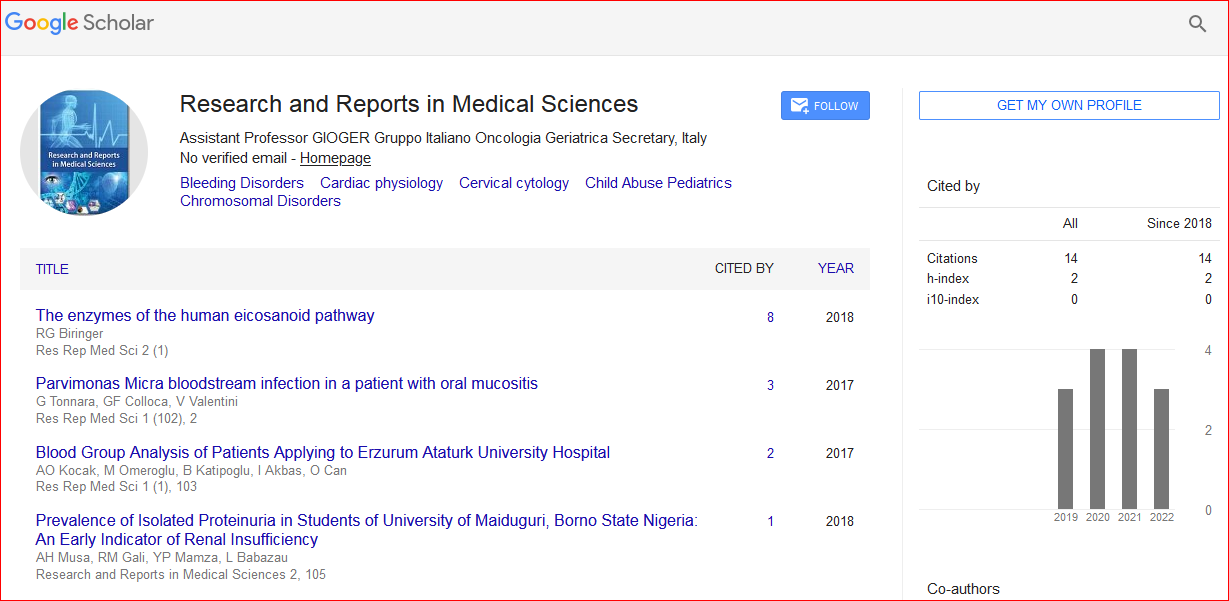
Research and Reports in Medical Sciences received 13 citations as per Google Scholar report