Opinion - (2025) Volume 15, Issue 3
Received: 01-May-2025, Manuscript No. jcde-25-175360;
Editor assigned: 05-May-2025, Pre QC No. P-175360;
Reviewed: 19-May-2025, QC No. Q-175360;
Revised: 22-May-2025, Manuscript No. R-175360;
Published:
29-May-2025
, DOI: 10.37421/2165-784X.2025.15.605
Citation: Al-Farsi, Fatima. ”Coastal Resilience: Adaptation,
Nature-Based Solutions, Modeling.” J Civil Environ Eng 15 (2025):605.
Copyright: © 2025 Al-Farsi F. This is an open-access article distributed under the terms of the Creative Commons Attribution License, which permits unrestricted use,
distribution and reproduction in any medium, provided the original author and source are credited.
This study provides a global perspective on the drivers of coastal change, quantitatively assessing how sea level rise and human activities contribute to erosion and accretion patterns worldwide. It uses remote sensing data and modeling to identify hotspots and project future trends, offering crucial insights for regional and global coastal management strategies[1].
This global synthesis examines how mangrove forests respond to sea-level rise and their effectiveness in providing coastal protection. It highlights the ecological mechanisms mangroves employ to adapt and the factors influencing their capacity to buffer coastlines against climate change impacts, emphasizing their vital role in natural coastal defense[2].
This systematic review synthesizes various strategies employed for coastal adaptation to climate change, categorizing them by their nature and effectiveness. It also identifies significant barriers to implementation, including governance, funding, and socio-economic challenges, proposing ways to overcome them for successful adaptation planning[3].
This review examines the complex interactions between extreme weather events (like storms and hurricanes) and coastal environments, focusing on their impact on sediment transport and morphological changes. It synthesizes current understanding and highlights knowledge gaps in predicting coastal responses to these high-impact events, emphasizing the need for improved models[4].
This paper discusses the critical role of coastal blue carbon ecosystems, such as mangroves, saltmarshes, and seagrasses, in both mitigating climate change by sequestering carbon and adapting to its impacts by providing coastal protection. It outlines strategies for their restoration and conservation to maximize these invaluable benefits[5].
This review evaluates various modeling approaches used to predict long-term coastal sediment budgets in the context of rising sea levels. It critically assesses their strengths, limitations, and predictive capabilities, offering insights into improving future coastal management strategies and understanding sediment dynamics[6].
This study quantifies the projected increase in global coastal flood risk due to the combined effects of sea-level rise and extreme storm events. It provides critical insights for policymakers and planners on the urgency of implementing adaptive measures to protect coastal communities and infrastructure from future hazards[7].
This systematic review evaluates the effectiveness and applicability of various nature-based solutions (NBS) for mitigating coastal erosion. It analyzes different NBS types, their ecological and engineering performance, and identifies factors crucial for successful implementation in diverse coastal environments, promoting sustainable defense strategies[8].
This systematic review synthesizes global evidence on community-based strategies for enhancing coastal resilience against climate change impacts. It explores participatory approaches, local knowledge integration, and the socio-economic factors that influence the success of such initiatives, underscoring the importance of local engagement[9].
This study investigates the complex interplay between climate change and human activities in shaping coastal geomorphology globally. It analyzes various coastal systems' responses to sea-level rise, altered sediment supply, and land-use changes, offering insights into sustainable coastal zone management strategies[10].
Coastal environments worldwide face significant transformations driven by a complex interplay of natural processes, climate change, and human activities. Research provides a global perspective on the drivers of coastal change, quantitatively assessing how sea level rise and human activities contribute to distinct erosion and accretion patterns across the globe. This work utilizes remote sensing data and advanced modeling to identify critical hotspots and project future trends, offering crucial insights for regional and global coastal management strategies that aim to maintain the integrity of these dynamic systems [1]. Furthermore, a broader examination investigates the intricate relationships between climate change and human actions in shaping coastal geomorphology. This analysis spans various coastal systems, detailing their responses to sea-level rise, alterations in sediment supply, and shifts in land-use, ultimately informing more sustainable approaches to coastal zone management [10].
Extreme weather events, such as storms and hurricanes, exert profound and often devastating impacts on coastal environments, significantly influencing sediment transport dynamics and leading to substantial morphological changes. A comprehensive review synthesizes current understanding of these complex interactions, highlighting critical knowledge gaps in our ability to accurately predict coastal responses to such high-impact events. It strongly emphasizes the urgent need for improved predictive models to better anticipate and mitigate future damage [4]. Compounding this, studies quantify the projected increase in global coastal flood risk, a direct consequence of the combined effects of accelerating sea-level rise and the increasing frequency or intensity of extreme storm events. This provides critical, data-driven insights for policymakers and urban planners, underscoring the pressing urgency of implementing robust adaptive measures to safeguard vulnerable coastal communities and essential infrastructure from future hazards [7].
Natural ecosystems offer indispensable solutions for coastal protection and climate change mitigation, often referred to as Nature-Based Solutions (NBS). Global syntheses specifically examine how mangrove forests respond structurally and functionally to sea-level rise, assessing their effectiveness in providing vital coastal protection. These studies highlight the intricate ecological mechanisms mangroves employ to adapt to changing conditions and identify the factors that influence their capacity to buffer coastlines against various climate change impacts, thereby emphasizing their crucial role in natural coastal defense systems [2]. Beyond mangroves, coastal blue carbon ecosystemsâ??encompassing saltmarshes and seagrassesâ??are recognized for their dual critical role: mitigating climate change by sequestering significant amounts of carbon, and adapting to its impacts by offering essential coastal protection. Research outlines actionable strategies for their restoration and conservation to maximize these invaluable ecological benefits [5]. In a broader context, a systematic review comprehensively evaluates the effectiveness and practical applicability of diverse Nature-Based Solutions (NBS) specifically for mitigating coastal erosion. This analysis dissects different NBS types, assesses their ecological and engineering performance, and identifies factors crucial for their successful implementation across diverse coastal environments, thereby promoting more sustainable defense strategies [8].
Effective coastal adaptation to the challenges of climate change necessitates a multifaceted approach, blending strategic planning with community engagement and advanced predictive tools. A systematic review meticulously synthesizes various strategies employed for coastal adaptation, categorizing them by their nature and observed effectiveness. It also identifies significant barriers to their widespread implementation, which include complex governance structures, insufficient funding, and prevailing socio-economic challenges, while proposing practical ways to overcome these obstacles for more successful adaptation planning [3]. Complementing top-down strategies, community-based approaches are vital for enhancing coastal resilience against climate change impacts. These initiatives explore participatory methods, integrate valuable local knowledge, and consider the socio-economic factors that profoundly influence their success, thereby underscoring the critical importance of local engagement and empowerment [9]. To inform these strategies, robust modeling approaches are indispensable for predicting long-term coastal sediment budgets in the context of continually rising sea levels. Relevant reviews critically assess the strengths, inherent limitations, and predictive capabilities of these models, offering valuable insights into how to improve future coastal management strategies and deepen our understanding of dynamic sediment movement [6].
Coastal regions globally face escalating challenges from climate change and human activities, leading to significant erosion, accretion, and increased flood risks. Studies highlight the combined impact of sea-level rise, extreme weather events like storms, and anthropogenic pressures on coastal geomorphology and sediment dynamics [1, 4, 7, 10]. There's a critical focus on adaptation strategies, ranging from broad policy frameworks to localized community-based initiatives. These strategies address barriers such as governance and funding, advocating for participatory approaches and integrating local knowledge for enhanced resilience [3, 9]. A key theme involves leveraging natural defenses. Mangrove forests and other blue carbon ecosystems (saltmarshes, seagrasses) are recognized for their dual role in mitigating climate change through carbon sequestration and providing crucial coastal protection against rising seas and storms [2, 5]. Nature-Based Solutions (NBS) are systematically reviewed for their effectiveness in mitigating erosion, offering sustainable defense strategies [8]. The advancement of predictive modeling is also essential for understanding long-term coastal sediment budgets under sea-level rise, providing tools for informed management decisions [6]. Overall, the research emphasizes the urgent need for integrated, multi-faceted approaches combining ecological protection, adaptive planning, and robust scientific modeling to safeguard vulnerable coastal environments and communities.
1. Dehong D, Shugui H, Ying Z. "Global analysis of coastal erosion and accretion driven by sea level rise and anthropogenic activities".Glob Planet Change 227 (2023):104230.
Indexed at, Google Scholar, Crossref
2. Keryn R, Catherine EL, Neil S. "Mangrove forest structural and functional responses to sea-level rise and coastal protection: A global synthesis".Sci Total Environ 808 (2022):152771.
Indexed at, Google Scholar, Crossref
3. Md AH, Kazi PA, Apu S. "Coastal adaptation to climate change: A systematic review of strategies and barriers".Ocean Coast Manag 237 (2023):106720.
Indexed at, Google Scholar, Crossref
4. Zhao Y, Jinliang W, Lin Z. "Dynamic changes in coastal sediment transport and morphology under extreme events: A review".Estuar Coast Shelf Sci 296 (2024):108781.
Indexed at, Google Scholar, Crossref
5. Peter IM, Timothy KO, Emma LJ. "Enhancing coastal blue carbon ecosystems for climate change mitigation and adaptation".Sci Total Environ 897 (2023):165431.
Indexed at, Google Scholar, Crossref
6. Roshanka R, Marcel JS, Zheng BW. "Modelling long-term coastal sediment budgets under sea-level rise: A review".Earth-Sci Rev 212 (2021):103762.
Indexed at, Google Scholar, Crossref
7. Jeroen CJHA, W. JWB, Hamed RM. "Future increases in coastal flood risk from sea-level rise and storms".Nat Clim Change 10 (2020):897â??900.
Indexed at, Google Scholar, Crossref
8. Roberto G, Salvatore MV, LluÃs M. "Nature-based solutions for coastal erosion mitigation: A systematic review".J Environ Manage 344 (2023):118678.
Indexed at, Google Scholar, Crossref
9. Amrita S, Anushree R, Prosenjit KG. "Community-based coastal resilience strategies in the face of climate change: A systematic review".Sci Total Environ 806 (2022):151740.
Indexed at, Google Scholar, Crossref
10. Jing L, Sheng Y, Jinhua Y. "Coastal geomorphological responses to climate change and human activities: A global perspective".J Environ Manage 346 (2023):119747.
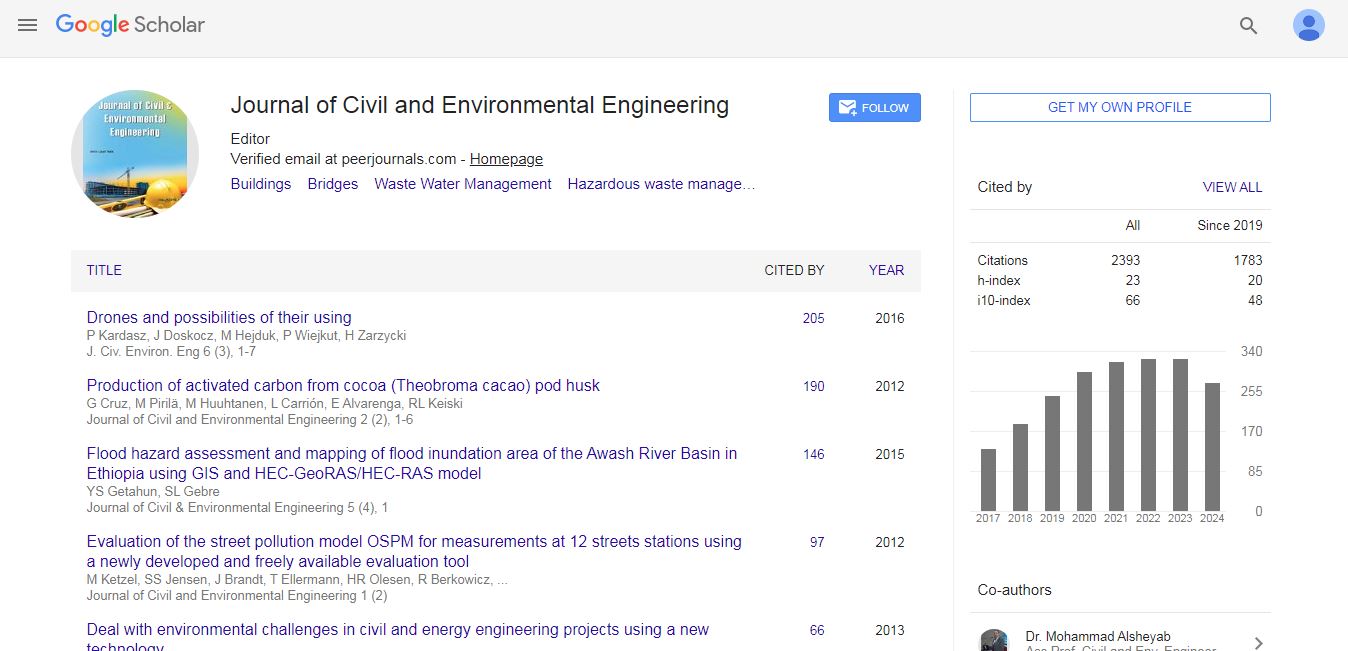
Journal of Civil and Environmental Engineering received 1798 citations as per Google Scholar report