Short Communication - (2025) Volume 17, Issue 3
Received: 14-Jul-2024, Manuscript No. JCST-24-141630;
Editor assigned: 17-Jul-2024, Pre QC No. JCST-24-141630 (PQ);
Reviewed: 31-Jul-2024, QC No. JCST-24-141630;
Revised: 17-Jun-2025, Manuscript No. JCST-24-141630 (R);
Published:
24-Jun-2025
, DOI: 10.37421/1948-5956.2025.17.700
Citation: Nasrallah, Amanda. "Genetic Basis of Male Breast Cancer." J Cancer Sci Ther 17 (2025): 700.
Copyright: © 2025 Nasrallah A. This is an open-access article distributed under the terms of the creative commons attribution license which permits unrestricted use, distribution and reproduction in any medium, provided the original author and source are credited.
Male Breast Cancer (MaleBC) is a rare disease, accounting for <1% of all male tumors. Along with the rise in Female Breast Cancer (FBC) over the past several years, there has also been an increase in the incidence of this disease. Though its pathophysiology has been linked to hormonal, environmental and genetic variables, little is understood regarding the etiology of Male BC. Radiation exposure, hormone imbalance-causing clinical diseases and most importantly, a positive family history for BC which indicates a genetic susceptibility are major risk factors. High-penetrance gene mutations (BRCA1 and BRCA2) are rare and have a high risk of developing BC; low-penetrance gene mutations (CHEK-2) are more prevalent but carry a reduced risk.
Subsequently, investigation of further studies may answer the question of “how does genetic factors correlate with male breast cancer?”.
Hence, in our comprehensive literature review focused on the genetic underpinnings of Male Breast Cancer (MBC), exclusively considering studies on humans published in English. We assessed selected studies for their methodological integrity, sample size, statistical robustness, and relevance, revealing the pivotal role of genetics in MBC predisposition.
Specifically, BRCA2 mutations were identified as significant risk factors, while multi-gene panel testing has exposed other genes potentially increasing MBC risk. MBC research has classified two main subgroups, luminal M1 and luminal M2, through transcriptional and copy number profiling. Luminal M1 features chromosomal abnormalities and gene overexpression related to cellular processes and angiogenesis, whereas luminal M2 is characterized by upregulated genes in immune response and estrogen receptor signaling. Additionally, unique somatic mutations in genes like MAP2K4, ZNF217 and novel genes THY1 and SPAG5 linked to cancer growth and metastasis have been noted [1,2]. As a matter of fact, MBC is molecularly distinct from Female Breast Cancer (FBC), lacking common genetic and epigenetic traits, indicating a unique pathogenesis. Inherited BRCA1 and BRCA2 mutations account for a significant portion of MBC cases, suggesting a substantial genetic predisposition. Moreover, mutations in PALB2 and CHEK2, among others, also contribute to MBC risk, highlighting a complex genetic landscape [3]. Distinctions in genetic mutations within luminal subtypes and a gender-based variance in mutation hotspots further emphasize the intricate interaction between gender and genetic risk factors. Genome-Wide Association Studies (GWAS) have identified specific Single Nucleotide Polymorphisms (SNPs) increasing MBC susceptibility, underlining the genetic framework distinguishing MBC from FBC. This overview underscores the importance of genetic factors in understanding and managing MBC, pointing towards a nuanced and comprehensive approach to its study and treatment [4].
In conclusion, as we can follow up on the selected literature discovering the genetic basis of male breast cancer, we can observe that the genetic component of the incidence of tumors arising in male breast is not as significant and clear as it is to their gender counterpart.
However, the rate of mutation in the studied genes mentioned, such as, MAP2K4, ZNF217 and the most famous BRCA1 and especially BRCA2, are directly related to more incidence of male breast cancer suggesting that there is a solid relationship between the two. these somehow bombarding results strongly urges the need for further research and studies to better understand and navigate through the genetic basis of male breast cancer.
[Google Scholar] [Crossref] [PubMed]
[Google Scholar] [Crossref] [PubMed]
[Google Scholar] [CrossRef] [PubMed]
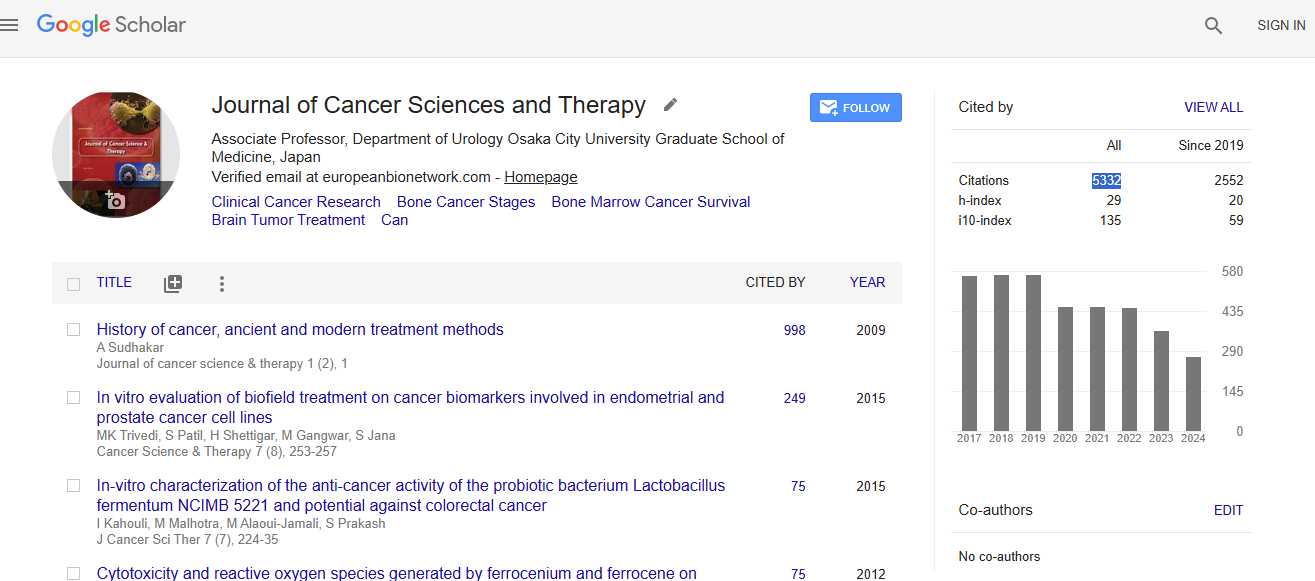
Cancer Science & Therapy received 5332 citations as per Google Scholar report