Perspective - (2025) Volume 12, Issue 3
Received: 02-Jun-2025, Manuscript No. fmoa-26-187915;
Editor assigned: 04-Jun-2025, Pre QC No. P-187915;
Reviewed: 18-Jun-2025, QC No. Q-187915;
Revised: 23-Jun-2025, Manuscript No. R-187915;
Published:
30-Jun-2025
, DOI: 10.37421/2476-2296.2025.12.337
Citation: Pereira, Joao. ”CFD Analysis of Stirred Tank Mixing Processes.” Fluid Mech Open Acc 12 (2025):337.
Copyright: © 2025 Pereira J. This is an open-access article distributed under the terms of the Creative Commons Attribution License, which permits unrestricted use, distribution and reproduction in any medium, provided the original author and source are credited.
The numerical analysis of fluid mixing in stirred tanks is a cornerstone of numerous industrial processes, essential for ensuring product quality, reaction efficiency, and process safety. Computational Fluid Dynamics (CFD) has emerged as a powerful tool for understanding and predicting the intricate flow patterns and concentration distributions within these systems. This advanced simulation technique allows for detailed investigations into various aspects of mixing, from impeller design to fluid properties, offering significant advantages over traditional experimental methods in terms of cost and time [1].
The hydrodynamic behavior within stirred tanks is heavily influenced by geometric configurations, particularly the presence and design of baffles. These elements play a crucial role in disrupting bulk liquid rotation, promoting turbulence, and enhancing axial and radial mixing. Understanding the impact of different baffle designs is vital for optimizing mixing efficiency and minimizing energy consumption in industrial reactors [2].
Beyond steady-state analysis, the transient behavior of mixing is also a critical area of study. This involves examining how concentration profiles evolve over time after the introduction of a tracer or reactant. Numerical simulations can accurately capture the dynamics of mixing time, which is paramount for processes requiring rapid and homogeneous blending, providing insights into the key factors governing this transient phenomenon [3].
A significant challenge in scaling up mixing processes from laboratory to industrial scale is maintaining consistent performance. CFD studies have demonstrated that simple geometric scaling is often insufficient. A thorough understanding of flow dynamics and turbulence is required to appropriately adjust operational parameters and impeller configurations for effective scale-up, ensuring desired mixing outcomes at larger volumes [4].
The mixing of non-Newtonian fluids presents unique challenges due to their complex rheological behaviors, such as shear-thinning or shear-thickening properties. Numerical simulations are instrumental in accounting for these complexities, allowing for the prediction of flow fields and homogenization rates for fluids that do not follow simple Newtonian laws. This is particularly important in industries like food processing and pharmaceuticals [5].
Furthermore, the interaction between the impeller, the fluid, and the vessel walls can significantly influence mixing performance. Advanced numerical models that incorporate the flexibility of vessel walls and the resulting deformations provide a more comprehensive understanding of these complex interactions. This consideration can lead to more accurate predictions of mixing efficiency and power requirements [6].
For processes involving immiscible liquids, such as liquid-liquid extraction or emulsification, understanding droplet breakage and coalescence is critical. Multi-phase CFD models are employed to simulate these phenomena, providing insights into the evolution of droplet size distribution and the overall effectiveness of mixing, with validation against experimental data enhancing confidence in their predictive capabilities [7].
The precise positioning of impellers within a stirred tank is another key factor affecting mixing efficiency. CFD investigations into the vertical and radial placement of impellers have identified optimal configurations that minimize dead zones and reduce energy consumption. This optimization is crucial for achieving uniform mixing and preventing localized concentration gradients in industrial applications [8].
Mixing solids in stirred tanks introduces further complexities related to particle suspension, segregation, and sedimentation. Multi-phase CFD simulations are used to model the behavior of solid particles within the fluid phase. These studies help identify operating conditions and impeller designs that ensure uniform suspension and prevent settling, which is vital for many chemical and pharmaceutical processes [9].
Finally, the rheological properties of fluids, including viscosity and yield stress, profoundly impact mixing dynamics and power consumption. CFD simulations incorporating these properties, such as those for Bingham plastics, reveal how they affect flow patterns and turbulence. This information is essential for the effective design of mixing systems for a wide range of complex fluids [10].
Computational Fluid Dynamics (CFD) has become an indispensable tool for analyzing and optimizing fluid mixing in stirred tanks, a fundamental unit operation across many industries. The numerical analysis of mixing performance, considering various impeller types and operating conditions, provides critical insights into enhancing efficiency and reducing energy consumption. This approach allows for the prediction of dead zones and the effectiveness of different mixing strategies, thereby aiding in process optimization [1].
The design of baffles within stirred tanks plays a pivotal role in governing the hydrodynamics and mixing characteristics. Numerical simulations exploring the influence of different baffle configurations reveal their significant impact on the flow field, turbulence intensity, and power consumption. Understanding these effects is key to breaking vortex formation and achieving superior axial and radial mixing, offering practical guidance for engineers [2].
Investigating the transient behavior of mixing in stirred tanks is crucial for processes that demand rapid and uniform blending. Numerical analyses focusing on the time evolution of concentration profiles after tracer introduction highlight the critical factors like impeller speed and fluid properties that influence mixing time. The validation of CFD results against experimental data underscores its predictive power for transient mixing phenomena [3].
Scaling up mixing processes from laboratory to industrial scales presents considerable challenges. CFD-based studies on scale-up reveal that maintaining consistent mixing efficiency requires more than simple geometric scaling. A detailed understanding of flow dynamics is paramount for adjusting geometric and operational parameters to ensure comparable mixing performance across different tank sizes [4].
Mixing non-Newtonian fluids in stirred tanks necessitates specialized numerical approaches due to their complex rheological properties. CFD models are employed to accurately predict flow fields and concentration homogenization for shear-thinning and shear-thickening fluids. This research provides essential strategies for effectively mixing these materials, vital for sectors like food processing and pharmaceuticals [5].
The intricate interactions between the impeller, fluid, and the flexible vessel walls can significantly alter mixing performance. Numerical analyses incorporating these impeller-fluid-vessel interactions reveal their non-negligible effect on mixing efficiency and power draw. This comprehensive approach contributes to a deeper understanding for designing high-performance mixing systems [6].
For systems involving immiscible liquids, the simulation of droplet breakage and coalescence is critical for forming stable emulsions. Multi-phase CFD models have been utilized to investigate these phenomena in stirred tanks, with validation against experimental data confirming their ability to predict droplet size distribution evolution and overall mixing effectiveness, particularly relevant for liquid-liquid extraction and emulsification processes [7].
The optimization of impeller positioning within stirred tanks is a direct pathway to enhanced mixing efficiency. CFD investigations analyze the impact of vertical and radial impeller placement on flow patterns, turbulence, and mixing time. Identifying optimal positions helps minimize dead zones and energy consumption, offering practical recommendations for industrial tank designs [8].
Mixing solids in stirred tanks poses unique challenges related to particle suspension and segregation. Multi-phase CFD approaches are applied to model solid particle behavior, identifying operating conditions and impeller designs that promote uniform suspension and prevent sedimentation. This is crucial for the successful execution of many chemical and pharmaceutical processes [9].
The influence of fluid rheology, encompassing viscosity and yield stress, on mixing dynamics and power consumption is a subject of significant numerical study. CFD simulations explore how varying rheological properties, including those of Bingham plastics, impact flow patterns, turbulence, and mixing efficiency, providing essential data for process design involving complex fluids [10].
This collection of research utilizes Computational Fluid Dynamics (CFD) to analyze various aspects of mixing in stirred tanks. Studies cover optimizing impeller designs and operating conditions for enhanced efficiency [1], the influence of baffle configurations on hydrodynamics [2], and transient mixing behavior [3].
Scale-up challenges are addressed, emphasizing the need for detailed flow dynamics understanding [4].
The complexities of mixing non-Newtonian fluids [5], impeller-fluid-vessel interactions [6], and immiscible liquid mixing with droplet dynamics are explored [7].
Additionally, research focuses on optimizing impeller positioning [8], suspending solids effectively [9], and understanding the impact of fluid rheology on mixing performance [10].
Overall, CFD is presented as a vital tool for predicting and optimizing mixing processes across diverse industrial applications.
None
None
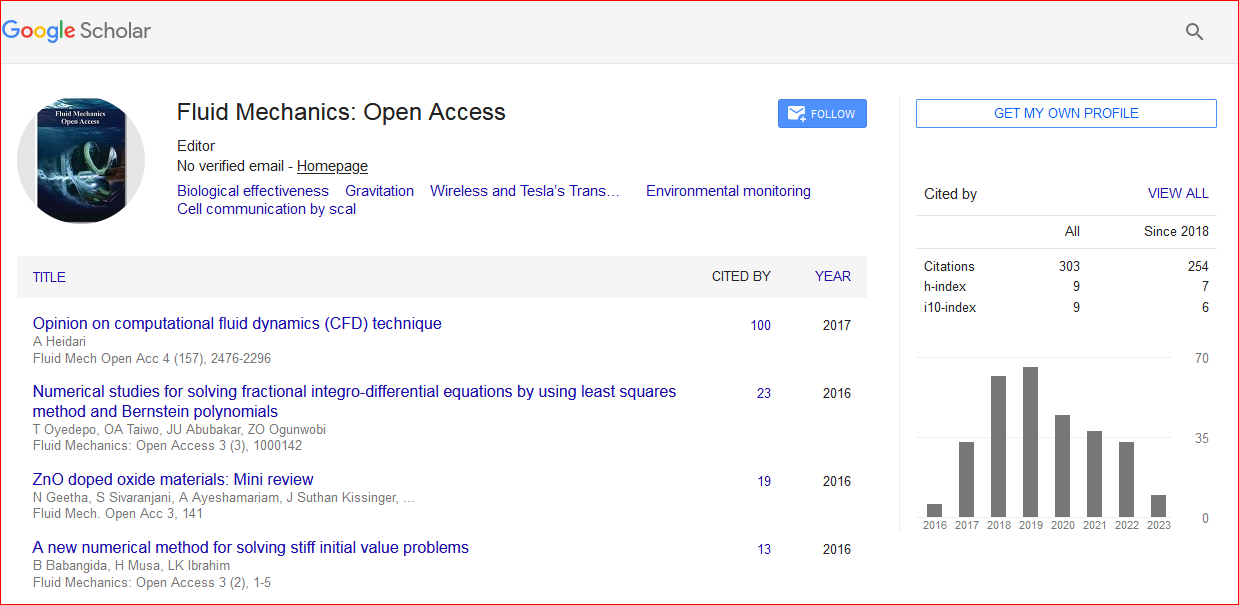
Fluid Mechanics: Open Access received 291 citations as per Google Scholar report