Brief Report - (2025) Volume 9, Issue 2
Received: 04-Mar-2025, Manuscript No. jma-25-172675;
Editor assigned: 06-Mar-2025, Pre QC No. P-172675;
Reviewed: 20-Mar-2025, QC No. Q-172675;
Revised: 25-Mar-2025, Manuscript No. R-172675;
Published:
31-Mar-2025
, DOI: 10.37421/2684-4265.2025.09.369
Citation: Johansen, Ingrid N.. ”Cadaveric Dissection: Essential in Hybrid Anatomy Education.” J Morphol Anat 09 (2025):369.
Copyright: © 2025 Johansen N. Ingrid This is an open-access article distributed under the terms of the Creative Commons Attribution License, which permits unrestricted use, distribution and reproduction in any medium, provided the original author and source are credited.
Cadaveric dissection remains a cornerstone in medical education, profoundly impacting how future healthcare professionals understand human anatomy. This study explores how combining traditional cadaveric dissection with digital resources and virtual tools impacts medical studentsâ?? anatomical dissection skills and their ability to retain that knowledge. What this really means is that a hybrid approach seems to enhance practical skills and long-term recall, suggesting a blended learning model optimizes anatomy education [1].
Advanced surgical training often benefits immensely from high-fidelity models, which is why a pilot study investigated the effectiveness of using three-dimensional cadaveric dissection techniques for surgical trainees. Here's the thing, the findings suggest it offers a more realistic and impactful learning experience for complex procedures, enhancing spatial understanding and practical dexterity [2].
A comparative study directly pitted virtual reality (VR) against traditional cadaveric dissection in anatomy education. What this really means is that while VR offers accessibility and repeatable experiences, cadaveric dissection still provides unparalleled tactile feedback and a deeper appreciation for anatomical variation, suggesting a role for both in modern curricula [3].
Dissecting human cadavers for medical education and research comes with significant ethical responsibilities. This global perspective discusses these considerations, emphasizing the importance of informed consent, respectful handling, and transparent donor programs. It highlights the evolving standards for ethical practice in anatomy labs worldwide [4].
Let's break it down: this study compares learning outcomes when students engage in either prosection (pre-dissected specimens) or full dissection. The takeaway is that while both methods are valuable, active dissection often leads to better retention of complex anatomical relationships and superior spatial reasoning skills among undergraduate students [5].
This article delves into the latest advancements and techniques for cadaveric dissection, especially for specialized anatomical education. It highlights methods like plastination, advanced imaging integration, and targeted dissections for surgical subspecialties, showcasing how dissection continues to evolve as a cornerstone of learning [6].
Here's the thing: cadaveric dissection, while invaluable for learning, can have a profound psychological impact on medical students. This qualitative study explores the emotional responses, coping mechanisms, and support systems needed. It emphasizes the importance of addressing student well-being during their initial exposure to human dissection [7].
This study investigates how well anatomical knowledge gained through cadaveric dissection is retained over time. What this really means is that active participation in dissection promotes robust and long-lasting memory of complex anatomical structures, underscoring its unique pedagogical value compared to other learning methods [8].
For surgical residents, a deep understanding of anatomy is non-negotiable. This article explores the clinical relevance of cadaveric dissection in teaching anatomy specifically to surgical trainees. It highlights how hands-on dissection directly translates to improved surgical skill, decision-making, and patient safety, bridging the gap between theory and practice [9].
This paper looks at how cadaveric dissection is adapting and remaining relevant in an era dominated by digital anatomy tools. It discusses the integration of dissection with virtual reality, augmented reality, and 3D imaging, arguing that while technology enhances learning, the tactile and experiential aspects of dissection remain uniquely vital for comprehensive anatomical education [10].
Cadaveric dissection holds a central, evolving role in modern medical and surgical education. The integration of traditional dissection with contemporary digital resources and virtual tools is proving to be a powerful strategy. This hybrid approach significantly enhances medical students' practical dissection skills and improves their long-term retention of anatomical knowledge. What this really means is that this blended learning model actively optimizes the delivery and effectiveness of anatomy education, preparing students more comprehensively for clinical practice [1]. Furthermore, for surgical trainees, advanced methods like three-dimensional cadaveric dissection techniques offer a highly realistic and impactful learning experience. This approach refines their understanding of complex procedures by enhancing spatial comprehension and practical dexterity, critical skills for any aspiring surgeon [2].
The landscape of anatomical education is also shaped by the comparative effectiveness of different learning modalities. A direct comparison between virtual reality (VR) and traditional cadaveric dissection reveals distinct benefits. While VR provides unparalleled accessibility and the advantage of repeatable experiences without material costs, cadaveric dissection continues to offer unique tactile feedback and exposes learners to the invaluable realities of anatomical variation. This suggests that a balanced curriculum incorporating both methodologies could be the most beneficial, leveraging the strengths of each to provide a holistic educational experience [3]. In this context, the ethical dimensions of cadaveric dissection are paramount. A global perspective underscores the critical importance of informed consent from donors, the respectful handling of human remains, and the transparent operation of donor programs. These evolving standards ensure that the practice of anatomy education and research remains ethically sound and respectful worldwide [4].
When considering fundamental learning outcomes, the method of preparation significantly impacts retention. A study comparing prosection, where specimens are pre-dissected, with full, active dissection found notable differences. Here's the thing, active dissection often leads to superior retention of complex anatomical relationships and better development of spatial reasoning skills among undergraduate students. This suggests that the hands-on engagement inherent in active dissection fosters a deeper cognitive processing and understanding compared to passively observing pre-prepared specimens [5]. Moreover, the field of cadaveric dissection itself is not static; it continually evolves with new innovations. Recent advancements include methods like plastination, which preserves specimens for long-term study, the integration of advanced imaging technologies, and the development of targeted dissections tailored for specific surgical subspecialties. These innovations demonstrate how dissection remains a dynamic and foundational aspect of specialized anatomical education [6].
Beyond the purely academic and technical aspects, the psychological impact of cadaveric dissection on medical students is a critical area of study. Here's the thing, initial exposure to human dissection can evoke profound emotional responses. A qualitative study exploring these impacts highlighted the need for robust coping mechanisms and strong support systems for students. This emphasizes the importance of addressing student well-being as an integral part of their anatomical education journey [7]. The long-term benefits of this intensive learning method are also well-documented. Active participation in cadaveric dissection promotes a robust and remarkably long-lasting memory of intricate anatomical structures. This underscores its unique pedagogical value, reinforcing why it's considered superior to many other learning methods for enduring knowledge retention [8].
For surgical residents, the clinical relevance of cadaveric dissection is undeniable. A deep understanding of anatomy is not merely academic; it directly informs surgical skill, decision-making, and ultimately, patient safety. Hands-on dissection provides a crucial bridge between theoretical knowledge and practical application, equipping trainees with the confidence and competence necessary for complex surgical procedures [9]. In an era increasingly dominated by digital anatomy tools, cadaveric dissection is not being supplanted but rather adapting. It is integrating seamlessly with technologies like virtual reality, augmented reality, and 3D imaging. This evolution highlights that while technology enhances learning, the tactile and experiential aspects of physical dissection remain uniquely vital for comprehensive anatomical education, ensuring its continued relevance and irreplaceable role in the digital age [10].
Cadaveric dissection continues to be a fundamental component of anatomical education and surgical training, yet its application is adapting with technological advancements and evolving pedagogical insights. Combining traditional cadaveric dissection with digital resources and virtual tools creates a hybrid learning environment that significantly enhances practical skills and promotes long-term knowledge retention among medical students. What this really means is that blended learning models optimize anatomy education. For advanced surgical training, using high-fidelity three-dimensional cadaveric dissection offers a remarkably realistic and impactful experience, refining spatial understanding and practical dexterity for intricate procedures. Here's the thing, while virtual reality offers accessible and repeatable learning opportunities, the irreplaceable tactile feedback and exposure to anatomical variation provided by traditional dissection suggest a continued role for both approaches in modern curricula. Ethical responsibilities are crucial in this practice, emphasizing informed consent, respectful handling, and transparent donor programs worldwide. Research shows that active, hands-on dissection tends to foster better retention of complex anatomical relationships and superior spatial reasoning skills compared to passive prosection. Moreover, innovations like plastination and advanced imaging integration ensure cadaveric dissection remains at the forefront of specialized anatomical education. It's also important to acknowledge the psychological impact dissection can have on medical students, highlighting the need for adequate support systems. Ultimately, the robust and long-lasting memory of anatomical structures acquired through active participation in dissection underscores its unique pedagogical value, directly contributing to improved surgical skill, decision-making, and patient safety for surgical residents. The evolving role of cadaveric dissection in the digital age, with its integration of virtual and augmented reality, affirms that its tactile and experiential elements are uniquely vital for comprehensive anatomical understanding.
None
None
Indexed at, Google Scholar, Crossref
Indexed at, Google Scholar, Crossref
Indexed at, Google Scholar, Crossref
Indexed at, Google Scholar, Crossref
Indexed at, Google Scholar, Crossref
Indexed at, Google Scholar, Crossref
Indexed at, Google Scholar, Crossref
Indexed at, Google Scholar, Crossref
Indexed at, Google Scholar, Crossref
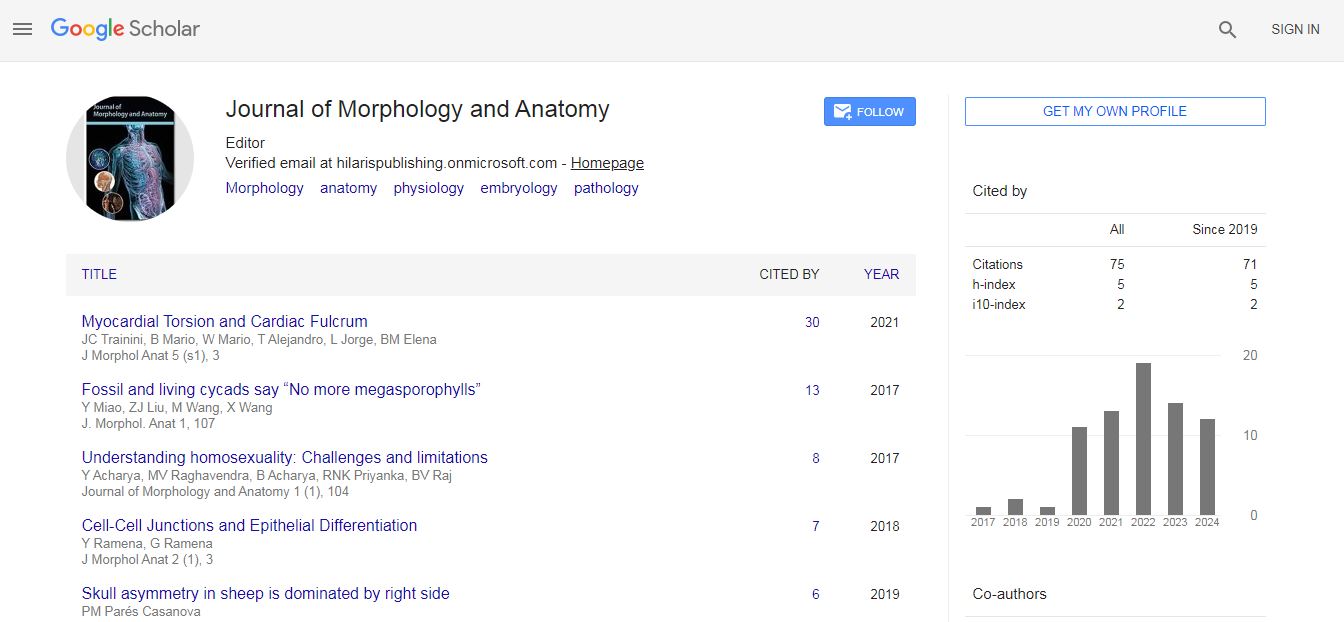
Journal of Morphology and Anatomy received 63 citations as per Google Scholar report