Brief Report - (127) Volume 14, Issue 4
Received: 01-Jul-2025, Manuscript No. jtm-26-186015;
Editor assigned: 03-Jul-2025, Pre QC No. P-186015;
Reviewed: 17-Jul-2025, QC No. Q-186015;
Revised: 22-Jul-2025, Manuscript No. R-186015;
Published:
29-Jul-2025
, DOI: 10.37421/2167-1222.2025.14.688
Citation: Pereira, Lucas. ”Burn Treatment Innovations: Improving Patient Outcomes.” J Trauma Treat 14 (2025):688.
Copyright: © 2025 Pereira L. This is an open-access article distributed under the terms of the Creative Commons Attribution License, which permits unrestricted use, distribution and reproduction in any medium, provided the original author and source are credited.
Recent advancements in the field of burn injury treatment and reconstruction are profoundly enhancing patient outcomes through innovative approaches and technologies. The progress in wound healing technologies, particularly in the realm of advanced biomaterials and regenerative medicine, stands as a cornerstone of these improvements. Sophisticated reconstructive surgical techniques, including the burgeoning fields of tissue engineering and the application of custom 3D-printed implants, are now enabling more functional and aesthetically pleasing restoration of severely burned tissues, marking a significant shift in the therapeutic landscape for burn survivors. [1] The application of negative pressure wound therapy (NPWT) continues its evolutionary trajectory, consistently demonstrating enhanced efficacy in the management of complex burn wounds that often pose significant clinical challenges. Ongoing developments in NPWT devices and their associated interfaces are specifically geared towards optimizing exudate management, actively promoting the formation of granulation tissue, and concurrently reducing the frequency of dressing changes, ultimately leading to superior wound bed preparation for definitive closure procedures. [2] Tissue engineering and regenerative medicine are fundamentally revolutionizing reconstructive surgery for individuals who have sustained burn injuries, offering novel solutions that were previously unimaginable. This includes the pioneering development of bioengineered skin substitutes, the utilization of autologous cell therapies, and the creation of sophisticated scaffolds specifically designed to foster the regeneration of both dermal and epidermal layers, aiming to overcome limitations inherent in traditional autografting methods. [3] The integration of virtual surgical planning and the precision offered by 3D printing technology is demonstrably transforming reconstructive procedures aimed at correcting post-burn deformities. The creation of patient-specific implants, surgical guides, and anatomical models derived from detailed CT or MRI scans facilitates exceptionally precise pre-operative planning and the meticulous execution of complex reconstructions, particularly those involving significant facial and limb defects. [4] Pharmacological interventions are actively being investigated as critical tools to modulate the inflammatory cascade, promote accelerated healing processes, and effectively prevent the development of debilitating scar contractures that commonly follow burn injuries. Current research focuses on the development of novel anti-inflammatory agents, the strategic use of growth factors, and the exploration of agents specifically designed to target fibrotic pathways, offering new avenues for therapeutic intervention. [5] Minimally invasive techniques are increasingly gaining traction within the domain of burn reconstruction, offering a distinct set of advantages that include a reduction in visible scarring and a significantly faster recovery period for patients. Refinements in techniques such as laser therapy for scar revision and the application of minimally invasive flap reconstruction are contributing to improved aesthetic and functional outcomes. [6] Advanced imaging modalities are now playing an indispensable role in the accurate assessment of burn depth, a critical factor that guides subsequent treatment decisions, thereby optimizing patient care. Techniques such as hyperspectral imaging and optical coherence tomography are providing more objective and real-time information about the burn wound compared to traditional assessment methods, leading to more informed clinical judgments. [7] The integration of artificial intelligence (AI) and machine learning (ML) into the field of burn care represents an emergent and highly promising area of development. AI/ML algorithms are being meticulously developed for the predictive analysis of burn wound healing outcomes, the optimization of complex treatment protocols, and the early identification of patients who may be at a higher risk of developing complications. [8] Developments in the field of wound dressings, including the incorporation of antimicrobial agents and the design of advanced hydrogels, are vital for effectively preventing infection and promoting a conducive moist wound healing environment. These innovative dressings are engineered to facilitate the sustained release of therapeutic agents and to actively support cell migration, thereby enhancing the natural healing process. [9] Biologics and cell-based therapies are emerging as exceptionally powerful tools in the armamentarium of burn reconstruction, offering new possibilities for advanced tissue repair. This category includes the strategic use of mesenchymal stem cells and their secreted factors, as well as the application of engineered cell sheets, all aimed at enhancing tissue regeneration and mitigating persistent inflammation. [10]
Recent progress in burn injury treatment and reconstruction is substantially enhancing patient recovery and functional outcomes, driven by novel technologies and therapeutic strategies. Innovations in wound healing, such as advanced biomaterials and regenerative medicine, are central to this evolution. Moreover, sophisticated reconstructive surgical techniques, including tissue engineering and custom 3D-printed implants, are enabling more effective restoration of burned tissues, improving both function and aesthetics. [1] Negative pressure wound therapy (NPWT) continues to evolve, offering improved effectiveness in managing complex burn wounds. New NPWT devices and interfaces are being developed to better manage wound exudate, encourage granulation tissue formation, and reduce the need for frequent dressing changes, thereby preparing the wound bed more effectively for closure. [2] Tissue engineering and regenerative medicine are revolutionizing reconstructive surgery for burn patients. This involves developing bioengineered skin substitutes, autologous cell therapies, and scaffolds designed to promote the regeneration of dermal and epidermal layers, aiming to overcome the limitations of autografts, such as donor site morbidity and limited availability for extensive burns. [3] The use of virtual surgical planning and 3D printing is significantly improving reconstructive procedures for post-burn deformities. Patient-specific implants, guides, and models created from imaging data allow for precise pre-operative planning and execution of complex reconstructions, particularly for defects in the face and limbs. [4] Pharmacological interventions are being explored to modulate inflammation, promote healing, and prevent scar contractures in burn injuries. Research is focusing on novel anti-inflammatory agents, growth factors, and compounds that target fibrotic pathways, offering new therapeutic avenues for burn management. [5] Minimally invasive techniques are becoming more prevalent in burn reconstruction, offering benefits like reduced scarring and faster recovery. Techniques such as laser therapy for scar revision and minimally invasive flap reconstructions are being refined to provide better aesthetic and functional results. [6] Advanced imaging techniques are crucial for accurately assessing burn depth and guiding treatment decisions. Modalities like hyperspectral imaging and optical coherence tomography provide more objective and real-time information compared to traditional methods, leading to more precise wound management. [7] The integration of artificial intelligence (AI) and machine learning (ML) in burn care is an emerging and promising area. AI/ML algorithms are being developed to predict burn wound healing outcomes, optimize treatment protocols, and identify patients at risk of complications, potentially leading to more personalized and effective care. [8] Advancements in wound dressings, including antimicrobial-impregnated dressings and advanced hydrogels, are critical for preventing infection and maintaining a moist wound environment. These dressings are designed to release therapeutic agents over time and to facilitate cell migration, thereby supporting the healing process. [9] Biologics and cell-based therapies are emerging as important tools in burn reconstruction. This includes the use of mesenchymal stem cells and their secretomes, as well as engineered cell sheets, to enhance tissue regeneration and reduce inflammation, offering new regenerative approaches for burn wound care. [10]
Recent advancements in burn injury treatment and reconstruction are significantly improving patient outcomes. Innovations in wound healing, such as advanced biomaterials and regenerative medicine, along with sophisticated reconstructive surgical techniques including tissue engineering and 3D-printed implants, are enabling better restoration of burned tissues. Negative pressure wound therapy (NPWT) continues to evolve for complex burn wound management. Tissue engineering offers bioengineered skin substitutes and regenerative scaffolds. Virtual surgical planning and 3D printing enhance reconstructive procedures for post-burn deformities. Pharmacological interventions aim to modulate inflammation and prevent scarring. Minimally invasive techniques and advanced imaging modalities are refining scar management and burn depth assessment. Artificial intelligence and machine learning are emerging for predicting outcomes and optimizing treatment. Advanced wound dressings are crucial for preventing infection, and biologics/cell-based therapies offer new regenerative approaches. These collective advancements are reshaping the landscape of burn care, leading to improved functional and aesthetic results for patients.
None
None
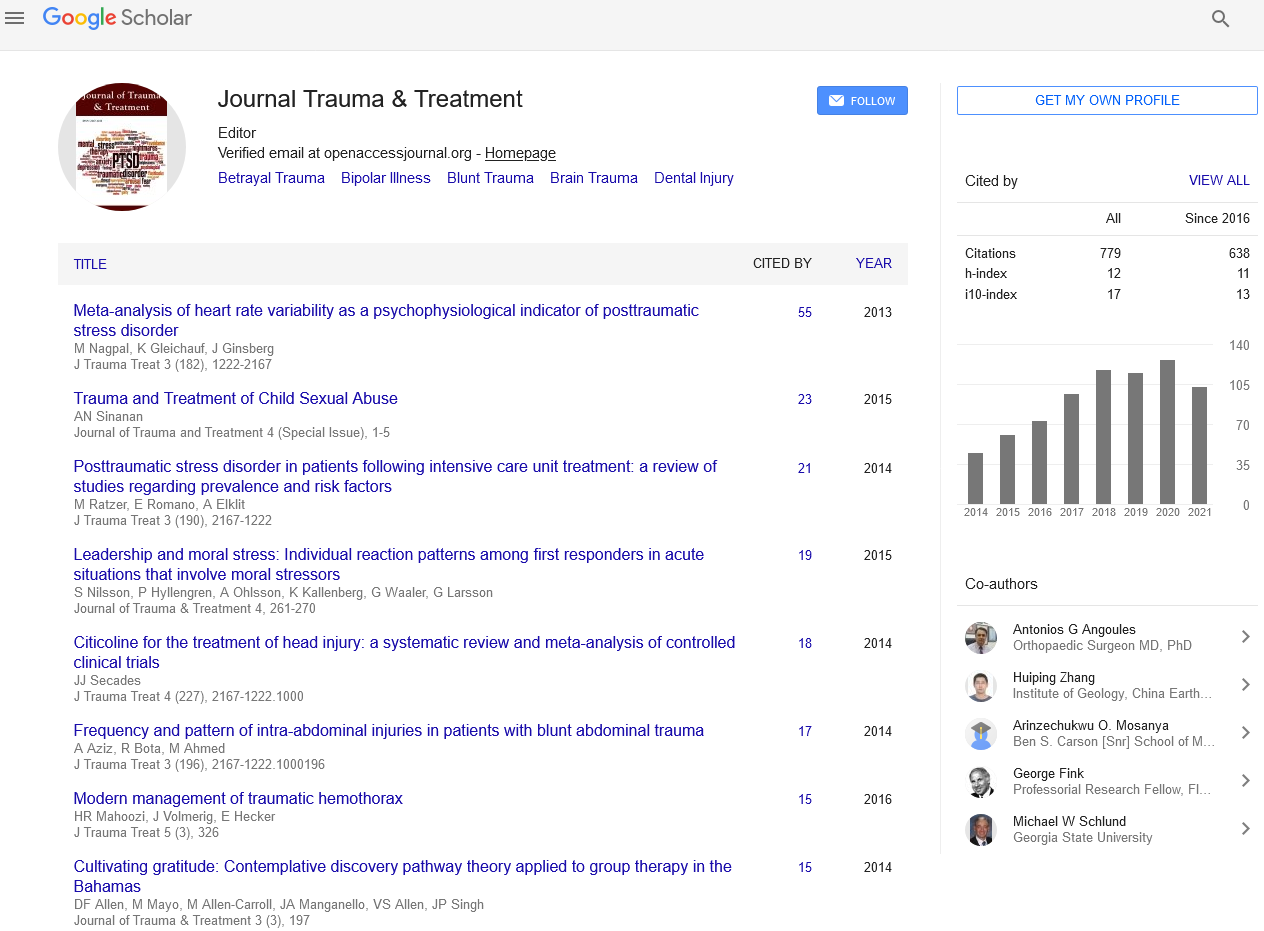
Journal of Trauma & Treatment received 1048 citations as per Google Scholar report