Short Communication - (2025) Volume 14, Issue 4
Received: 01-Jul-2025, Manuscript No. pbt-25-173769;
Editor assigned: 03-Jul-2025, Pre QC No. P-173769;
Reviewed: 17-Jul-2025, QC No. Q-173769;
Revised: 22-Jul-2025, Manuscript No. R-173769;
Published:
29-Jul-2025
, DOI: 10.37421/2167-7689.2025.14.498
Citation: Bianchi, Paolo. ”Biologics Regulation: Development, Safety, Patient Focus.” Pharmaceut Reg Affairs 14 (2025):498.
Copyright: © 2025 Bianchi P. This is an open-access article distributed under the terms of the Creative Commons Attribution License, which permits unrestricted use,
distribution and reproduction in any medium, provided the original author and source are credited.
The dynamic environment of biologics and biosimilars presents continuous challenges and future directions for their development and regulatory approval. This field requires robust analytical characterization and clinical comparability studies to navigate the complex regulatory landscape, ultimately ensuring patient safety and product efficacy. Successful Biologics License Applications (BLAs) are dependent on a deep understanding of evolving scientific and regulatory expectations [1].
Translational and regulatory aspects are critical for advancing gene therapies from initial research to clinical application. This includes key considerations for manufacturing, preclinical evaluation, and clinical trial design, all essential components for a successful BLA. What this really means is that the unique characteristics of gene therapies necessitate specialized regulatory strategies tailored to their nature [2].
Biosimilar development involves its own distinct regulatory pathways, presenting both promising opportunities and inherent challenges. Scientific and regulatory hurdles must be addressed to demonstrate biosimilarity, which is crucial for obtaining a BLA. Understanding these nuances helps innovators and regulators ensure equivalent quality, safety, and efficacy compared to reference biologics [3].
The Food and Drug Administration (FDA) has developed expedited programs for serious conditions, specifically designed to accelerate drug development and approval for novel biologics. These programs detail criteria for designations like Fast Track, Breakthrough Therapy, Accelerated Approval, and Priority Review. Here's the thing: these pathways can significantly shorten the BLA review timeline, bringing critical treatments to patients faster [4].
Europe's regulatory framework for Advanced Therapy Medicinal Products (ATMPs) offers valuable insights that parallel global biologics license applications. This comprehensive review highlights the complexities of regulating gene, cell, and tissue-engineered products, encompassing manufacturing, quality control, and clinical development. Understanding these specific European guidelines is key for developers navigating similar biologics applications elsewhere [5].
Post-marketing surveillance of biologics and biosimilars plays a critical role after their approval. This involves exploring methodologies and regulatory expectations for monitoring these products, which is an integral part of the BLA lifecycle. What this means for us is that continuous safety and effectiveness monitoring ensures long-term patient well-being and product accountability [6].
Chemistry, Manufacturing, and Controls (CMC) present significant challenges during the development and approval of biologics and advanced therapy medicinal products. The inherent complexity of these products demands rigorous CMC strategies throughout the entire BLA process. Ultimately, robust CMC data is fundamental to demonstrating product quality, safety, and consistency to regulatory bodies [7].
Real-World Evidence (RWE) is increasingly important in regulatory decision-making for biologics and biosimilars. RWE, derived from routine clinical practice, can effectively complement traditional clinical trial data to support BLAs, especially for post-market commitments or label expansions. Here's the thing: RWE offers a broader understanding of product performance across diverse patient populations in real-world settings [8].
Immunogenicity, the complex issue of immune responses to biologics, requires careful assessment, prediction, and management due to its clinical implications. Understanding and addressing immunogenicity is a crucial aspect throughout the development and Biologics License Application process. Let's break it down: unexpected immune responses can significantly impact product efficacy and patient safety, necessitating thorough characterization and ongoing monitoring [9].
Integrating patient perspectives into the development and regulatory review of biologics is growing in importance. Patient input can inform various crucial elements, including trial design, endpoint selection, and risk-benefit assessments, directly influencing the BLA process. What this really means is that patient-centered approaches significantly enhance the relevance and acceptability of new biologic therapies, ensuring they meet actual patient needs [10].
The development and regulatory pathways for biologics and biosimilars are complex, constantly evolving, and present significant challenges alongside promising opportunities [1, 3]. Innovators must demonstrate robust analytical characterization and conduct thorough clinical comparability studies to navigate this landscape effectively. The goal is to ensure patient safety and product efficacy, with successful Biologics License Applications (BLA) requiring a deep understanding of current scientific and regulatory expectations [1]. For biosimilars specifically, the scientific and regulatory hurdles in proving biosimilarity are crucial for obtaining a BLA, aiming to guarantee equivalent quality, safety, and efficacy to reference biologics [3].
Specialized considerations extend to advanced therapeutic modalities. Gene therapies, for instance, necessitate intricate translational and regulatory approaches to move from initial research to clinical application [2]. This involves key considerations in manufacturing, preclinical evaluation, and clinical trial design, all vital for a successful BLA. Similarly, Advanced Therapy Medicinal Products (ATMPs) within Europe operate under a complex regulatory framework that offers insights globally. This framework addresses the complexities of regulating gene, cell, and tissue-engineered products, including their manufacturing, quality control, and clinical development, which is key for developers pursuing similar biologics applications [5].
The Food and Drug Administration (FDA) has developed expedited programs for serious conditions, specifically designed to accelerate drug development and approval for novel biologics [4]. These programs, including Fast Track, Breakthrough Therapy, Accelerated Approval, and Priority Review, can significantly shorten the BLA review timeline, bringing vital treatments to patients more quickly [4]. Alongside this, the Chemistry, Manufacturing, and Controls (CMC) aspects present their own set of challenges [7]. The inherent complexity of biologics and ATMPs demands rigorous CMC strategies throughout the entire BLA process, as strong CMC data is fundamental for demonstrating product quality, safety, and consistency [7].
Post-marketing surveillance is another critical phase in the Biologics License Application lifecycle, focusing on monitoring products after approval [6]. This continuous safety and effectiveness monitoring ensures long-term patient well-being [6]. Furthermore, Real-World Evidence (RWE) is gaining significant importance in regulatory decision-making for biologics and biosimilars [8]. RWE, derived from routine clinical practice, complements traditional clinical trial data and can support BLAs, particularly for post-market commitments or label expansions. It offers a broader understanding of product performance in diverse patient populations [8].
Managing immunogenicity, the complex issue of immune responses to biologics, is a crucial aspect throughout the development and BLA process [9]. Unexpected immune responses can impact product efficacy and safety, requiring careful characterization and monitoring [9]. Finally, there is an increasing emphasis on integrating patient perspectives into the entire development and regulatory review process for biologics [10]. Patient input can inform various stages, including trial design, endpoint selection, and risk-benefit assessments, ultimately influencing the BLA process. Patient-centered approaches enhance the relevance and acceptability of new biologic therapies, making sure they truly serve the people who need them [10].
The regulatory landscape for biologics and biosimilars is dynamic and multifaceted, encompassing a wide range of considerations from initial development to post-market surveillance. A deep understanding of evolving scientific and regulatory expectations is crucial for successful Biologics License Applications (BLA) [1]. This includes rigorous analytical characterization and clinical comparability studies to ensure safety and efficacy [1, 3]. Gene therapies and Advanced Therapy Medicinal Products (ATMPs) present unique translational and regulatory challenges, requiring specialized strategies for manufacturing, preclinical evaluation, and clinical trial design [2, 5]. Regulatory bodies like the FDA have established expedited programs to accelerate the approval of novel biologics, aiming to bring critical treatments to patients faster [4]. Chemistry, Manufacturing, and Controls (CMC) data are fundamental for demonstrating product quality and consistency throughout the BLA process [7]. Beyond approval, post-marketing surveillance is vital for long-term patient well-being, continuously monitoring safety and effectiveness [6]. Real-World Evidence (RWE) is also increasingly significant, complementing traditional clinical data to support BLAs and expand understanding of product performance [8]. Moreover, addressing complex issues like immunogenicity â?? its assessment, prediction, and clinical impact â?? is essential to manage potential adverse immune responses that could affect efficacy and safety [9]. Integrating patient perspectives into development and regulatory review further enhances the relevance and acceptability of new biologic therapies, ensuring patient-centered approaches inform trial design and risk-benefit assessments [10]. This holistic approach underscores the complexities and collaborative efforts needed in modern biologic drug development and regulation.
None
None
1. Meena S, Julie MS, Daniel SS. "The evolving landscape of biologics and biosimilars: Current challenges and future directions".J Pharm Sci 112 (2023):23-34.
Indexed at, Google Scholar, Crossref
2. X. W, P. JH, H. CZ. "Translational and Regulatory Considerations for Advancing Gene Therapies from Bench to Bedside".Mol Ther 29 (2021):25-39.
Indexed at, Google Scholar, Crossref
3. S. KS, A. KG, S. K. "Biosimilar development and regulatory pathway: opportunities and challenges".J Drug Target 28 (2020):481-489.
Indexed at, Google Scholar, Crossref
4. Elena NK, Jessica MR, Lisa RJ. "FDA's Expedited Programs: Pathway to Innovation".Clin Pharmacol Ther 109 (2021):867-876.
Indexed at, Google Scholar, Crossref
5. M. AG, C. PSdA, M. MSS. "Regulatory Framework for Advanced Therapy Medicinal Products in Europe: A Comprehensive Review".Adv Drug Deliv Rev 187 (2022):114389.
Indexed at, Google Scholar, Crossref
6. A. PS, B. KS, C. VG. "Post-marketing surveillance of biologics and biosimilars: current challenges and future perspectives".Expert Opin Biol Ther 23 (2023):33-44.
Indexed at, Google Scholar, Crossref
7. J. MC, S. LW, H. CL. "Chemistry, Manufacturing, and Controls (CMC) Challenges in Biologics and Advanced Therapy Medicinal Products".AAPS J 23 (2021):1.
Indexed at, Google Scholar, Crossref
8. E. PJ, F. RW, G. HG. "The Role of Real-World Evidence in Regulatory Decision-Making for Biologics and Biosimilars".J Manag Care Spec Pharm 28 (2022):1098-1107.
Indexed at, Google Scholar, Crossref
9. I. MP, J. KS, K. LD. "Immunogenicity of Biologics: Assessment, Prediction, and Clinical Impact".Front Immunol 11 (2020):1528.
Indexed at, Google Scholar, Crossref
10. L. NE, M. PR, N. JW. "Integrating Patient Perspectives into Biologics Development and Regulatory Review".Patient (Auckland) 17 (2024):1-10.
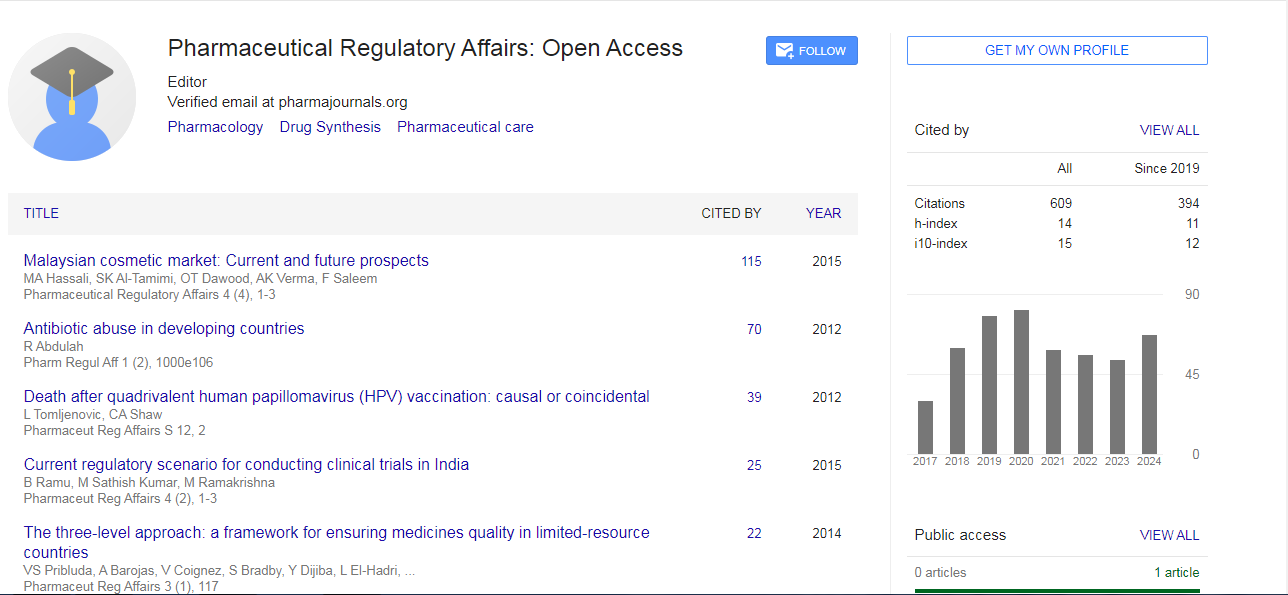
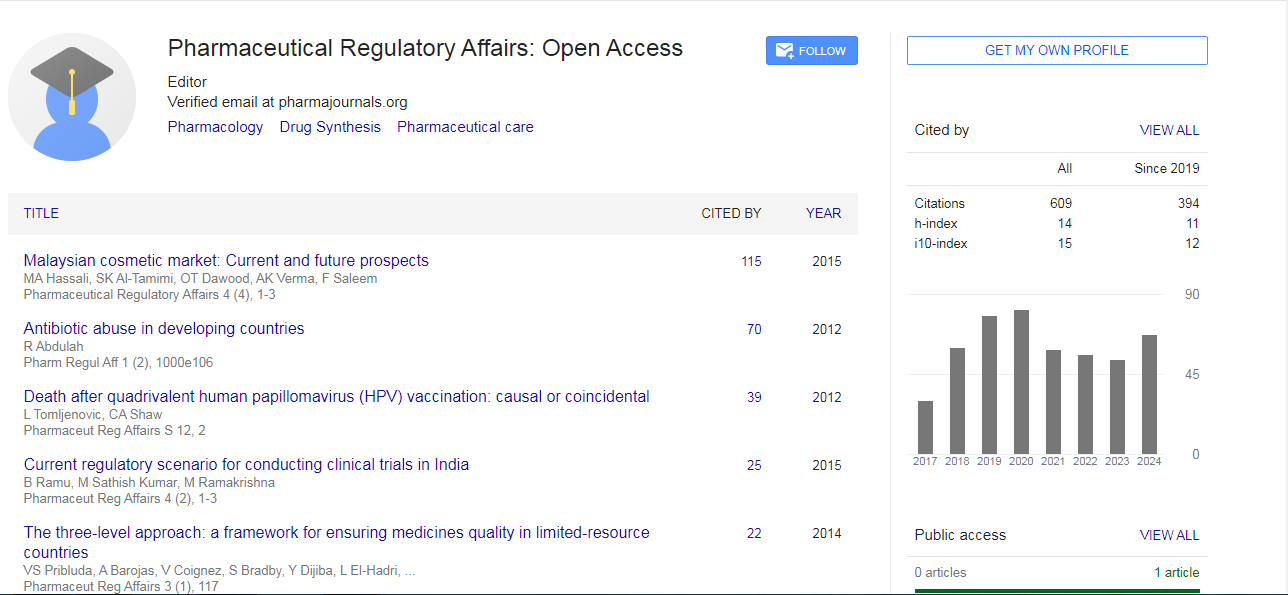
Pharmaceutical Regulatory Affairs: Open Access received 533 citations as per Google Scholar report