Opinion - (2025) Volume 9, Issue 3
Received: 01-May-2025, Manuscript No. jma-26-184590;
Editor assigned: 05-May-2025, Pre QC No. P-184590;
Reviewed: 19-May-2025, QC No. Q-184590;
Revised: 22-May-2025, Manuscript No. R-184590;
Published:
29-May-2025
, DOI: : 10.37421/2684-4265.2025.09.380
Citation: Fournier, Isabelle. ”Aquatic Feeding Apparatus: Form, Function, Evolution.” J Morphol Anat 09 (2025):380.
Copyright: © 2025 Fournier I. This is an open-access article distributed under the terms of the Creative Commons Attribution License, which permits unrestricted use, distribution and reproduction in any medium, provided the original author and source are credited.
The study of functional morphology, particularly concerning feeding apparatus in aquatic animals, reveals a profound link between anatomical structure and ecological function across diverse taxa. This field meticulously examines how evolutionary pressures have sculpted specialized oral and pharyngeal structures to optimize nutrient acquisition in varied aquatic environments. From the intricate filter-feeding mechanisms of sessile organisms to the sophisticated predatory adaptations of mobile species, functional morphology provides a framework for understanding the biomechanics and evolutionary trajectories of feeding systems. The comparative analysis of these structures offers deep insights into niche partitioning and trophic dynamics within aquatic ecosystems. The biomechanics of suction feeding, a prevalent strategy among teleost fish, has been a focal point of research. This process involves the coordinated action of muscular hydrostats and skeletal linkages to generate negative pressure, effectively drawing prey into the oral cavity. Quantitative assessments of the forces involved, coupled with detailed morphological studies of the oral and pharyngeal structures, underscore a strong correlation between feeding efficiency and anatomical design. These findings are crucial for comprehending prey selection and the intricate predator-prey interactions that characterize aquatic food webs. Marine reptiles exhibit remarkable cranial and jaw adaptations tailored to specific prey types, notably hard-shelled organisms. Studies investigating their bite force, gape size, and jaw muscle arrangements highlight specialized features enabling efficient prey crushing. These morphological traits are intrinsically linked to their ecological roles in benthic environments and their dietary preferences, demonstrating how functional anatomy drives niche differentiation within marine ecosystems. Such adaptations exemplify convergent evolution in response to similar ecological challenges. Filter-feeding, a vital strategy in many aquatic invertebrates, has been extensively studied in bivalve mollusks. Research on their ctenidia and labial palps elucidates how their intricate structure facilitates the efficient capture of suspended particles from the water column. Quantitative analyses exploring the relationship between gill surface area, particle size selectivity, and feeding rates offer valuable insights into filter-feeding performance and its evolutionary significance in shaping aquatic communities. Herbivory in aquatic mammals presents unique morphological challenges, necessitating specialized cranial and dental adaptations for processing tough aquatic vegetation. Studies examining jaw structure, tooth morphology, and masticatory muscle arrangements reveal features optimized for efficient mastication. These functional traits play a critical role in niche differentiation among herbivorous aquatic species and influence the structure of underwater plant communities. The feeding apparatus of larval amphibians showcases specialized structures adapted for microphagy, the consumption of small food particles. Investigations into the morphology of their mouths, gills, and associated musculature reveal their efficacy in capturing planktonic or detrital food. This research also emphasizes the developmental plasticity and functional constraints that shape these feeding structures during metamorphosis, a critical transitional phase. Deep-sea fishes present a fascinating case study in functional morphology, with adaptations to extreme environments characterized by low prey densities and unique food sources. Their specialized jaws, bioluminescent lures (photophores), and energy-conserving feeding mechanisms are crucial for survival. These morphological traits are directly linked to the challenging environmental conditions and the distinct trophic ecology of abyssal ecosystems, highlighting the power of adaptation. Cephalopods, with their highly specialized feeding apparatus, offer another compelling area of study. The beak, radula, and extensible tentacles are key components involved in prey capture, manipulation, and ingestion. An analysis of the biomechanical principles underlying the efficiency of these structures, alongside their evolutionary diversification across different cephalopod lineages, provides a comprehensive understanding of their predatory success. Cartilaginous fishes (Chondrichthyes) display a range of feeding adaptations, including protrusible jaws, specialized tooth replacement patterns, and sophisticated electroreception. These features facilitate diverse predatory strategies, from engulfment to precise biting. The evolutionary history of jaw suspension and its impact on feeding performance in sharks, rays, and chimaeras are key areas of investigation. Aquatic birds, particularly waterfowl, exhibit remarkable adaptations in their feeding apparatus, specifically in their bills, tongues, and pharyngeal structures. These adaptations are tailored to specialized diets, including macrophytes, invertebrates, and fish. The interplay between morphology and feeding behavior in exploiting diverse aquatic resources, along with instances of evolutionary convergence among different avian groups, underscores the adaptive radiation of feeding strategies.
The functional morphology of feeding apparatus in aquatic animals is a broad field that encompasses a wide range of taxa and feeding strategies. One overarching theme is the intricate relationship between anatomical structure and ecological function, evident in how diverse feeding mechanisms have evolved to exploit available resources. This includes understanding the evolutionary adaptations in jaw mechanisms, dentition, and pharyngeal structures that enable efficient nutrient acquisition in varied aquatic environments. Such specializations provide crucial insights into ecological niches and trophic dynamics within aquatic ecosystems. For example, the general exploration of diverse feeding strategies from filter feeding to predatory pursuits highlights the vast array of morphological solutions found in nature. Focusing on specific feeding mechanisms, the biomechanics of suction feeding in teleost fish exemplifies the power of functional morphology. This process relies on the coordinated action of muscular hydrostats and skeletal linkages to generate negative pressure for prey capture. Quantitative analysis of the forces involved and their correlation with oral and pharyngeal morphology underscores the direct link between anatomical design and feeding efficiency. This understanding is vital for unraveling prey selection and predator-prey interactions in aquatic systems. Marine reptiles present specialized adaptations for feeding on hard-shelled prey, showcasing the influence of diet on cranial and jaw morphology. Studies examining bite force, gape size, and jaw musculature reveal features that facilitate crushing. These morphological traits are closely tied to their ecological roles in benthic environments and their dietary preferences, illustrating how functional anatomy drives niche partitioning. Filter-feeding in bivalve mollusks offers a clear example of how structure dictates function in particle capture. The ctenidia and labial palps are finely tuned for efficient extraction of suspended food from the water column. Research quantifies the relationship between gill surface area, particle size selectivity, and feeding rates, providing a deep understanding of filter-feeding performance and its evolutionary significance. Herbivory in aquatic mammals necessitates distinct cranial and dental adaptations for processing plant matter. Analysis of jaw structure, tooth morphology, and masticatory muscle arrangements highlights features optimized for efficient mastication. These functional traits contribute significantly to niche differentiation among herbivorous aquatic species and influence the structure of underwater plant communities. Larval amphibians exhibit feeding apparatus specialized for microphagy, the consumption of minute food particles. The morphology of their mouths, gills, and associated musculature is adapted for capturing planktonic or detrital food. This area of study also emphasizes developmental plasticity and functional constraints during metamorphosis. Deep-sea fishes exhibit remarkable adaptations to extreme environments, including low prey densities and unique food sources. Their feeding apparatus features specialized jaws, luring mechanisms like photophores, and energy-efficient feeding strategies. These morphological traits are directly linked to the challenging environmental conditions and trophic ecology of abyssal ecosystems. Cephalopods possess a highly specialized feeding apparatus, including a sharp beak, radula, and extensible tentacles. Research focuses on the biomechanical principles underlying the efficiency of these structures and their evolutionary diversification across different cephalopod lineages, providing insight into their predatory capabilities. Cartilaginous fishes, such as sharks and rays, display feeding adaptations like protrusible jaws and specialized tooth replacement. Their ability to electroreception also plays a role in feeding strategies. The evolutionary history of jaw suspension significantly impacts feeding performance in this group. Aquatic birds, particularly waterfowl, have evolved specialized bills, tongues, and pharyngeal structures for varied diets like macrophytes, invertebrates, and fish. The interplay between their feeding morphology and behavior allows them to exploit diverse aquatic resources, and instances of evolutionary convergence are notable among different avian groups.
This collection of research explores the functional morphology of feeding apparatus across a wide spectrum of aquatic animals, including fish, marine reptiles, bivalves, aquatic mammals, larval amphibians, deep-sea fish, cephalopods, cartilaginous fishes, and aquatic birds. The studies highlight how diverse feeding strategies, from suction feeding and filter feeding to herbivory and specialized predation, have driven the evolution of distinct anatomical structures. Key areas of investigation include jaw mechanics, dentition, oral cavity and pharyngeal structures, beak and radula morphology, and adaptations for specific diets and environments. The research consistently demonstrates a strong correlation between morphology, feeding efficiency, ecological niche partitioning, and predator-prey dynamics within aquatic ecosystems. Evolutionary adaptations, biomechanical principles, and developmental plasticity are recurring themes, underscoring the intricate interplay between form and function in aquatic feeding systems.
None
None
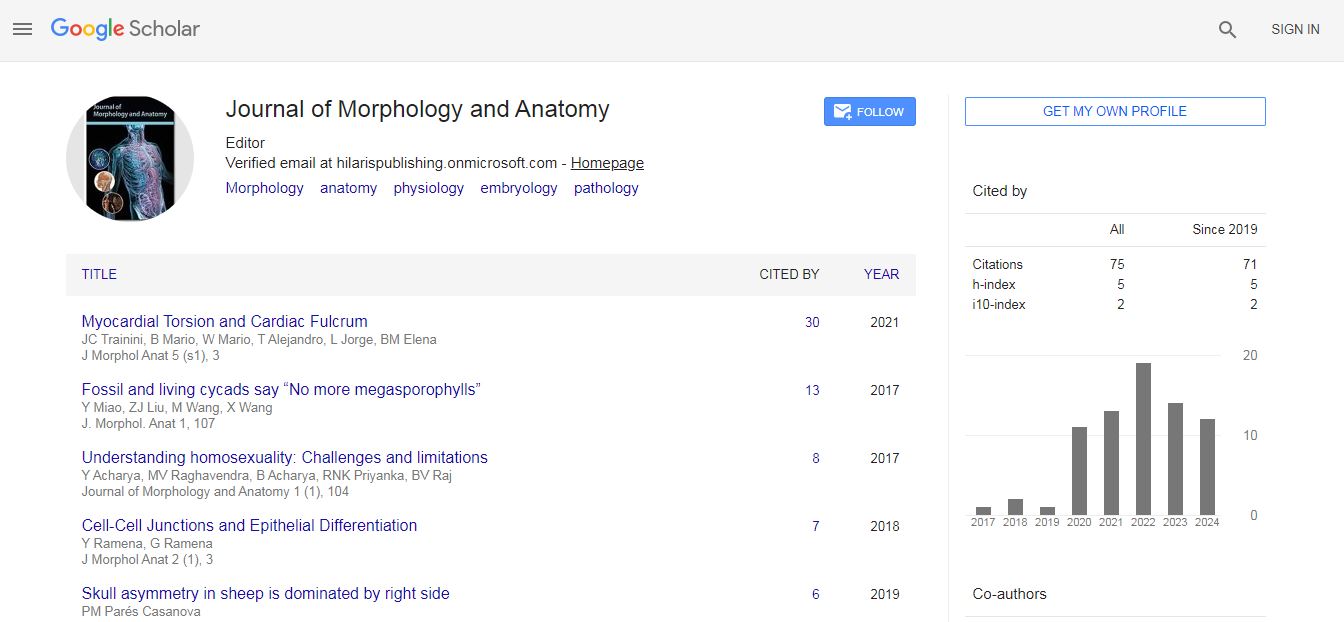
Journal of Morphology and Anatomy received 63 citations as per Google Scholar report