Brief Report - (2025) Volume 13, Issue 6
Received: 01-Dec-2025, Manuscript No. JCMG-26-185576;
Editor assigned: 03-Dec-2025, Pre QC No. P-185576;
Reviewed: 17-Dec-2025, QC No. Q-185576;
Revised: 22-Dec-2025, Manuscript No. R-185576;
Published:
29-Dec-2025
, DOI: 10.37421/2472-128X.2025.13.368
Citation: Mwangi, Daniel. ”AI Revolutionizing Genomic Medicine: Promises and Challenges.” J Clin Med Genomics 13 (2025):368.
Copyright: © 2025 Mwangi D. This is an open-access article distributed under the terms of the Creative Commons Attribution License, which permits unrestricted use, distribution and reproduction in any medium, provided the original author and source are credited.
Artificial intelligence (AI) is profoundly reshaping the landscape of genomic medicine, ushering in an era of enhanced analytical capabilities for massive datasets. This technological advancement is instrumental in fostering the development of personalized treatment plans, improving the precision of disease diagnostics, and accelerating the pace of drug discovery. However, the seamless integration of AI into this field is not without its hurdles, encompassing critical issues such as data privacy concerns, the potential for algorithmic bias, and the imperative for establishing robust regulatory frameworks to ensure the ethical and equitable application of these powerful tools [1].
The application of machine learning algorithms within the interpretation of complex genomic data represents a significant area where AI is making substantial progress. These sophisticated tools possess the capacity to discern subtle patterns that may be indicative of disease susceptibility or a patient's response to specific drugs, thereby paving the way for the realization of precision medicine tailored precisely to an individual's unique genetic makeup. Nevertheless, the attainment of reliable AI-driven insights remains contingent upon addressing persistent challenges related to data quality and standardization [2].
AI-powered diagnostic systems are demonstrably improving the early identification of both genetic disorders and various forms of cancer. By meticulously analyzing genomic sequences in conjunction with associated clinical data, AI algorithms can predict an individual's risk of developing a particular disease with elevated accuracy, thereby enabling the implementation of timely and effective interventions. Paramount to the successful deployment of these diagnostic systems are stringent ethical considerations, particularly concerning informed patient consent and the anonymization of sensitive data [3].
The domain of drug discovery is experiencing a significant acceleration due to the development of AI-guided pipelines, which are instrumental in identifying novel therapeutic targets and promising drug candidates for genetic diseases. AI's ability to efficiently scrutinize vast chemical and biological databases allows for the prediction of drug efficacy and potential toxicity, thereby substantially reducing the time and financial investment typically associated with traditional drug development processes. A critical factor for the scientific validation of AI-driven drug discovery efforts is ensuring the interpretability of the models employed [4].
As AI becomes more prevalent in genomic medicine, concerns regarding the privacy of genomic data have emerged as a critical challenge. The protection of sensitive patient information from unauthorized access or misuse necessitates the implementation of stringent security measures and adherence to comprehensive ethical guidelines. Promising approaches such as differential privacy and federated learning are being explored as effective strategies to facilitate AI model training without the direct exposure of raw genomic data [5].
One of the significant risks associated with AI in genomics is the potential for algorithmic bias. AI models that are trained on genomic data that lacks representativeness of diverse populations may exhibit diminished performance when applied to underrepresented demographic groups, potentially leading to healthcare disparities. Mitigation strategies include meticulous dataset curation, the development of fairness-aware algorithms, and continuous monitoring of AI performance across various population segments [6].
The regulatory environment governing the use of AI in genomic medicine is currently in a state of ongoing development. The establishment of clear and comprehensive guidelines is essential to guarantee the safety, efficacy, and ethical implementation of AI-powered tools. A collaborative effort involving researchers, clinicians, regulatory bodies, and industry stakeholders is vital for the creation of appropriate frameworks that simultaneously encourage innovation and safeguard patient interests [7].
AI is also revolutionizing the interpretation of pharmacogenomic data, enabling more precise predictions regarding drug efficacy and the likelihood of adverse reactions. By integrating an individual's genomic profile with their broader clinical data, AI can empower clinicians to select optimal drug regimens, thereby minimizing the need for empirical trial-and-error approaches and ultimately improving patient outcomes. This highly personalized approach to pharmacotherapy represents a significant advantage offered by AI in the field of genomic medicine [8].
The integration of AI into the daily clinical workflows for genomic medicine necessitates substantial investment in infrastructure and comprehensive training for healthcare professionals. It is imperative that these professionals possess a thorough understanding of AI's capabilities and limitations to effectively leverage AI-generated insights. Overcoming implementation barriers, such as issues of interoperability and resistance to change within established practices, is crucial for achieving widespread adoption of AI technologies [9].
Looking ahead, future advancements in AI for genomic medicine are poised to include the development of increasingly sophisticated deep learning models for the prediction of complex traits, enhancements in natural language processing for the extraction of genomic information from unstructured clinical notes, and the establishment of federated learning platforms to facilitate collaborative research across multiple institutions while upholding stringent data privacy standards. The overarching objective is to render genomic insights more accessible and actionable, thereby significantly enhancing patient care [10].
Artificial intelligence (AI) is fundamentally transforming genomic medicine by providing the tools necessary for the rapid and accurate analysis of extensive biological data. This technological evolution is instrumental in enabling the creation of highly personalized treatment strategies, refining the accuracy of disease diagnoses, and expediting the complex process of drug discovery. Despite these advancements, the successful integration of AI presents notable challenges, including safeguarding sensitive patient data, addressing the inherent risks of algorithmic bias, and the critical need for well-defined regulatory frameworks to ensure that AI is deployed ethically and equitably across all populations [1].
A key area where AI is demonstrating considerable impact is in the application of machine learning algorithms for the interpretation of intricate genomic information. These AI-driven tools have the capability to identify subtle genetic patterns that are associated with an increased risk of developing certain diseases or predict an individual's response to pharmacological interventions. This capability is fundamental to the advancement of precision medicine, which aims to tailor medical treatments based on a person's unique genetic makeup. Ensuring the reliability of these AI-generated insights hinges on overcoming persistent issues related to data quality and the standardization of genomic datasets [2].
The development and deployment of AI-driven diagnostic tools are significantly enhancing the capacity for early detection of genetic disorders and various types of cancer. By processing and analyzing vast amounts of genomic sequence data alongside relevant clinical information, AI algorithms can forecast an individual's disease risk with a higher degree of certainty. This predictive power allows for the timely initiation of appropriate medical interventions. It is crucial, however, that the implementation of these advanced diagnostic systems is guided by stringent ethical principles, particularly concerning the obtainment of informed patient consent and the rigorous anonymization of all patient data [3].
The field of drug discovery is undergoing a rapid transformation, largely driven by AI-guided development pipelines. These systems are accelerating the identification of potential therapeutic targets and promising drug candidates for a range of genetic diseases. AI possesses the unique ability to efficiently sift through enormous databases containing chemical and biological information, predicting the potential efficacy and toxicity of compounds, which can dramatically reduce the time and cost associated with traditional drug development. A vital component for the scientific validation of these AI-driven discoveries is ensuring that the underlying models are interpretable [4].
The increasing reliance on AI in genomic medicine has brought the issue of genomic data privacy to the forefront. It is imperative to establish robust security protocols and comprehensive ethical guidelines to prevent unauthorized access to or misuse of highly sensitive patient information. Techniques such as differential privacy and federated learning are emerging as promising solutions that allow for the training of AI models without requiring direct access to raw, identifiable genomic data [5].
A significant concern within the application of AI in genomics is the potential for algorithmic bias. AI models are trained on existing datasets, and if these datasets do not accurately represent the diversity of human populations, the resulting AI tools may perform less effectively for certain demographic groups. To address this, strategies such as careful curation of training datasets, the development of algorithms designed to promote fairness, and continuous evaluation of AI performance across different population groups are essential [6].
The regulatory framework surrounding the use of AI in genomic medicine is still in its formative stages and requires considerable development. Clear and comprehensive guidelines are necessary to ensure that AI-powered diagnostic and therapeutic tools are safe, effective, and deployed in an ethically responsible manner. Fostering innovation while simultaneously protecting patients requires close collaboration among researchers, clinicians, regulatory agencies, and industry partners to establish appropriate oversight mechanisms [7].
AI is playing an increasingly vital role in the interpretation of pharmacogenomic data, leading to more accurate predictions of how individuals will respond to specific medications and their likelihood of experiencing adverse drug reactions. By integrating a patient's unique genomic profile with their clinical data, AI can assist clinicians in selecting the most effective drug regimens, thereby minimizing the inefficiencies and potential risks associated with trial-and-error prescribing. This personalized approach to pharmacotherapy is a major advancement facilitated by AI in genomic medicine [8].
The successful integration of AI into the daily clinical workflows of genomic medicine requires significant investment in technological infrastructure and comprehensive training programs for healthcare professionals. Clinicians need to develop a strong understanding of both the capabilities and limitations of AI to effectively utilize the insights it provides. Overcoming practical implementation challenges, such as ensuring interoperability between different systems and addressing potential resistance to adopting new technologies, is critical for widespread adoption [9].
Future advancements in AI for genomic medicine are expected to encompass the development of more sophisticated deep learning models capable of predicting complex genetic traits, improvements in natural language processing to extract valuable genomic information from unstructured clinical text, and the creation of advanced federated learning platforms that enable collaborative research across institutions while strictly maintaining data privacy. The ultimate aspiration is to make genomic insights more readily accessible and actionable for the purpose of improving patient care outcomes [10].
Artificial intelligence (AI) is revolutionizing genomic medicine by enabling faster, more accurate analysis of vast datasets. This technology facilitates personalized treatments, improves diagnoses, and accelerates drug discovery. Key applications include using machine learning for genomic data interpretation, developing AI-powered diagnostic tools for early disease detection, and leveraging AI for accelerated drug discovery pipelines. However, significant challenges remain, including genomic data privacy, algorithmic bias, and the need for robust regulatory frameworks. Addressing data quality, standardization, ethical considerations like patient consent and data anonymization, and ensuring model interpretability are crucial. Future directions involve advanced deep learning models, enhanced natural language processing, and federated learning platforms to improve accessibility and actionability of genomic insights for better patient care.
None
None
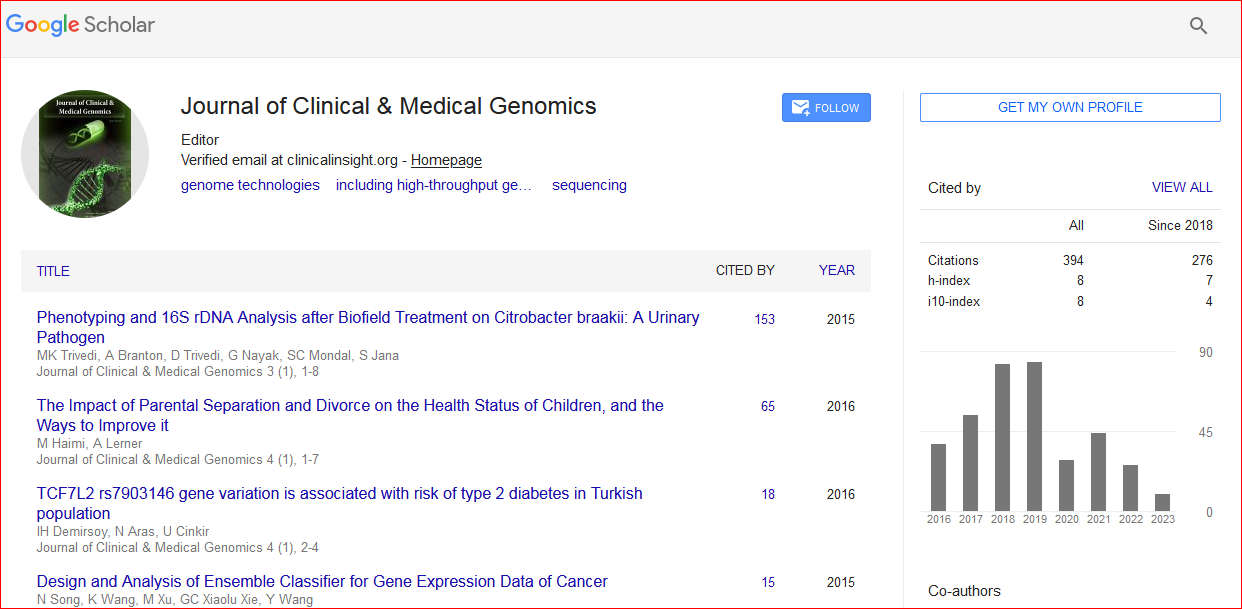
Journal of Clinical & Medical Genomics received 391 citations as per Google Scholar report