Commentary - (2025) Volume 16, Issue 5
Received: 01-Oct-2025, Manuscript No. jtse-26-184778;
Editor assigned: 03-Oct-2025, Pre QC No. P-184778;
Reviewed: 17-Oct-2025, QC No. Q-184778;
Revised: 22-Oct-2025, Manuscript No. R-184778;
Published:
29-Oct-2025
, DOI: 10.37421/2157-7552.2025.16.456
Citation: Khalil, Omar. ”AI Revolutionizes Tissue Engineering For Regenerative Medicine.” J Tissue Sci Eng 16 (2026):456.
Copyright: © 2026 Khalil O. This is an open-access article distributed under the terms of the Creative Commons Attribution License, which permits unrestricted use, distribution and reproduction in any medium, provided the original author and source are credited.
Artificial intelligence (AI) is profoundly transforming the field of tissue engineering by facilitating the rapid exploration of extensive design spaces and enabling accurate predictions of material properties. This advanced computational approach allows for the analysis of intricate relationships between material composition, processing parameters, and the resulting characteristics of engineered tissues, thereby accelerating development cycles and enhancing precision in tissue control. This leads to the accelerated creation of scaffolds with customized mechanical, biological, and degradation profiles, which are vital for regenerative medicine applications. [1] Deep learning algorithms are proving to be instrumental in forecasting cellular responses to various biomaterials and in identifying optimal scaffold architectures. By leveraging large datasets of experimental outcomes, AI can accurately predict cell behavior, differentiation trajectories, and tissue integration, thereby guiding the design of more biocompatible and functional engineered tissues. This predictive capability substantially reduces the reliance on extensive empirical testing. [2] Generative adversarial networks (GANs) are emerging as potent tools for the conceptualization of novel biomaterial designs and the optimization of micro- and nanoscale features within engineered tissues. GANs possess the ability to discern the underlying patterns in successful tissue scaffolds and subsequently generate new designs with improved attributes. This capacity is critical for the design of sophisticated tissue constructs possessing specific functionalities, such as vascularization or innervation. [3] AI-driven high-throughput screening methodologies are significantly accelerating the process of identifying optimal biomaterials and fabrication parameters for tissue engineering applications. Through the automation of both design and testing procedures, AI facilitates the rapid evaluation of a multitude of material combinations and processing conditions, ultimately leading to the discovery of superior candidates for specific tissue regeneration objectives. [4] AI is actively being employed to optimize the intricate design of 3D printed scaffolds intended for tissue engineering purposes. Machine learning models are capable of predicting the mechanical integrity and the capacity for cell infiltration within complex scaffold geometries, thereby enabling the design of structures that more closely mimic native tissues and actively promote regenerative processes. [5] The integration of AI with experimental data is paving the way for the creation of highly personalized tissue-engineered constructs. By meticulously analyzing patient-specific data, AI can assist in the design of scaffolds and cell-based therapies that are precisely tailored to individual patient needs, thereby enhancing treatment efficacy and minimizing the occurrence of adverse reactions. [6] AI models are actively enhancing the simulation and prediction of tissue development and remodeling processes. This advancement empowers researchers to virtually assess various design strategies and therapeutic interventions, consequently optimizing the conditions necessary for successful tissue regeneration both in vitro and in vivo. [7] AI-powered image analysis plays a crucial role in the characterization of engineered tissues and the assessment of their overall quality. Machine learning algorithms can automate the quantification of cellular morphology, tissue organization, and vascularization directly from microscopy images, providing objective metrics that are essential for design optimization and stringent quality control. [8] The development of AI-driven design platforms is enabling the creation of bio-inspired materials that feature precisely controlled hierarchical structures. These sophisticated platforms are capable of exploring an extensive design space to identify materials that effectively emulate the intricate architectures of natural tissues, resulting in significant improvements in mechanical properties and biological interactions. [9] AI holds critical importance in optimizing the microenvironment of engineered tissues, which includes the design of advanced hydrogels and extracellular matrix mimetics. Machine learning algorithms can predict how subtle alterations in material properties and composition influence fundamental cell behaviors such as proliferation and differentiation, thereby guiding the development of more effective strategies for tissue regeneration. [10]
Artificial intelligence (AI) is revolutionizing biomaterial design for tissue engineering by enabling rapid exploration of vast design spaces and prediction of material properties. Machine learning models can analyze complex relationships between material composition, processing parameters, and resulting tissue characteristics, leading to faster development cycles and more precise control over engineered tissues. This approach accelerates the creation of scaffolds with tailored mechanical, biological, and degradation profiles for regenerative medicine applications. [1] Deep learning algorithms are proving invaluable for predicting cellular responses to biomaterials and identifying optimal scaffold architectures. By learning from large datasets of experimental outcomes, AI can forecast cell behavior, differentiation pathways, and tissue integration, thus guiding the design of more biocompatible and functional engineered tissues. This predictive power significantly reduces the need for extensive empirical testing. [2] Generative adversarial networks (GANs) are emerging as powerful tools for creating novel biomaterial designs and optimizing micro/nanoscale features of engineered tissues. GANs can learn the underlying patterns of successful tissue scaffolds and generate new designs with improved properties. This capability is crucial for designing complex tissue constructs with specific functionalities, such as vascularization or innervation. [3] AI-driven high-throughput screening is accelerating the identification of optimal biomaterials and fabrication parameters for tissue engineering. By automating design and testing, AI enables the rapid evaluation of numerous material combinations and processing conditions, leading to the discovery of superior candidates for specific tissue regeneration applications. [4] AI is being used to optimize the design of 3D printed scaffolds for tissue engineering. Machine learning models can predict the mechanical integrity and cell infiltration capabilities of complex scaffold geometries, enabling the design of structures that better mimic native tissues and promote regenerative processes. [5] The integration of AI with experimental data allows for the creation of personalized tissue engineered constructs. By analyzing patient-specific data, AI can help design scaffolds and cell-based therapies tailored to individual needs, improving treatment efficacy and reducing adverse reactions. [6] AI models are enhancing the simulation and prediction of tissue development and remodeling processes. This enables researchers to virtually test different design strategies and interventions, thereby optimizing the conditions for successful tissue regeneration in vitro and in vivo. [7] AI-powered image analysis is crucial for characterizing engineered tissues and assessing their quality. Machine learning can automate the quantification of cellular morphology, tissue organization, and vascularization from microscopy images, providing objective metrics for design optimization and quality control. [8] The development of AI-driven design platforms is enabling the creation of bio-inspired materials with precisely controlled hierarchical structures. These platforms can explore a vast design space to identify materials that mimic the intricate architectures of natural tissues, leading to enhanced mechanical properties and biological interactions. [9] AI is critical for optimizing the microenvironment of engineered tissues, including the design of hydrogels and extracellular matrix mimetics. Machine learning can predict how subtle changes in material properties and composition influence cell behavior, proliferation, and differentiation, thereby guiding the development of more effective tissue regeneration strategies. [10]
Artificial intelligence (AI) is revolutionizing tissue engineering by enabling rapid design exploration and property prediction. Machine learning models analyze material composition, processing, and tissue characteristics for faster development and precise control, creating scaffolds with tailored profiles for regenerative medicine. Deep learning algorithms predict cellular responses and guide scaffold design for biocompatibility and functionality, reducing empirical testing. Generative adversarial networks (GANs) create novel biomaterial designs and optimize nanoscale features for complex tissue constructs. AI-driven high-throughput screening accelerates the identification of optimal biomaterials and fabrication parameters. AI optimizes 3D printed scaffolds by predicting mechanical integrity and cell infiltration, enhancing mimicry of native tissues. AI facilitates personalized tissue engineering by analyzing patient data for tailored scaffolds and therapies. AI models enhance simulation of tissue development, allowing virtual testing of designs for optimized regeneration. AI-powered image analysis automates tissue characterization and quality assessment. AI-driven platforms create bio-inspired materials with controlled hierarchical structures. AI optimizes engineered tissue microenvironments, guiding development of effective regeneration strategies.
None
None
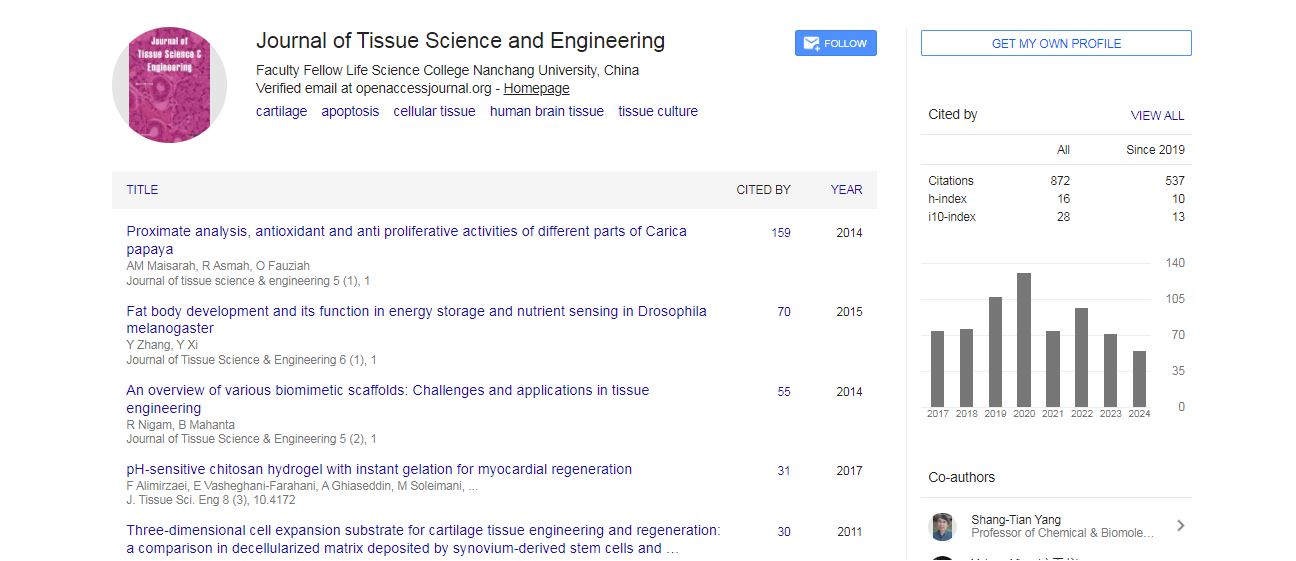
Journal of Tissue Science and Engineering received 807 citations as per Google Scholar report