Opinion - (2025) Volume 14, Issue 5
Received: 02-Sep-2025, Manuscript No. pbt-25-173774;
Editor assigned: 04-Sep-2025, Pre QC No. P-173774;
Reviewed: 18-Sep-2025, QC No. Q-173774;
Revised: 23-Sep-2025, Manuscript No. R-173774;
Published:
30-Sep-2025
, DOI: 10.37421/2167-7689.2025.14.503
Citation: Yamamoto, Kenji. ”Advancing Drug Safety, Development, and Patient Care.” Pharmaceut Reg Affairs 14 (2025):503.
Copyright: © 2025 Yamamoto K. This is an open-access article distributed under the terms of the Creative Commons Attribution License, which permits unrestricted use,
distribution and reproduction in any medium, provided the original author and source are credited.
Artificial Intelligence (AI) and Machine Learning (ML) are actively transforming drug safety. These advanced technologies are revolutionizing pharmacovigilance by enabling sophisticated signal detection, robust risk assessment, and precise predictive analytics. This significantly improves the continuous monitoring of adverse drug reactions, making the entire process more proactive and efficient [1].
The pharmaceutical industry is increasingly recognizing the invaluable contribution of real-world data (RWD) and real-world evidence (RWE). These insights are crucial throughout the drug development and regulatory processes, offering a deeper understanding of drug safety and efficacy that beautifully complements findings from traditional clinical trials, providing a more holistic view of drug performance [2].
Pharmacovigilance, at its core, is dedicated to ensuring drug safety. A comprehensive review of its current landscape reveals evolving challenges and outlines crucial future directions. These efforts are focused on continuous monitoring and effective risk management strategies to maintain high standards of patient safety in a dynamic therapeutic environment [3].
Drug repositioning, which involves identifying novel therapeutic uses for existing drugs, presents a highly efficient and cost-effective pathway in drug development. This approach is particularly advantageous because these drugs already possess established safety profiles, streamlining the development timeline and significantly reducing associated risks and costs [4].
Patient safety is gravely threatened by medication errors, a pervasive issue that underscores the critical necessity for comprehensive medication management systems and practices. These measures are essential to ensure the delivery of high-quality patient care and to diligently minimize the occurrence of adverse events associated with drug administration, protecting patients from harm [5].
Personalized medicine represents a profound paradigm shift in both drug development and patient care. By leveraging individual genetic and molecular profiles, this approach enables the tailoring of therapies. The goal is to achieve improved efficacy while simultaneously reducing undesirable adverse effects, moving towards more precise and individualized treatments for better patient outcomes [6].
Regulatory science for medical products faces a dynamic environment, filled with both new opportunities and significant challenges. This is particularly true for advanced therapies, where agile regulatory frameworks are essential. The aim is to balance the need for innovation with rigorous oversight to ensure both safety and efficacy of cutting-edge treatments [7].
Drug-drug interactions carry substantial clinical implications, directly impacting patient safety and the overall success of therapeutic outcomes. Developing and implementing effective management strategies is crucial to mitigate these risks in everyday clinical practice, safeguarding patients from potential harm and optimizing their treatment regimens [8].
Ensuring drug safety within pediatric populations presents a unique set of challenges, primarily due to distinct physiological differences in children. This necessitates specialized research and development efforts. These efforts are vital to guarantee the safe and effective use of medications tailored specifically for younger patients, addressing their specific developmental needs [9].
Post-marketing surveillance stands as an indispensable component of comprehensive drug safety monitoring. Its role is to continuously identify rare or long-term adverse reactions that may have been overlooked in initial clinical trials. This ongoing vigilance refines and enhances the overall drug safety profiles, providing a complete and long-term picture of a drug's performance [10].
The pharmaceutical industry is experiencing a profound shift, with Artificial Intelligence (AI) and Machine Learning (ML) emerging as pivotal technologies that are revolutionizing drug safety. These advanced tools significantly enhance pharmacovigilance efforts through sophisticated signal detection, precise risk assessment, and powerful predictive analytics, which together streamline and improve the monitoring of adverse drug reactions [1]. In parallel, real-world data (RWD) and real-world evidence (RWE) are increasingly vital assets in drug development and regulatory processes. They provide invaluable insights into drug safety and efficacy, acting as a crucial complement to the data traditionally gathered during clinical trials, thereby offering a more comprehensive understanding of a drug's performance in varied patient populations [2]. This evolving landscape of pharmacovigilance continuously faces new challenges and directions, demanding ongoing innovation in risk management and continuous monitoring to maintain the highest standards of drug safety [3].
Beyond novel drug discovery, drug repositioning offers an exceptionally efficient and cost-effective pathway in drug development. This involves identifying new therapeutic uses for existing drugs, a strategy that benefits immensely from their already established safety profiles, which inherently reduces development time and costs [4]. However, even with established drugs, patient safety remains a critical concern, particularly when it comes to medication errors. These errors pose a significant threat, underscoring the urgent need for robust medication management systems and meticulous practices. These measures are fundamental to ensuring high-quality patient care and minimizing adverse events associated with drug administration [5].
A transformative shift in patient care and drug development is marked by the advent of personalized medicine. This innovative approach leverages individual genetic and molecular profiles to tailor therapies, aiming for superior efficacy and a marked reduction in adverse effects. Such individualized treatment paradigms promise a future of more precise and effective healthcare delivery [6]. Furthermore, regulatory science for medical products is constantly adapting to new opportunities and challenges, especially those presented by advanced therapies. This requires the development of agile and flexible regulatory frameworks designed to ensure both groundbreaking innovation and rigorous oversight regarding safety and efficacy [7].
Complexities in drug administration extend to the realm of drug-drug interactions, which carry significant clinical implications. These interactions can adversely affect patient safety and therapeutic outcomes, making effective management strategies absolutely essential to mitigate these risks in everyday practice. Understanding and addressing these interactions is paramount for optimal patient care and drug efficacy [8]. Another critical area of focus is ensuring drug safety in pediatric populations. This presents unique challenges due to the distinct physiological differences in children compared to adults. Specialized research and development efforts are therefore vital to guarantee the safe and effective use of medications for younger patients, ensuring their unique needs are met safely [9].
Rounding out the comprehensive approach to drug safety, post-marketing surveillance serves as an essential and continuous component. Its primary role is to diligently identify rare or long-term adverse reactions that may not have been detectable during the more controlled and often limited scope of clinical trials. This ongoing vigilance is crucial for refining overall drug safety profiles, providing long-term data that informs better patient care and drug management strategies over the product's entire lifecycle [10].
The landscape of drug safety and development is undergoing significant transformation, driven by advancements in various fields. Artificial Intelligence (AI) and Machine Learning (ML) are enhancing pharmacovigilance through advanced signal detection and risk assessment, improving the monitoring of adverse drug reactions. Real-world data and evidence are becoming vital for drug development, offering insights that supplement traditional clinical trials. Pharmacovigilance itself is continuously evolving, facing challenges in risk management and monitoring. New strategies like drug repositioning offer efficient pathways by finding new uses for existing drugs, leveraging their established safety profiles. Patient safety is paramount, particularly concerning medication errors, which necessitate robust management systems. Personalized medicine is reshaping patient care by tailoring therapies based on individual profiles, aiming for improved efficacy and reduced adverse effects. Regulatory science adapts to new medical products and advanced therapies, demanding agile frameworks for oversight and innovation. Critical areas like drug-drug interactions require effective management to safeguard patient outcomes. Special attention is given to pediatric drug safety, acknowledging unique physiological challenges and the need for specialized development. Finally, post-marketing surveillance remains crucial for identifying rare or long-term adverse reactions, ensuring comprehensive drug safety profiles. This comprehensive approach reflects a dedication to improving therapeutic outcomes across diverse populations.
None
None
1. Ping M, Hui L, Zhen C. "Artificial intelligence and machine learning in drug safety: a new paradigm".Acta Pharm Sin B 13 (2023):1471-1483.
Indexed at, Google Scholar, Crossref
2. Hyun-Sun K, Ju-Hong K, Seung-Hwan L. "Real-world data and real-world evidence for drug development: an overview of the regulatory perspective".Front Pharmacol 14 (2023):1221376.
Indexed at, Google Scholar, Crossref
3. Majed MR, Sami S, Majed A. "Pharmacovigilance: A review of the current landscape and future directions".J Pharm Pract 36 (2023):1083-1090.
Indexed at, Google Scholar, Crossref
4. Mingyi Z, Yan H, Jiahong X. "Drug repositioning: From concept to successful applications".J Med Chem 66 (2023):5293-5321.
Indexed at, Google Scholar, Crossref
5. Walid A, Sarah R, Ahmad M. "Patient safety and quality of care in medication management: A review of the literature".J Pharm Policy Pract 16 (2023):144.
Indexed at, Google Scholar, Crossref
6. Lara HG, Nicholas JS, Eric JT. "Personalized medicine: A paradigm shift in drug development and patient care".Pharmacogenomics J 23 (2023):181-190.
Indexed at, Google Scholar, Crossref
7. Peter WM, Scott G, Celine Z. "Regulatory science for medical products: opportunities and challenges for advanced therapies".Nat Rev Drug Discov 22 (2023):579-594.
Indexed at, Google Scholar, Crossref
8. Jun L, Chong G, Xiaolei Z. "Drug-drug interactions: Clinical implications and management strategies".Clin Pharmacol Ther 113 (2023):1177-1188.
Indexed at, Google Scholar, Crossref
9. Adel R, Mahmoud EK, Mohammed ES. "Drug safety in pediatrics: Challenges and solutions".J Adv Res 51 (2023):111-120.
Indexed at, Google Scholar, Crossref
10. Vidya R, Moni N, Shalini P. "Post-marketing surveillance: Evolving strategies for drug safety monitoring".Curr Drug Saf 16 (2021):109-118.
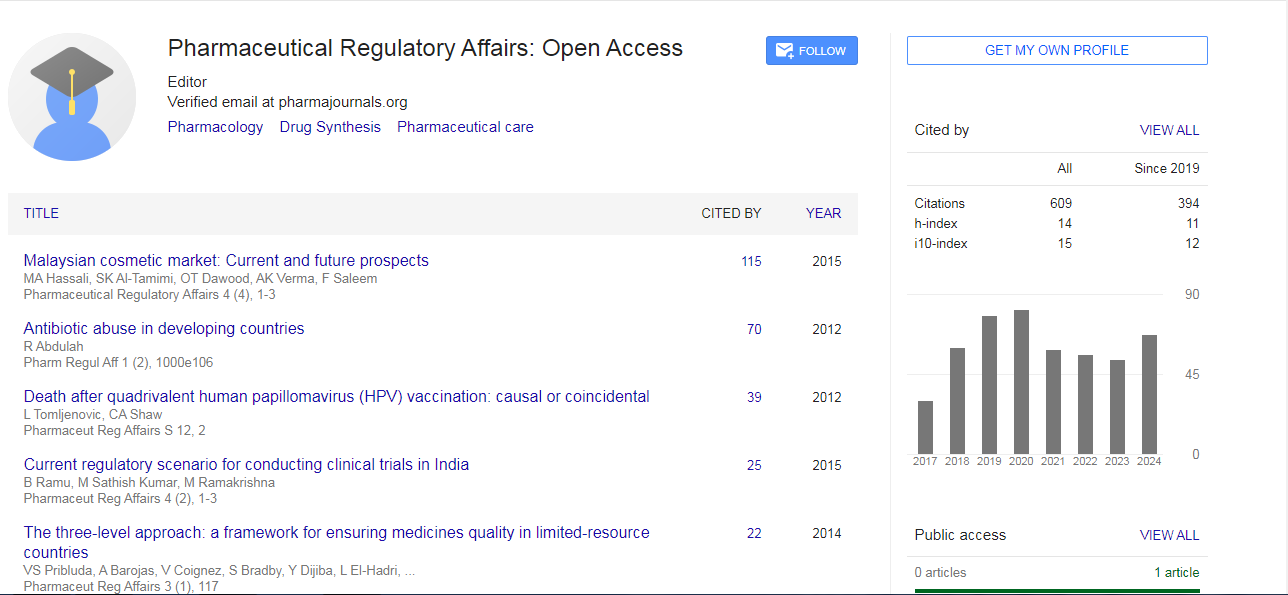
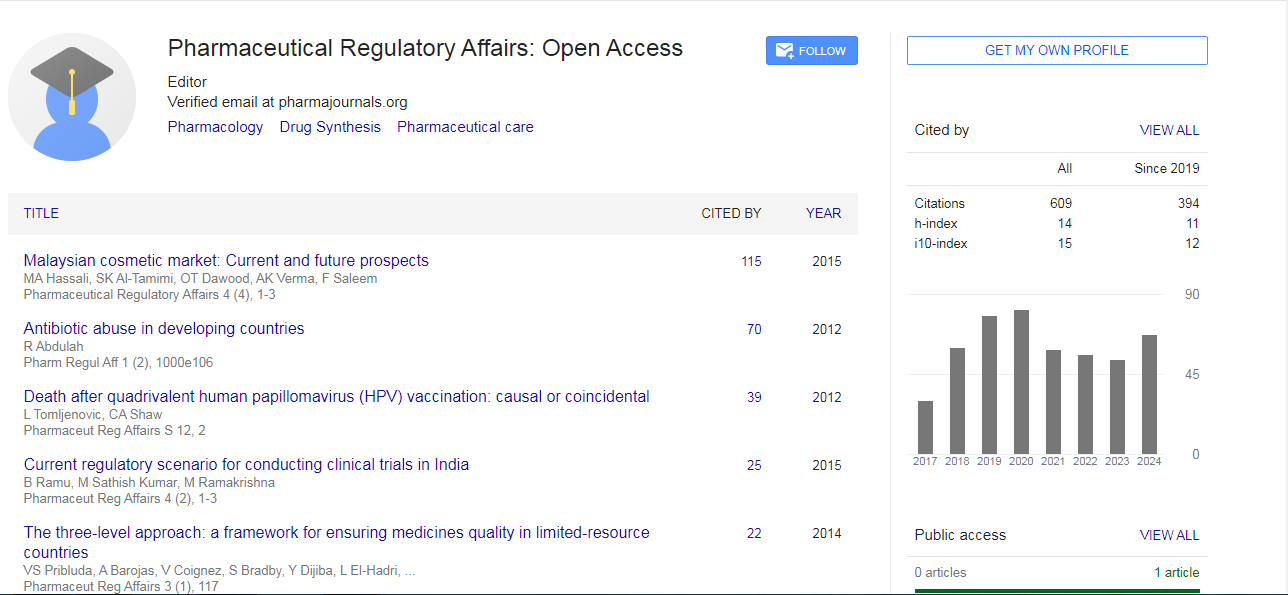
Pharmaceutical Regulatory Affairs: Open Access received 533 citations as per Google Scholar report