Opinion - (2025) Volume 15, Issue 4
Received: 03-Aug-2025, Manuscript No. jprm-25-174458;
Editor assigned: 06-Aug-2025, Pre QC No. P-174458;
Reviewed: 19-Aug-2025, QC No. Q-174458;
Revised: 25-Aug-2025, Manuscript No. R-174458;
Published:
30-Aug-2025
, DOI: 10.37421/2161-105X.2025.15.751
Citation: Foster, Daniel. ”Advances in Mechanical Ventilation and Patient Care.” J Pulm Respir Med 15 (2025):751.
Copyright: © 2025 Foster D. This is an open-access article distributed under the terms of the Creative Commons Attribution License, which permits unrestricted use, distribution and reproduction in any medium, provided the original author and source are credited.
Mechanical ventilation is a cornerstone of critical care, providing life support for patients with severe respiratory failure. The optimal management of these patients involves a complex interplay of ventilator settings, adjunctive therapies, and vigilant monitoring to improve outcomes and minimize complications. Recent advancements and ongoing research continue to refine our understanding and approach to this critical intervention. This body of work begins with a comprehensive review of Acute Respiratory Distress Syndrome (ARDS), detailing the evolution of mechanical ventilation strategies. It emphasizes that lung-protective ventilation, characterized by low tidal volumes and appropriate Positive End-Expiratory Pressure (PEEP), stands as a foundational treatment to reduce ventilator-induced lung injury and enhance patient outcomes. The article also touches upon adjunctive therapies and future directions in ARDS management [1].
Next, we look at the critical process of weaning from mechanical ventilation. This review discusses current strategies and inherent challenges, underscoring the importance of timely, individualized approaches. These include spontaneous breathing trials, robust assessment criteria, and recognizing factors contributing to weaning failure. The need for a multidisciplinary team approach to optimize this process and reduce the duration of mechanical ventilation is also highlighted [2].
Building on the idea of lung protection, another review specifically delves into the concept of lung protective ventilation, drawing crucial lessons from ARDS management. It explains how strategies like low tidal volume and plateau pressure limitation reduce ventilator-induced lung injury (VILI) by minimizing mechanical stress and strain on the delicate lung tissue. The authors discuss the physiological basis and clinical evidence supporting these approaches, highlighting their impact on mortality and morbidity in critically ill patients [4].
A significant challenge in ventilated patients is patient-ventilator asynchrony, which often leads to adverse outcomes. This article explores the complexities, detailing various types of asynchrony, their physiological consequences, and effective methods for detection and management. The review stresses the importance of careful ventilator settings, diligent sedation management, and advanced monitoring techniques to improve patient comfort and further reduce ventilator-induced lung injury [3].
Optimizing Positive End-Expiratory Pressure (PEEP) titration in ARDS represents another ongoing area of debate and evolving evidence. This article reviews various strategies for setting PEEP, including decremental PEEP trials, esophageal pressure-guided PEEP, and individualized approaches based on lung mechanics. The goal of PEEP in ARDS, which is to prevent alveolar collapse, improve oxygenation, and minimize ventilator-induced lung injury, is discussed, acknowledging the difficulties in finding the 'optimal' level [9].
Adjunctive therapies are also vital in managing respiratory failure. For instance, High-Flow Nasal Cannula (HFNC) is evaluated for its role in acute hypoxemic respiratory failure, often serving as an alternative or bridge to invasive ventilation. This article compares HFNC's effectiveness against conventional oxygen therapy and non-invasive ventilation, discussing its mechanisms, patient selection, and clinical outcomes. The review highlights HFNC's capacity to provide respiratory support, lessen the work of breathing, and potentially avert intubation in selected patients [5].
In cases of severe ARDS where standard ventilation fails, Extracorporeal Membrane Oxygenation (ECMO) emerges as a vital rescue therapy. Its application, though complex, is guided by specific indications and contraindications, with ongoing research refining patient selection and management, including anticoagulation and complication mitigation [6].
Furthermore, neuromuscular blocking agents (NMBAs) are utilized in ARDS to improve patient-ventilator synchrony, reduce lung injury, and decrease oxygen consumption. Their use requires careful patient selection and continuous monitoring to ensure safety and efficacy [7].
The process of liberating patients from mechanical ventilation is further elaborated by a comprehensive review focusing on spontaneous breathing trials (SBTs) as a key component. This article details the physiological basis, methodology, and predictors of success and failure for various SBT modalities. It offers insights into optimizing SBTs to facilitate successful liberation, minimize complications, and improve long-term outcomes for critically ill patients [8].
Finally, the rapidly expanding role of Artificial Intelligence (AI) in mechanical ventilation is explored. This narrative review discusses how AI algorithms can enhance patient care by optimizing ventilator settings, predicting complications, detecting patient-ventilator asynchrony, and assisting in the weaning process. The article emphasizes AI's potential to personalize ventilation strategies, improve diagnostic accuracy, and reduce clinician workload, while also addressing challenges and future directions for its clinical integration [10].
Mechanical ventilation serves as a crucial intervention in critical care, supporting patients with severe respiratory compromise. The literature consistently points to the imperative of lung-protective ventilation, especially in conditions like Acute Respiratory Distress Syndrome (ARDS) [1]. Strategies such as maintaining low tidal volumes and carefully setting Positive End-Expiratory Pressure (PEEP) are fundamental. These practices are designed to reduce ventilator-induced lung injury (VILI) by minimizing mechanical stress and strain on the delicate lung tissue, ultimately improving patient outcomes and survival [1, 4]. Finding the optimal PEEP level in ARDS, however, remains a complex challenge, with various titration strategies like decremental PEEP trials and esophageal pressure-guided approaches being explored to balance alveolar recruitment and prevent collapse [9].
Beyond the initial management, a significant focus lies on the process of weaning patients from mechanical ventilation. This transition is critical and demands timely, individualized strategies [2]. Spontaneous breathing trials (SBTs) are central to this process, with reviews detailing their physiological basis, methodology, and predictors of success or failure. Optimizing SBTs is key to facilitating successful liberation, minimizing complications, and improving long-term patient outcomes [2, 8]. Successful weaning often requires a multidisciplinary team approach, recognizing factors that contribute to failure to ensure a smoother transition off the ventilator [2].
Patient-ventilator asynchrony presents another common hurdle in mechanically ventilated patients, often leading to adverse outcomes. Understanding the various types of asynchrony, their physiological impacts, and effective methods for detection and management is essential. Careful ventilator settings, appropriate sedation management, and advanced monitoring techniques are crucial steps in enhancing patient comfort and further mitigating ventilator-induced lung injury attributed to asynchrony [3]. The goal here is to ensure the ventilator works harmoniously with the patient's own respiratory efforts.
Several adjunctive therapies complement conventional mechanical ventilation strategies. High-Flow Nasal Cannula (HFNC) is a valuable tool for managing acute hypoxemic respiratory failure, sometimes serving as an alternative or bridge to invasive ventilation. Studies show HFNC's effectiveness compared to traditional oxygen therapy, highlighting its ability to provide respiratory support, reduce the work of breathing, and potentially prevent intubation in select patients [5]. For the most severe cases of ARDS, where standard ventilation fails, Extracorporeal Membrane Oxygenation (ECMO) acts as a vital rescue therapy. Its application, though complex, is guided by specific indications and contraindications, with ongoing research refining patient selection and management, including anticoagulation and complication mitigation [6]. Furthermore, neuromuscular blocking agents (NMBAs) are utilized in ARDS to improve patient-ventilator synchrony, reduce lung injury, and decrease oxygen consumption. Their use requires careful patient selection and continuous monitoring to ensure safety and efficacy [7].
Looking ahead, the integration of Artificial Intelligence (AI) into mechanical ventilation promises to revolutionize patient care. AI algorithms can optimize ventilator settings, predict complications, detect asynchrony, and even assist in the weaning process. This technology holds the potential to personalize ventilation strategies, boost diagnostic accuracy, and lessen the workload for clinicians, pointing towards a significant future direction in critical care management [10]. The continuous evolution of these strategies, from fundamental lung protection to advanced AI applications, reflects an ongoing commitment to enhancing respiratory support for critically ill individuals.
The provided reviews offer a comprehensive look at modern mechanical ventilation practices, with a strong focus on improving patient outcomes and minimizing harm. A central theme is the management of Acute Respiratory Distress Syndrome (ARDS), where lung-protective ventilation, involving low tidal volumes and appropriate Positive End-Expiratory Pressure (PEEP), is paramount to reduce ventilator-induced lung injury. These strategies are crucial for patient survival. Beyond initial ventilation, successfully weaning patients from mechanical support is a critical, often challenging process. This involves individualized strategies, spontaneous breathing trials, and a multidisciplinary approach to ensure timely liberation and reduce complications. Issues like patient-ventilator asynchrony are also thoroughly discussed, noting their adverse effects and the importance of careful ventilator settings, sedation, and advanced monitoring for detection and management. Adjunctive therapies play a significant role. High-Flow Nasal Cannula (HFNC) emerges as an alternative for acute hypoxemic respiratory failure, potentially avoiding intubation in select cases. For severe ARDS where conventional ventilation fails, Extracorporeal Membrane Oxygenation (ECMO) acts as a rescue therapy, though its use requires careful patient selection and management of complexities like anticoagulation. Neuromuscular Blocking Agents (NMBAs) are also considered for ARDS patients, aiming to improve synchrony and reduce lung injury. Looking ahead, Artificial Intelligence (AI) is set to transform mechanical ventilation by optimizing settings, predicting complications, and assisting in weaning. This technological integration aims to personalize care, enhance diagnostic accuracy, and ease clinician workload, marking a vital future direction in critical care.
None
None
1. Matthay MA, Arabi YM, Ranieri VM. "Acute Respiratory Distress Syndrome".N Engl J Med 388 (2023):601-615.
Indexed at, Google Scholar, Crossref
2. Ambrosino N, Vianello A, Vitacca M. "Weaning from mechanical ventilation: a narrative review".Pulmonology 26 (2020):298-306.
Indexed at, Google Scholar, Crossref
3. Mellum CD, Telfer J, Bellani G. "Patient-ventilator asynchrony: Current knowledge and future perspectives".Semin Respir Crit Care Med 43 (2022):838-846.
Indexed at, Google Scholar, Crossref
4. Gattinoni L, Chiumello D, Caironi P. "Lung protective ventilation: lessons from ARDS".Crit Care 24 (2020):608.
Indexed at, Google Scholar, Crossref
5. Roche-Campo F, Roca O, Riera J. "High-Flow Nasal Cannula for Acute Hypoxemic Respiratory Failure".Crit Care Clin 38 (2022):299-317.
Indexed at, Google Scholar, Crossref
6. Combes A, Hajage D, Capellier G. "Extracorporeal membrane oxygenation for severe acute respiratory distress syndrome".Intensive Care Med 46 (2020):2424-2432.
Indexed at, Google Scholar, Crossref
7. Papazian L, Aubrun F, Combes A. "Neuromuscular blocking agents in ARDS: what is the evidence?".Curr Opin Crit Care 26 (2020):32-38.
Indexed at, Google Scholar, Crossref
8. Schellekens W, van dBM, van dSA. "Spontaneous breathing trials: a comprehensive review".Crit Care 25 (2021):284.
Indexed at, Google Scholar, Crossref
9. Borges JB, Hedenstierna G, Larsson A. "Optimal PEEP in ARDS: current evidence and future directions".Ann Transl Med 9 (2021):284.
Indexed at, Google Scholar, Crossref
10. Arnal J, Perbet S, LaCombe J. "Artificial intelligence in mechanical ventilation: a narrative review".Crit Care 26 (2022):241.
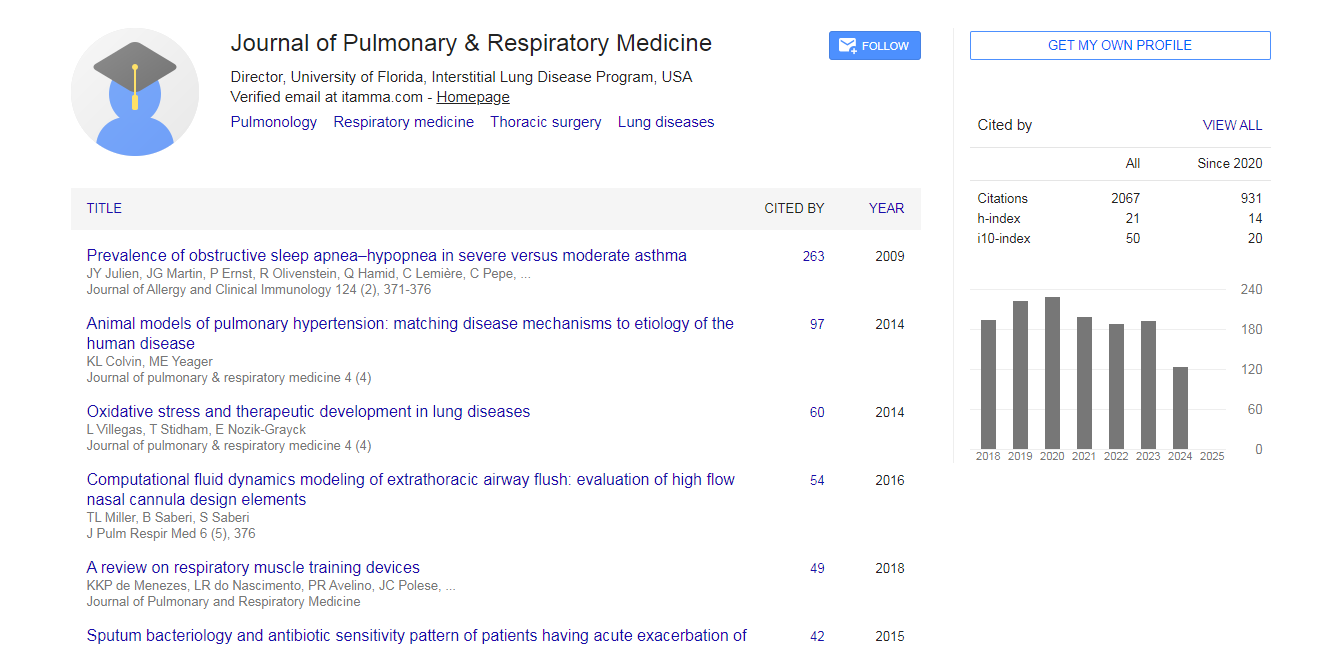
Pulmonary & Respiratory Medicine received 1690 citations as per Google Scholar report