Opinion - (2025) Volume 11, Issue 2
Received: 01-Mar-2025, Manuscript No. ldt-25-178415;
Editor assigned: 03-Mar-2025, Pre QC No. P-178415;
Reviewed: 17-Mar-2025, QC No. Q-178415;
Revised: 24-Mar-2025, Manuscript No. R-178415;
Published:
31-Mar-2025
, DOI: 10.37421/2472-1018.2025.11.298
Citation: Moore, Rebecca L.. ”Advances In Interstitial Lung Disease Management.” J Lung Dis Treat 11 (2025):298.
Copyright: © 2025 Moore L. Rebecca This is an open-access article distributed under the terms of the Creative Commons Attribution License, which permits unrestricted use, distribution and reproduction in any medium, provided the original author and source are credited.
The management of Interstitial Lung Diseases (ILDs) has undergone significant evolution, with a pronounced emphasis on achieving early diagnosis and implementing tailored therapeutic strategies to improve patient outcomes and quality of life. Current approaches are meticulously designed to decelerate disease progression and alleviate debilitating symptoms by addressing the underlying pathological mechanisms. For Idiopathic Pulmonary Fibrosis (IPF), antifibrotic agents have become a cornerstone, while immunosuppressants are crucial for ILDs associated with connective tissue diseases. Supportive care remains indispensable for various other ILD subtypes, addressing the multifaceted nature of these conditions. [1] Pirfenidone and nintedanib represent the leading antifibrotic therapies for IPF, consistently demonstrating their ability to slow the decline in lung function. The ongoing exploration of their utility in other fibrotic ILDs and in combination with other therapeutic agents signifies a dynamic research landscape aimed at optimizing treatment efficacy. A thorough understanding of patient selection criteria and vigilant treatment monitoring are paramount for achieving the best possible outcomes with these agents. [2] Immunosuppressive agents, encompassing corticosteroids, mycophenolate mofetil, and azathioprine, are integral to the effective management of ILDs that arise in the context of connective tissue diseases, such as scleroderma and rheumatoid arthritis. The development of personalized treatment plans, meticulously tailored to the specific disease phenotype and severity, is essential for maximizing therapeutic benefit while diligently minimizing the risks of treatment-related toxicities. [3] For individuals afflicted with advanced ILDs who have exhausted conventional treatment modalities, lung transplantation emerges as a potentially life-saving intervention. The success of this procedure is heavily reliant on rigorous patient selection, meticulous perioperative management, and the administration of appropriate long-term immunosuppression to prevent graft rejection and ensure favorable long-term outcomes. [4] The established benefits of pulmonary rehabilitation in enhancing exercise capacity and improving the overall quality of life for patients diagnosed with ILDs cannot be overstated. Comprehensive rehabilitation programs are designed to address physical deconditioning, effectively manage dyspnea, and provide crucial psychosocial support, thereby empowering patients to better navigate the challenges posed by their chronic condition. [5] Emerging therapeutic targets within the ILD domain are continuously being identified, with a strategic focus on pathways implicated in fibroblast activation, the aberrant deposition of extracellular matrix, and dysregulated immune responses. This includes the investigation of novel drug candidates that target critical signaling pathways such as TGF-β and chemokine pathways, alongside the development of innovative anti-inflammatory agents. [6] Genetic predisposition has been recognized as a significant contributor to the pathogenesis of a variety of ILDs, with particular relevance observed in IPF. The identification of these genetic susceptibilities holds considerable promise for improving risk stratification among individuals and could potentially pave the way for the development of highly personalized treatment strategies in the future. [7] A fundamental pillar of optimal ILD management lies in the adoption of a comprehensive multidisciplinary approach. This collaborative model involves the coordinated efforts of pulmonologists, radiologists, pathologists, rheumatologists, specialized nurses, and physiotherapists, ensuring a holistic assessment and the development of individualized treatment plans. [8] Nintedanib has demonstrated notable efficacy in retarding disease progression among patients diagnosed with systemic sclerosis-associated interstitial lung disease (SSc-ILD). The expanding application of this antifibrotic agent beyond its initial indication for IPF to encompass other fibrotic ILDs signifies a transformative shift in the therapeutic paradigm for these complex respiratory conditions. [9] Advancements in imaging technologies, particularly high-resolution computed tomography (HRCT), coupled with the utilization of novel biomarkers, are significantly enhancing the early detection and accurate differential diagnosis of ILDs. This improved diagnostic capability is instrumental in facilitating the timely initiation of appropriate and effective therapeutic interventions. [10]
The management of Interstitial Lung Diseases (ILDs) is characterized by a growing emphasis on early detection and the implementation of personalized therapeutic strategies aimed at slowing disease progression and improving patient quality of life. This involves addressing the underlying pathological mechanisms and effectively managing symptoms across diverse ILD subtypes. [1] Antifibrotic agents, specifically pirfenidone and nintedanib, are recognized as central to the treatment of Idiopathic Pulmonary Fibrosis (IPF), showing a consistent ability to mitigate the decline in lung function. Research continues to explore their expanded roles in other fibrotic ILDs and in combination therapies, underscoring the importance of precise patient selection and diligent monitoring for optimal results. [2] In cases of ILDs linked to connective tissue diseases, such as scleroderma and rheumatoid arthritis, immunosuppressive agents like corticosteroids, mycophenolate mofetil, and azathioprine are indispensable. A personalized approach that considers the specific disease phenotype and its severity is crucial for balancing therapeutic effectiveness with the mitigation of potential treatment-related toxicities. [3] Lung transplantation represents a critical, life-saving option for carefully selected patients with advanced ILDs who have exhausted other treatment avenues. The success of this intervention hinges on stringent patient selection criteria, optimized perioperative care, and sustained immunosuppression to ensure long-term graft survival and patient well-being. [4] Pulmonary rehabilitation programs are well-established for their role in improving exercise capacity and enhancing the quality of life for individuals living with ILDs. These comprehensive programs tackle physical deconditioning, offer strategies for dyspnea management, and provide essential psychosocial support, thereby improving patients' ability to cope with their illness. [5] The field of ILD therapeutics is actively exploring novel targets related to fibroblast activation, extracellular matrix accumulation, and immune dysregulation. This includes the development of drugs targeting key signaling pathways like TGF-β, as well as exploring new anti-inflammatory agents and chemokine pathway modulators. [6] Genetic factors significantly influence the development of various ILDs, particularly IPF. Identifying genetic predispositions can play a crucial role in stratifying patient risk and may offer future avenues for developing highly personalized and targeted treatment strategies based on an individual's genetic makeup. [7] A multidisciplinary team approach is fundamental to the effective management of ILDs, integrating the expertise of pulmonologists, radiologists, pathologists, rheumatologists, nurses, and physiotherapists. This collaborative model ensures a holistic patient assessment and the formulation of individualized treatment plans that address all facets of the disease. [8] Nintedanib has shown demonstrable efficacy in slowing disease progression in patients with systemic sclerosis-associated interstitial lung disease (SSc-ILD). Its utility is expanding beyond IPF, indicating a broader potential application in managing a range of fibrotic ILDs and marking a significant advancement in the therapeutic landscape for these conditions. [9] Recent advancements in diagnostic tools, including high-resolution computed tomography (HRCT) and novel biomarkers, are greatly improving the early detection and accurate differentiation of ILDs. This enhanced diagnostic precision is vital for enabling the prompt initiation of appropriate and effective therapeutic interventions, leading to better patient outcomes. [10]
Interstitial Lung Diseases (ILDs) management has advanced with a focus on early diagnosis and tailored therapies, including antifibrotic agents for IPF and immunosuppressants for connective tissue disease-associated ILDs. Supportive care and emerging therapies targeting inflammation and fibrosis are also crucial. Pirfenidone and nintedanib remain key for IPF, with research exploring their use in other fibrotic ILDs. Immunosuppression is vital for CTD-ILDs, requiring personalized treatment. Lung transplantation is an option for advanced cases, demanding careful selection and management. Pulmonary rehabilitation is established for improving exercise capacity and quality of life. Novel therapeutic targets focusing on fibrotic and inflammatory pathways are emerging. Genetic factors play a role, aiding risk stratification and personalized treatment. A multidisciplinary approach involving various specialists ensures comprehensive care. Nintedanib shows promise in SSc-ILD, expanding its application. Improved imaging and biomarkers enhance early detection and diagnosis, facilitating timely interventions.
None
None
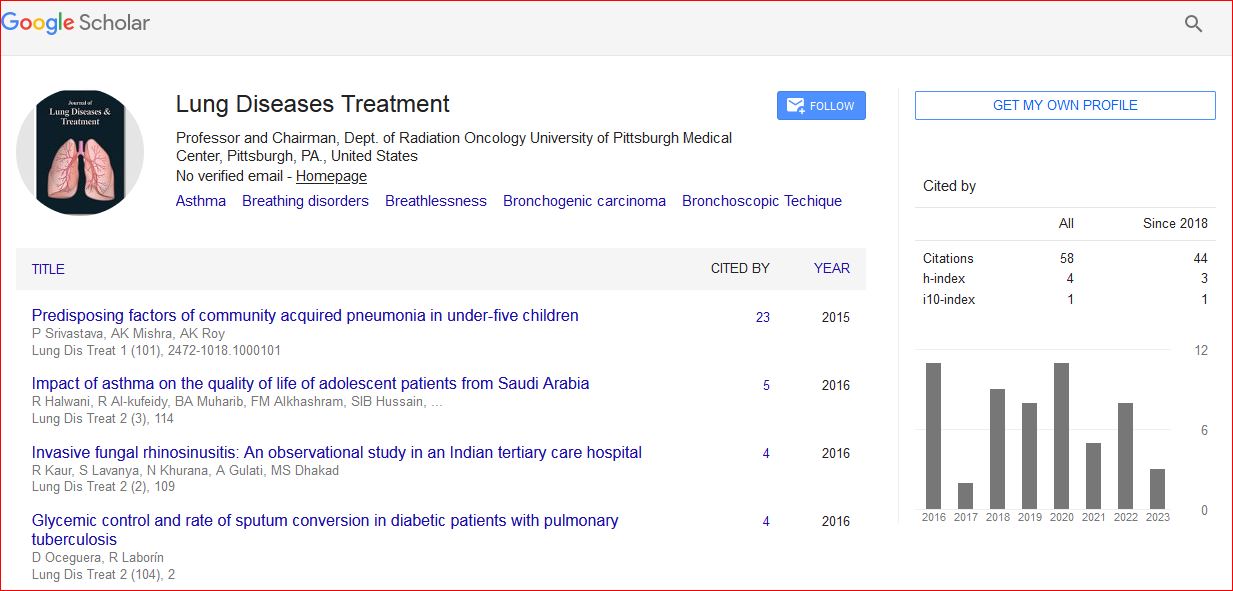
Journal of Lung Diseases & Treatment received 247 citations as per Google Scholar report