Opinion - (2025) Volume 11, Issue 2
Received: 01-Apr-2025, Manuscript No. jssc-26-188254;
Editor assigned: 03-Apr-2025, Pre QC No. P-188254;
Reviewed: 17-Apr-2025, QC No. Q-188254;
Revised: 22-Apr-2025, Manuscript No. R-188254;
Published:
29-Apr-2025
, DOI: 10.37421/2472-0437.2025.11.288
Citation: Zhang, Wei. ”Advancements In Steel Structure Design
Optimization: A Review.” J Steel Struct Constr 11 (2025):288.
Copyright: © 2025 Zhang W. This is an open-access article distributed under the terms of the Creative Commons Attribution License, which permits unrestricted use,
distribution and reproduction in any medium, provided the original author and source are credited.
The field of structural engineering is continuously evolving, driven by the need for more efficient, resilient, and sustainable construction practices. Steel structures, owing to their inherent strength and versatility, remain a cornerstone of modern architecture and infrastructure. Recent advancements in design optimization are crucial for harnessing the full potential of steel, ensuring that new projects meet the stringent demands of performance, safety, and environmental responsibility. This exploration begins with a look at the multifaceted aspects of design optimization for steel structures within contemporary construction. It delves into how advanced computational methods, material innovations, and sustainable practices are being integrated to achieve more efficient, resilient, and economical steel building designs. Key insights highlight the impact of performance-based design, the role of artificial intelligence in structural analysis, and the growing importance of life-cycle assessment in optimizing material usage and minimizing environmental impact [1].
Further research focuses on the seismic performance of steel buildings, investigating optimization strategies to enhance structural resilience. This work examines the effectiveness of different bracing systems and connection designs, employing sophisticated finite element analysis to predict behavior under extreme loading. The findings underscore how optimized designs can significantly reduce damage and ensure occupant safety, aligning with modern demands for robust infrastructure [2].
A significant challenge in tall structures is the optimization of slender steel columns. One study addresses this by presenting a novel approach to optimize cross-sectional dimensions and member lengths to maximize load-carrying capacity while minimizing material usage, considering buckling phenomena. These findings contribute to a more efficient use of steel in high-rise construction projects [3].
The integration of generative design and machine learning for optimizing steel structural components represents a significant technological leap. This research proposes algorithms that can rapidly generate and evaluate numerous design alternatives, identifying optimal solutions that balance structural integrity, constructability, and cost. It signifies a paradigm shift towards more intelligent and automated design processes in steel construction [4].
In the realm of composite structures, the optimization of steel-concrete composite beams is investigated for improved structural performance and sustainability. This paper analyzes different composite configurations and shear connection details to maximize load-bearing capacity and minimize deflection, considering long-term effects like creep. The study highlights how optimized composite designs offer significant advantages in terms of efficiency and material reduction compared to traditional steel-only structures [5].
The optimization of steel connections is identified as a critical factor for the overall performance of steel structures. This research concentrates on optimizing bolted and welded connections using advanced simulation tools and experimental validation. It explores how to achieve optimal strength, ductility, and fatigue resistance while minimizing material and fabrication costs, which are crucial for modern construction practices [6].
A distinct approach to optimization involves the topology of steel structural components. This paper presents a method that utilizes topology optimization algorithms, enabling designers to identify the most efficient material distribution within a given design space to achieve maximum stiffness and strength with minimal material. This technique is particularly relevant for complex steel geometries and lightweight structures [7].
With an increasing global focus on environmental impact, the optimization of steel structures considering sustainability and circular economy principles is gaining prominence. This research explores the use of recycled steel and the design for disassembly to minimize waste and facilitate material reuse at the end of a structure's life. It emphasizes a holistic approach to optimization that extends beyond structural performance to encompass environmental impact [8].
Finally, the optimization of steel gridshell structures for large-span applications is explored. This article focuses on achieving an optimal balance between structural stability, material usage, and aesthetic form through advanced computational design tools. The research provides valuable insights for designing innovative and efficient large-span steel structures [9].
Furthermore, the role of multi-objective optimization in the design of steel buildings is thoroughly discussed. This research investigates how to simultaneously optimize for competing objectives such as cost, weight, and structural performance, employing evolutionary algorithms. The findings offer a systematic framework for making informed design decisions in complex steel construction projects [10].
The contemporary landscape of steel structure design is being redefined by advanced optimization techniques aimed at enhancing efficiency and performance. The integration of computational methods, material science, and sustainable principles is at the forefront of this evolution, leading to more robust and economical steel buildings. Performance-based design, coupled with artificial intelligence in structural analysis and life-cycle assessment, are key elements in optimizing material use and reducing environmental footprints [1].
Seismic resilience in steel buildings is a paramount concern, driving research into optimization strategies that can improve structural integrity under extreme seismic events. Investigations into various bracing systems and connection designs, supported by sophisticated finite element analysis, predict structural behavior under intense loading. This research highlights the substantial benefits of optimized designs in minimizing damage and ensuring occupant safety, thereby meeting the requirements for resilient infrastructure [2].
The optimization of slender steel columns, a frequent challenge in the design of high-rise structures, is addressed through innovative approaches. By optimizing cross-sectional dimensions and member lengths, the goal is to maximize load-carrying capacity while simultaneously minimizing material consumption and accounting for buckling. This leads to more efficient material utilization in extensive vertical constructions [3].
A paradigm shift in steel structural component design is occurring with the integration of generative design and machine learning. These advanced algorithms are capable of rapidly generating and evaluating a multitude of design possibilities, identifying optimal solutions that harmoniously balance structural integrity, ease of construction, and overall cost-effectiveness. This heralds a new era of intelligent and automated design processes within the steel construction industry [4].
In the context of composite structures, the optimization of steel-concrete composite beams is being pursued to achieve superior structural performance and enhanced sustainability. The analysis of various composite configurations and shear connection details aims to maximize load-bearing capabilities and reduce deflection, taking into account long-term phenomena like creep. These optimized designs demonstrate considerable advantages in efficiency and material reduction compared to conventional steel structures [5].
Crucial to the overall robustness of steel structures is the meticulous optimization of connections. This research focuses on refining bolted and welded connections through advanced simulation techniques and empirical validation. The objective is to achieve optimal strength, ductility, and resistance to fatigue, while also minimizing material and fabrication expenses, which are vital considerations for contemporary building standards [6].
A specialized technique, topology optimization, is being applied to steel structural components. This method employs algorithms to determine the most effective distribution of material within a defined design space, aiming for maximum stiffness and strength with the least amount of material. This approach is especially beneficial for intricate steel geometries and lightweight structural applications [7].
The principles of sustainability and the circular economy are increasingly influencing the optimization of steel structures. Research in this area examines the utilization of recycled steel and the implementation of design for disassembly strategies to curtail waste and promote material reuse post-service life. This signifies a comprehensive approach to optimization that extends beyond mere structural functionality to encompass broader environmental stewardship [8].
For expansive constructions, the optimization of steel gridshell structures is a key area of focus. These studies aim to establish an ideal equilibrium between structural stability, material efficiency, and architectural form by leveraging sophisticated computational design tools. The insights derived are invaluable for conceptualizing novel and efficient large-span steel constructions [9].
Finally, the application of multi-objective optimization in the design of steel buildings is explored. This research addresses the challenge of simultaneously optimizing for conflicting objectives such as cost, weight, and structural performance, utilizing evolutionary algorithms. The outcomes provide a structured methodology for informed decision-making in the complex domain of steel construction projects [10].
Recent advancements in steel structure design optimization are driven by computational methods, material innovations, and sustainability. Research focuses on enhancing structural resilience, particularly in seismic zones, through improved bracing and connection designs. Optimization of slender columns aims to maximize load capacity while minimizing material use. Generative design and machine learning are revolutionizing the design process by rapidly evaluating numerous alternatives. Steel-concrete composite beams are optimized for performance and sustainability, with a focus on load-bearing capacity and reduced deflection. The optimization of bolted and welded connections is critical for structural integrity and cost-effectiveness. Topology optimization aids in efficient material distribution for complex geometries. Sustainability and circular economy principles are increasingly integrated, promoting the use of recycled steel and design for disassembly. Large-span steel gridshell structures are optimized for stability, material efficiency, and aesthetics. Multi-objective optimization frameworks help balance competing design goals like cost, weight, and performance.
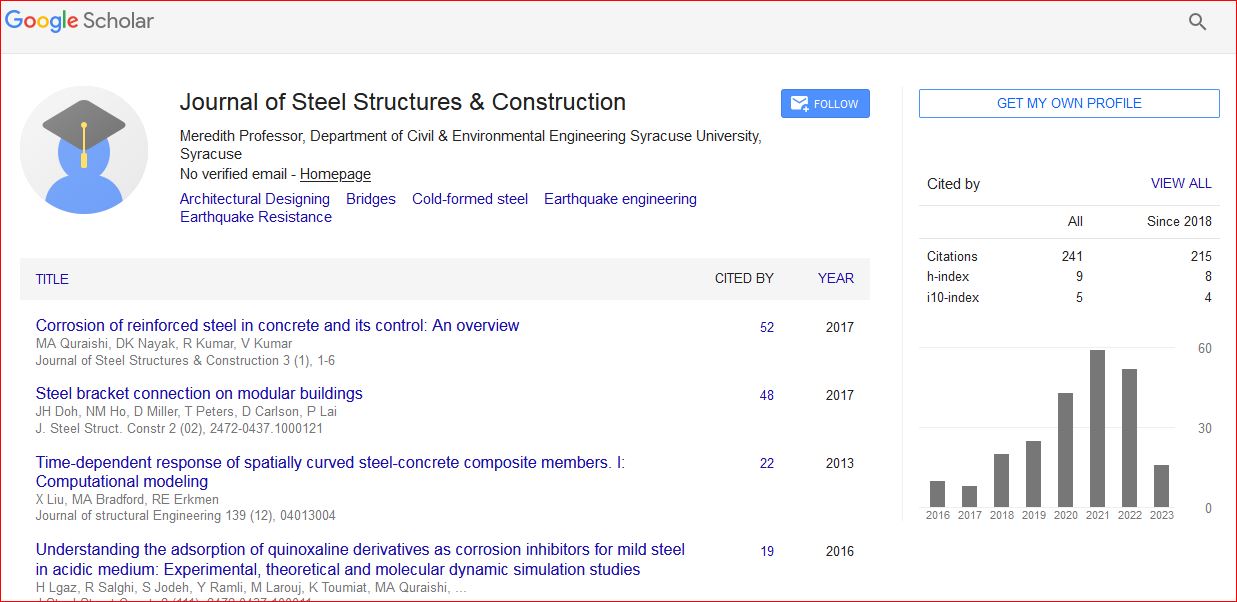
Journal of Steel Structures & Construction received 583 citations as per Google Scholar report