Short Communication - (2025) Volume 14, Issue 2
Received: 01-Apr-2025, Manuscript No. jsp-26-182244;
Editor assigned: 03-Apr-2025, Pre QC No. P-182244;
Reviewed: 17-Apr-2025, QC No. Q-182244;
Revised: 22-Apr-2025, Manuscript No. R-182244;
Published:
29-Apr-2025
, DOI: 10.37421/2165-7939.2025.14.719
Citation: Thompson, Laura M.. ”Advancements in Spinal Fusion: Accelerating Healing And Outcomes.” J Spine 14 (2025):719.
Copyright: © 2025 Thompson M. Laura This is an open-access article distributed under the terms of the Creative Commons Attribution License, which permits unrestricted use, distribution and reproduction in any medium, provided the original author and source are credited.
Recent advancements in spinal fusion surgery are significantly enhancing patient outcomes through innovations in biomaterials, surgical techniques, and technological integration. A primary focus has been on improving the efficacy of bone graft substitutes and the biomechanical stability of fixation devices. New biomaterials are being developed with the aim of augmenting osteoconductivity and osteoinductivity, properties crucial for accelerating bone healing and reducing the time required for successful fusion. Concurrently, minimally invasive surgical approaches are continuously evolving, offering substantial benefits such as reduced tissue disruption and expedited recovery periods for patients undergoing spinal fusion procedures [1].
The evolution of biologic agents has profoundly impacted spinal fusion rates, with bone morphogenetic proteins (BMPs) and platelet-rich plasma (PRP) leading the charge. These biological factors are instrumental in accelerating the bone healing process and improving the quality of the newly formed fusion mass, thereby increasing the likelihood of a solid bony union. Nevertheless, the optimal delivery methods and precise dosages for these potent agents remain subjects of ongoing and intensive research, aiming to maximize their therapeutic potential [2].
Three-dimensional (3D) printing technology is ushering in a new era for the design and fabrication of spinal implants. This advanced manufacturing technique allows for the creation of patient-specific implants that can precisely conform to complex anatomical structures, potentially leading to improved surgical fit and a reduction in operative time. Furthermore, the utilization of biocompatible materials such as titanium alloys and porous polymers in these 3D printed constructs is demonstrably enhancing osseointegration, the process by which bone grows onto the implant surface [3].
Navigation and robotic-assisted surgical systems are increasingly being employed to enhance the precision and safety profiles of spinal fusion procedures. These sophisticated technologies provide surgeons with real-time visualization and enable highly accurate trajectory planning for critical steps like pedicle screw placement. By minimizing the risk of inadvertent neurological injury and ensuring the integrity of the surgical construct, these systems contribute to superior surgical outcomes [4].
The application of absorbable polymers and biodegradable scaffolds is emerging as a valuable strategy for the delivery of bone graft substitutes and essential growth factors within the spinal fusion site. These advanced materials are engineered to degrade gradually over time as new bone tissue forms, thereby eliminating the need for subsequent hardware removal and simplifying the overall fusion process for the patient [5].
Augmenting traditional bone grafts with supplementary materials like demineralized bone matrix (DBM) and calcium sulfate has shown considerable promise in elevating fusion rates. DBM provides a rich source of osteoinductive factors that stimulate bone formation, while calcium sulfate offers a porous scaffold conducive to bone ingrowth, both contributing to a more robust fusion [6].
The development of innovative interbody fusion devices crafted from advanced biomaterials such as PEEK (polyetheretherketone) and porous titanium has significantly improved biomechanical stability and reduced interference with radiographic imaging. These materials are chosen for their radiolucent properties and excellent biocompatibility, which collectively promote superior bone integration with the vertebral bodies [7].
Percutaneous pedicle screw fixation techniques represent a significant stride forward in the domain of minimally invasive spinal fusion surgery. By enabling stable spinal fixation through substantially smaller incisions, these techniques lead to a cascade of benefits including reduced blood loss, lower rates of surgical site infection, and a faster and more comfortable recovery period for patients [8].
The utilization of allografts that have undergone advanced processing to enhance their osteoinductive potential marks another key developmental area. Sophisticated sterilization and conditioning methods are employed to preserve or even augment the biological activity of these grafts while rigorously ensuring their safety, thereby presenting a viable alternative to autograft and synthetic bone substitutes [9].
Nanotechnology is beginning to permeate the field of spinal fusion materials, offering novel applications. Nanoparticles can be strategically employed to improve the targeted delivery of growth factors or to engineer composite materials possessing superior mechanical properties and enhanced osteoconductivity, ultimately fostering more effective bone regeneration [10].
Recent developments in spinal fusion surgery have predominantly centered on refining bone graft substitutes and enhancing the biomechanical integrity of fixation devices. Novel biomaterials are being engineered to boost osteoconductivity and osteoinductivity, with the ultimate goal of shortening fusion durations and elevating patient recovery success rates. Simultaneously, the continuous advancement of minimally invasive surgical techniques aims to minimize tissue trauma and accelerate patient convalescence [1].
The integration of biologic agents, notably bone morphogenetic proteins (BMPs) and platelet-rich plasma (PRP), has substantially improved spinal fusion success rates. These agents are designed to expedite the bone healing cascade and enrich the quality of the resultant fusion mass. Active research continues to focus on elucidating the optimal protocols for their delivery and dosage to maximize clinical efficacy [2].
The advent of three-dimensional (3D) printing technology is fundamentally reshaping the landscape of spinal implant design. This technology facilitates the creation of patient-specific implants, meticulously tailored to intricate anatomical contours, thereby potentially optimizing fit and abbreviating surgical intervention times. The incorporation of biocompatible materials, including titanium alloys and porous polymers, into 3D printed implants is actively promoting enhanced osseointegration [3].
Navigation systems and robotic-assisted surgical platforms are increasingly contributing to heightened precision and safety in spinal fusion operations. These advanced technologies provide surgeons with real-time visual feedback and enable the meticulous planning of screw trajectories, thereby mitigating the risk of neurological compromise and bolstering the stability of the spinal construct [4].
The strategic application of absorbable polymers and biodegradable scaffolds is emerging as a promising modality for delivering bone graft substitutes and critical growth factors. These materials are designed to undergo progressive degradation, making way for newly formed bone and obviating the necessity for subsequent explantation, thereby streamlining the fusion process [5].
Supplementing conventional bone grafts with materials such as demineralized bone matrix (DBM) and calcium sulfate has demonstrated efficacy in improving fusion rates. DBM serves as a valuable source of osteoinductive signals, while calcium sulfate provides a porous matrix conducive to bone cell infiltration and proliferation [6].
The introduction of interbody fusion devices constructed from advanced materials like PEEK (polyetheretherketone) and porous titanium has led to improvements in biomechanical stability and a reduction in imaging artifacts. The inherent radiolucency and favorable biocompatibility of these materials encourage robust bone incorporation [7].
Percutaneous pedicle screw fixation methodologies represent a significant advancement in the field of minimally invasive spinal fusion. These techniques allow for secure fixation through significantly smaller surgical portals, resulting in diminished blood loss, reduced infection incidence, and a more rapid return to function for patients [8].
The processing of allografts using advanced techniques to augment their osteoinductive capacity is a notable development. Rigorous sterilization and conditioning protocols are employed to preserve or enhance the biological activity of these grafts while ensuring patient safety, offering a valuable alternative to autografts and synthetic materials [9].
Nanotechnology is beginning to influence the materials used in spinal fusion applications. Nanoparticles can be utilized to enhance the delivery mechanisms of growth factors or to develop composite materials exhibiting improved mechanical characteristics and superior osteoconductivity, thereby promoting more effective bone regeneration [10].
Spinal fusion techniques are continuously advancing with improvements in bone graft substitutes, biomechanical fixation devices, and biomaterials aimed at enhancing bone healing and reducing fusion times. Biologic agents like BMPs and PRP are accelerating bone formation, while 3D printing technology enables patient-specific implants with improved fit. Navigation and robotics enhance surgical precision and safety, and biodegradable scaffolds facilitate graft delivery. Materials such as PEEK and porous titanium improve implant stability and imaging, and percutaneous screw fixation minimizes invasiveness. Osteoinductive allografts and nanoparticle-based materials show promise in promoting bone regeneration and improving fusion outcomes.
None
None
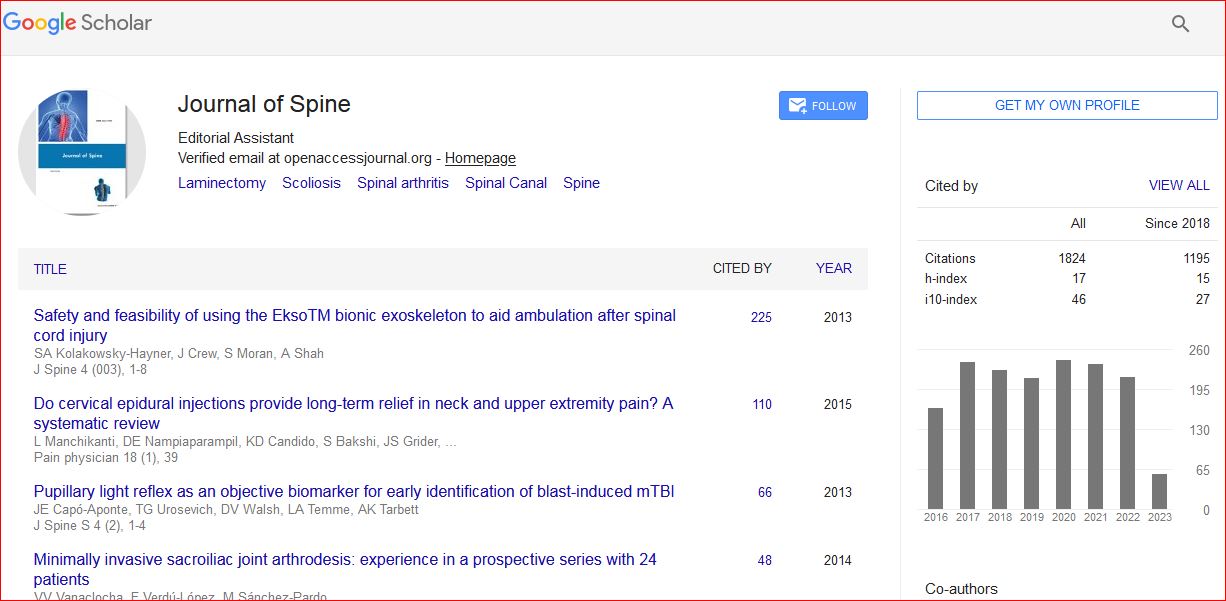
Journal of Spine received 2022 citations as per Google Scholar report