Opinion - (2025) Volume 14, Issue 6
Received: 01-Dec-2025, Manuscript No. jsp-26-182287;
Editor assigned: 03-Dec-2025, Pre QC No. P-182287;
Reviewed: 17-Dec-2025, QC No. Q-182287;
Revised: 22-Dec-2025, Manuscript No. R-182287;
Published:
29-Dec-2025
, DOI: 10.37421/2165-7939.2025.14.753
Citation: Foster, Benjamin R.. ”Advancements In Spinal Condition Diagnosis and Management.” J Spine 14 (2025):753.
Copyright: © 2025 Foster R. Benjamin This is an open-access article distributed under the terms of the Creative Commons Attribution License, which permits unrestricted use, distribution and reproduction in any medium, provided the original author and source are credited.
Degenerative disc disease is a predominant cause of spinal pain, frequently leading to conditions such as lumbar spinal stenosis. Current treatment paradigms are increasingly prioritizing conservative management and minimally invasive procedures to enhance patient outcomes and expedite recovery periods. This approach aims to address the underlying pathology while minimizing patient morbidity [1].
Adolescent idiopathic scoliosis represents a significant area of concern in pediatric orthopedics, with management strategies ranging from vigilant observation to surgical correction. The advent of advanced 3D imaging and sophisticated surgical planning tools is progressively improving procedural accuracy and reducing the incidence of complications. These technological advancements are critical for optimizing treatment efficacy [2].
Osteoporotic vertebral compression fractures pose a substantial clinical challenge, particularly within the elderly demographic. Minimally invasive interventions such as vertebroplasty and kyphoplasty are well-established treatment modalities. Ongoing research is focused on elucidating their long-term effectiveness and refining patient selection criteria to maximize benefits and minimize risks [3].
Spinal tumors, encompassing both primary and metastatic lesions, necessitate a comprehensive, multidisciplinary approach for optimal patient care. Significant progress in surgical techniques, radiotherapy, and targeted therapies is contributing to improved survival rates and enhanced quality of life for individuals affected by these challenging conditions. The collaborative nature of care is paramount [4].
Disorders of the cervical spine, including radiculopathy and myelopathy, can profoundly impair patient function and independence. Anterior cervical discectomy and fusion (ACDF) remains a cornerstone of treatment, while research continues to explore the potential of anterior cervical disc replacement (ACDR) and innovative fusion techniques. The goal is to provide effective and durable solutions [5].
Lumbar spinal stenosis is a common etiology for neurogenic claudication, characterized by pain and discomfort during ambulation. Decompressive laminectomy, with or without spinal fusion, is a primary surgical strategy. Evolving techniques are increasingly focused on preserving spinal stability and reducing the invasiveness of the procedure to promote better functional recovery [6].
Sacroiliac joint dysfunction can present with symptoms that closely mimic pain originating from the lumbar spine, leading to diagnostic complexities. Conservative management, including physical therapy and targeted injections, often yields positive results. However, surgical fusion remains a viable option for cases that prove refractory to non-operative treatments [7].
Management of spinal cord injury (SCI) has witnessed substantial advancements in both acute care protocols and long-term rehabilitation strategies. Promising research avenues in neuroprotection and regenerative medicine hold significant potential for fostering neurological recovery and improving functional outcomes for individuals with SCI. The path to recovery is complex [8].
Spondylolisthesis, particularly its degenerative and isthmic subtypes, frequently necessitates surgical intervention when conservative management fails to provide adequate relief. Surgical fusion techniques, such as posterior lumbar interbody fusion (PLIF) and transforaminal lumbar interbody fusion (TLIF), are widely employed to achieve spinal stability and alleviate symptoms. The choice of technique depends on individual patient factors [9].
Myofascial pain syndrome affecting the spine can be a source of considerable disability and diminished quality of life for affected individuals. An effective management strategy typically involves a multimodal approach, integrating manual therapy, targeted exercise regimens, and, in select cases, pharmacologic interventions to achieve optimal pain relief and functional restoration. A holistic approach is key [10].
Degenerative disc disease is a leading contributor to spinal pain, often manifesting as lumbar spinal stenosis. Contemporary treatment strategies are increasingly emphasizing conservative interventions and minimally invasive techniques to enhance patient recovery and reduce overall healing times. The goal is to provide effective relief with a focus on patient well-being [1].
In the realm of adolescent idiopathic scoliosis, management encompasses a broad spectrum of care, from initial observation to surgical correction. Breakthroughs in 3D imaging technologies and advanced surgical planning are significantly enhancing the precision of interventions and concurrently minimizing the occurrence of postoperative complications. These advancements are crucial for tailored treatment plans [2].
Osteoporotic vertebral compression fractures present a considerable challenge, especially in the elderly population. Established minimally invasive treatment options include vertebroplasty and kyphoplasty. Current research endeavors are dedicated to evaluating their long-term efficacy and refining the criteria for optimal patient selection, ensuring the best possible outcomes [3].
Spinal tumors, whether primary or metastatic, demand a coordinated, multidisciplinary approach. Significant strides in surgical methodologies, radiotherapy, and the development of targeted therapies are leading to improved survival rates and a better quality of life for patients facing these complex diagnoses. Collaboration is essential for success [4].
Cervical spine disorders, such as radiculopathy and myelopathy, can severely compromise an individual's functional capacity. The anterior cervical discectomy and fusion (ACDF) procedure remains a benchmark treatment. Simultaneously, ongoing investigations are exploring the merits of anterior cervical disc replacement (ACDR) and novel fusion approaches to offer viable alternatives and improvements [5].
Lumbar spinal stenosis is a frequent cause of neurogenic claudication, a condition characterized by leg pain during walking. Decompressive laminectomy, often combined with fusion, is a primary surgical approach. Current efforts are focused on refining techniques to preserve spinal stability while minimizing surgical invasiveness, thereby aiding recovery [6].
Sacroiliac joint dysfunction can frequently mimic pain originating from the lumbar spine, posing diagnostic challenges. Conservative treatments, including physical therapy and therapeutic injections, are often successful. For patients whose symptoms persist, surgical fusion represents a definitive management option [7].
Advancements in the acute care and rehabilitation phases of spinal cord injury (SCI) management have been substantial. The future holds promise with ongoing research in neuroprotection and regenerative medicine, which could potentially lead to significant neurological recovery and functional improvement for individuals with SCI. Hope for recovery is growing [8].
Spondylolisthesis, particularly the degenerative and isthmic forms, often necessitates surgical intervention when conservative therapies prove insufficient. Commonly utilized surgical fusion techniques include posterior lumbar interbody fusion (PLIF) and transforaminal lumbar interbody fusion (TLIF) to stabilize the spine and alleviate pain. The selection of the appropriate technique is patient-dependent [9].
Myofascial pain syndrome affecting the spine can be a source of severe discomfort and functional limitation. Effective management typically relies on a comprehensive, multimodal strategy that integrates manual therapy, prescribed exercises, and, when appropriate, pharmacological treatments to achieve lasting relief and restore function. A holistic strategy is vital [10].
The provided data highlights advancements in the diagnosis and management of various spinal conditions. Degenerative disc disease and lumbar spinal stenosis are addressed with a focus on conservative and minimally invasive treatments. Adolescent idiopathic scoliosis management benefits from 3D imaging and surgical planning. Osteoporotic vertebral compression fractures are treated with vertebroplasty and kyphoplasty, with ongoing research into their efficacy. Spinal tumors require multidisciplinary approaches including surgery, radiotherapy, and targeted therapies. Cervical spine disorders like radiculopathy and myelopathy are managed with ACDF, and research is exploring disc replacement. Lumbar spinal stenosis surgical interventions focus on decompression and stability. Sacroiliac joint dysfunction treatment ranges from conservative measures to surgical fusion. Spinal cord injury research is progressing in neuroprotection and regenerative medicine. Spondylolisthesis is often treated with fusion techniques like PLIF and TLIF. Myofascial pain syndrome management is multimodal, combining manual therapy, exercise, and medication. Overall, the field is moving towards more precise, less invasive, and integrated treatment strategies across a spectrum of spinal pathologies.
None
None
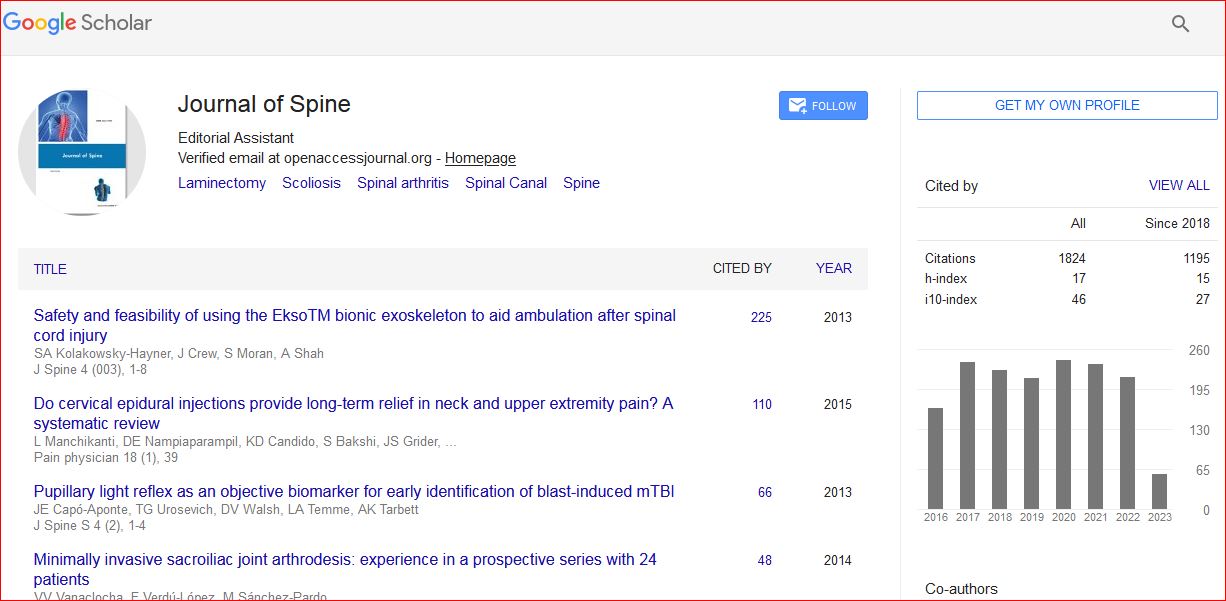
Journal of Spine received 2022 citations as per Google Scholar report