Opinion - (2025) Volume 12, Issue 3
Received: 01-May-2025, Manuscript No. jlop-26-179026;
Editor assigned: 05-May-2025, Pre QC No. P-179026;
Reviewed: 19-May-2025, QC No. Q-179026;
Revised: 22-May-2025, Manuscript No. R-179026;
Published:
29-May-2025
, DOI: 10.37421/2469-410X. 2025.12.201
Citation: Al-Hassan, Noor. ”Advancements in Semiconductor Optoelectronic Devices.” J Laser Opt Photonics 12 (2025):201.
Copyright: © 2025 Al-Hassan N. This is an open-access article distributed under the terms of the Creative Commons Attribution License, which permits unrestricted use, distribution and reproduction in any medium, provided the original author and source are credited.
Recent advancements in semiconductor laser technology are significantly expanding the capabilities and applications of light-emitting devices. The exploration of novel materials and sophisticated device architectures is paving the way for lasers with higher power outputs, improved energy efficiency, and broader wavelength coverage, as detailed in a comprehensive review of recent breakthroughs [1].
A key area of focus is the development of advanced quantum well structures. These structures are crucial for achieving better carrier confinement, which directly leads to a reduction in the threshold current required for lasing. Furthermore, the integration of photonic crystals is proving instrumental in enhancing light extraction efficiency and enabling precise beam shaping, thereby optimizing device performance [1].
Perovskite quantum dots (PQDs) have emerged as a highly promising material for next-generation optoelectronic devices, particularly in light-emitting diodes (LEDs) and lasers. Their tunable bandgap and exceptional photoluminescence quantum yield make them ideal candidates for applications demanding vibrant colors and high efficiency. Researchers are actively developing strategies to enhance device stability and efficiency, employing techniques such as surface passivation and robust encapsulation methods to overcome inherent material challenges [2].
Gallium nitride (GaN)-based micro-light-emitting diodes (micro-LEDs) are garnering significant attention for their potential in high-resolution display technologies. Advancements in epitaxy, device fabrication, and packaging techniques are crucial for overcoming challenges related to uniform emission and high manufacturing yields, especially for small-area devices. Novel approaches for current spreading and heat dissipation are being investigated to ensure optimal performance and longevity for micro-LED displays [3].
The realm of InGaN/GaN quantum well lasers is characterized by ongoing research into mitigating efficiency droop and enhancing device reliability, particularly at high optical power levels. Innovative designs for active regions and cladding layers are being developed to effectively suppress non-radiative recombination and thermal effects. The progress in creating efficient deep blue and ultraviolet (UV) lasers from these materials is critical for a range of advanced applications [4].
Quantum cascade lasers (QCLs) operating in the mid-infrared (MIR) and far-infrared (FIR) spectral regions represent a significant frontier in laser technology. The continuous development of advanced material systems and refined design principles allows for precise wavelength tunability and substantial output power. These lasers are finding increasing utility in specialized applications such as gas sensing and sophisticated medical diagnostics [5].
For demanding industrial applications, the focus is on developing high-power semiconductor lasers tailored for direct material processing. Fiber lasers and direct diode lasers are being favored for their superior beam quality and efficiency compared to conventional methods. Key research areas include optimizing thermal management, advancing beam combining techniques, and tailoring wavelength options to suit specific material interactions, thereby boosting manufacturing efficiency and enabling new processing capabilities [6].
Deep ultraviolet (DUV) light-emitting diodes (LEDs) based on aluminum gallium nitride (AlGaN) materials are experiencing notable progress, despite persistent challenges with low efficiency and device degradation in this spectral range. Innovations in epitaxy, particularly in strain management and defect reduction, are leading to improved quantum efficiency and enhanced operational stability. These improvements are vital for applications requiring germicidal UV light [7].
The integration of semiconductor lasers with photonic integrated circuits (PICs) is a rapidly evolving field, driven by the need for compact, efficient, and versatile light sources. Advancements in silicon photonics and indium phosphide (InP) platforms are central to this integration. Challenges related to wafer-scale fabrication, packaging, and heterogeneous integration are being addressed to unlock the full potential of these devices in high-speed optical communication and other advanced fields [8].
The emerging area of optoelectronic devices based on two-dimensional (2D) materials, including lasers and LEDs, holds immense promise for future technologies. The unique electronic and optical properties of materials such as graphene, MoS2, and WS2 are enabling novel device architectures. Research efforts are focused on material synthesis, fabrication, and performance enhancement to realize flexible, transparent, and ultrasmall optoelectronic components [9].
Plasmonic lasers, which leverage surface plasmon polaritons for sub-wavelength light confinement, represent a cutting-edge area of research. Various plasmonic laser designs are being explored, aiming to achieve miniaturization and seamless integration into nanophotonic systems. Overcoming challenges associated with low lasing thresholds and high efficiencies is key to unlocking their potential in advanced nanophotonics and optical sensing applications [10].
The field of semiconductor laser technology is witnessing a transformative period, characterized by continuous innovation in materials science and device engineering. Breakthroughs are enabling lasers with unprecedented power, efficiency, and spectral versatility. Advanced quantum well structures are a cornerstone of this progress, facilitating enhanced carrier confinement and lower threshold currents. The incorporation of photonic crystals further refines light extraction and beam quality, leading to more robust and adaptable laser systems for a wide array of applications [1].
Perovskite quantum dots (PQDs) are emerging as a highly adaptable material for optoelectronic applications, particularly in the development of LEDs and lasers. Their tunable bandgap and high photoluminescence quantum yield offer a pathway to vibrant displays and energy-efficient lighting. Significant research is dedicated to improving the stability and longevity of PQD devices through advanced surface treatments and protective encapsulation strategies, addressing critical limitations for commercial viability [2].
GaN-based micro-LEDs are at the forefront of high-resolution display technology due to their inherent advantages in brightness and efficiency. However, achieving uniform emission and high manufacturing yields for minute devices presents considerable engineering challenges. Ongoing efforts focus on refining epitaxy and fabrication processes, alongside developing innovative solutions for current distribution and thermal management to ensure the reliable performance of micro-LEDs in demanding applications [3].
Research into InGaN/GaN quantum well lasers is actively tackling the critical issues of efficiency droop and operational reliability at high power densities. The development of sophisticated active region designs and improved cladding layers aims to minimize non-radiative recombination pathways and mitigate thermal runaway. The advancement of efficient blue and UV lasers based on these materials is pivotal for applications requiring precise spectral outputs, such as sterilization and photolithography [4].
Quantum cascade lasers (QCLs) operating in the mid- and far-infrared spectrum are critical for specialized sensing and diagnostic applications. Significant progress is being made in material selection and device design to achieve precise wavelength tuning and high output power. The ability to operate at room temperature and emit multiple wavelengths from a single device further enhances their utility in fields like chemical detection and medical imaging [5].
High-power semiconductor lasers are essential tools for advanced material processing, offering superior efficiency and beam quality compared to traditional methods. Fiber lasers and direct diode lasers are leading this charge, with ongoing research focusing on thermal management, beam combining, and wavelength optimization for specific material interactions. These advancements are crucial for enhancing industrial manufacturing capabilities and enabling novel processing techniques [6].
Deep ultraviolet (DUV) LEDs based on AlGaN materials are making strides towards overcoming efficiency limitations and degradation issues. Advances in epitaxy, including strain engineering and defect reduction techniques, are yielding devices with improved quantum efficiency and extended operational lifetimes. These DUV LEDs are vital for applications requiring germicidal or sterilization capabilities, as well as in advanced lithography processes [7].
The integration of semiconductor lasers into photonic integrated circuits (PICs) is revolutionizing optical systems. Platforms such as silicon photonics and indium phosphide are enabling the creation of highly compact and functional light sources. Addressing challenges in large-scale fabrication, advanced packaging, and heterogeneous integration is key to realizing the potential of these PICs in high-speed communications, sensing, and quantum information processing [8].
Optoelectronic devices constructed from two-dimensional (2D) materials, including lasers and LEDs, represent a frontier in flexible and transparent electronics. The unique optoelectronic properties of materials like graphene and transition metal dichalcogenides are driving innovation in device architecture. Overcoming hurdles in material synthesis and device fabrication is essential for unlocking the full potential of these next-generation components for diverse applications [9].
Plasmonic lasers, which utilize the unique properties of surface plasmon polaritons to confine light at the nanoscale, are a subject of intense research. Efforts are concentrated on designing efficient plasmonic laser structures that can achieve low lasing thresholds and high optical output. The promise of extreme miniaturization and integration makes these devices highly attractive for applications in nanophotonics and highly sensitive optical sensing [10].
This compilation of research highlights significant advancements across various areas of semiconductor optoelectronic devices. Innovations in semiconductor lasers, including those based on advanced quantum well structures, perovskite quantum dots, and GaN materials, are pushing the boundaries of power, efficiency, and wavelength coverage. Developments in micro-LEDs, quantum cascade lasers, and DUV LEDs are enabling new applications in displays, sensing, and sterilization. The integration of lasers with photonic circuits and the exploration of 2D materials and plasmonics are further expanding the landscape of optical technologies, promising breakthroughs in communication, manufacturing, and nanoscale devices.
None
None
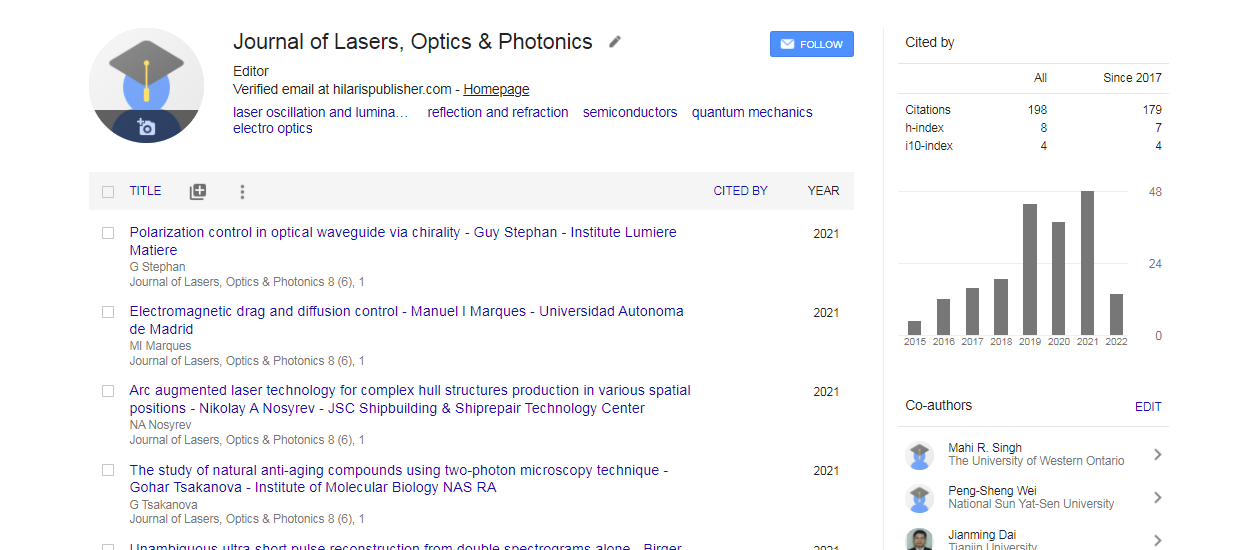
Journal of Lasers, Optics & Photonics received 279 citations as per Google Scholar report