Brief Report - (2025) Volume 12, Issue 5
Received: 02-Oct-2025, Manuscript No. fmoa-26-187956;
Editor assigned: 06-Oct-2025, Pre QC No. P-187956;
Reviewed: 20-Oct-2025, QC No. Q-187956;
Revised: 23-Oct-2025, Manuscript No. R-187956;
Published:
30-Oct-2025
, DOI: 10.37421/2476-2296.2025.12.362
Citation: Russo, Valentina. ”Advancements in Microfluidic and Lab-on-Chip Technologies.” Fluid Mech Open Acc 12 (2025):362.
Copyright: © 2025 Russo V. This is an open-access article distributed under the terms of the Creative Commons Attribution License, which permits unrestricted use, distribution and reproduction in any medium, provided the original author and source are credited.
The optimization of microchannel flow is a cornerstone for advancing the performance of lab-on-chip devices, particularly in diagnostics and analytical applications. Geometric modifications and surface treatments within these microchannels play a pivotal role in influencing fluid behavior, leading to enhanced mixing, reduced dispersion, and precise analyte manipulation, thereby enabling the design of more efficient and sensitive systems [1].
The impact of electroosmotic flow (EOF) is a significant area of investigation, offering a means to control sample separation and manipulation. By judiciously managing electric fields and surface chemistry, researchers can tailor EOF characteristics for highly efficient and rapid analyte separation and precise control over fluid movement and solute transport within microfluidic channels [2].
Understanding the interplay between fluid viscosity and channel geometry is paramount for optimizing reaction kinetics in lab-on-chip systems. Computational fluid dynamics (CFD) simulations are instrumental in analyzing mixing efficiency under various conditions, revealing how specific channel designs can induce chaotic advection and promote enhanced mixing without external energy input [3].
Surface modification of microchannels is crucial for controlling fluid-surface interactions, which directly impacts the prevention of biofouling and ensures accurate detection. The application of superhydrophobic coatings, for instance, has demonstrated reduced drag and improved droplet manipulation, contributing to more reliable and efficient microfluidic operations [4].
Precise droplet generation and manipulation are critical challenges in microfluidic applications such as digital microfluidics and droplet-based assays. Novel microchannel designs that enable stable and monodisperse droplet formation through careful control of flow rates and channel geometry, often employing hydrodynamic focusing, are essential for these advanced applications [5].
The flow characteristics within serpentine microchannels offer a passive yet effective method for improving mixing efficiency. The inherent curvature induces secondary flows and Taylor-vortex-like patterns, significantly enhancing mass transport and reaction kinetics compared to straight microchannels [6].
The integration of microvalves and micropumps into microchannels provides active flow control, enabling complex sample handling and multi-step assays without external tubing. Systems utilizing integrated pneumatic microvalves can precisely manage fluid flow paths and volumes, facilitating sophisticated lab-on-chip operations [7].
A systematic study of the Reynolds number's effect on flow regimes and mixing efficiency in microchannels provides fundamental insights for process design. Experimental data illustrating the transition from laminar to more complex flow patterns at higher Reynolds numbers within confined geometries is vital for understanding particle transport and reaction rates [8].
Acoustic streaming presents an innovative approach for inducing microchannel mixing and manipulating particles. By generating acoustic waves, well-defined flow patterns can be created, enhancing mass transport and enabling precise particle manipulation without the need for complex channel geometries or mechanical components [9].
The optimization of channel dimensions and surface properties is particularly important for advanced separation techniques like microfluidic electrophoresis. Specific geometries and surface treatments can minimize electroosmotic flow variability and reduce band broadening, leading to higher resolution separations of biomolecules and more sensitive diagnostic tools [10].
The optimization of microchannel geometry and surface treatments is a critical factor in enhancing the performance of lab-on-chip devices for diagnostics and analytical applications. These modifications directly influence fluid behavior, leading to improved mixing, reduced dispersion, and precise analyte manipulation, which are essential for designing more efficient and sensitive systems [1].
Electroosmotic flow (EOF) plays a substantial role in microchannel performance, particularly in sample separation and manipulation. Researchers can effectively control EOF by adjusting applied electric fields and surface chemistry, achieving highly efficient and rapid separation of analytes and precise control over fluid movement and solute transport within microfluidic channels [2].
The relationship between fluid viscosity and channel geometry is vital for optimizing reaction kinetics within lab-on-chip systems. Computational fluid dynamics (CFD) has been employed to analyze mixing efficiency under varying conditions, demonstrating that specific channel designs can induce chaotic advection, thereby promoting enhanced mixing without the need for external energy input [3].
Surface modification of microchannels is crucial for managing fluid-surface interactions, which is key to preventing biofouling and ensuring accurate detection in lab-on-chip devices. The utilization of superhydrophobic coatings, for example, has been shown to reduce drag and improve droplet manipulation capabilities, leading to more reliable and efficient microfluidic operations [4].
The precise generation and manipulation of droplets are significant challenges in microfluidic applications like digital microfluidics and droplet-based assays. Novel microchannel designs that achieve stable and monodisperse droplet formation through careful control of flow rates and channel geometry, often employing hydrodynamic focusing principles, are instrumental in overcoming these challenges [5].
The flow characteristics within serpentine microchannels have been extensively investigated for their impact on mixing efficiency. Studies have revealed that the inherent curvature of these channels can induce secondary flows and Taylor-vortex-like patterns, which significantly enhance mixing compared to straight microchannels, offering a passive method for improved microfluidic reaction and analysis [6].
The integration of microvalves and micropumps within microchannels enables active flow control, crucial for advanced lab-on-chip applications. Systems incorporating integrated pneumatic microvalves allow for precise control of fluid flow paths and volumes, facilitating complex sample handling and multi-step assays without the need for external tubing [7].
The influence of the Reynolds number on flow regimes and mixing efficiency within microchannels has been systematically studied. Experimental data illustrating the transition from laminar to more complex flow patterns at higher Reynolds numbers in confined microgeometries provides fundamental insights into particle transport and reaction rates, guiding the design of microfluidic processes [8].
Acoustic streaming offers a method for inducing microchannel mixing and manipulating particles without complex channel geometries or mechanical components. By generating acoustic waves within the microfluidic device, researchers can create well-defined flow patterns that enhance mass transport and facilitate precise particle manipulation [9].
Optimizing channel dimensions and surface properties is particularly important for microfluidic electrophoresis devices used in protein separation. Specific channel geometries and surface treatments have been shown to reduce electroosmotic flow variability and improve band broadening, resulting in higher resolution separations of biomolecules and contributing to the development of more sensitive diagnostic tools [10].
This collection of research highlights advancements in microfluidic devices and lab-on-chip technologies. Key areas of focus include optimizing microchannel geometry and surface treatments to improve fluid behavior, mixing, and analyte manipulation for enhanced diagnostic and analytical applications. Investigations into electroosmotic flow (EOF) demonstrate its utility in sample separation and manipulation through control of electric fields and surface chemistry. Computational fluid dynamics (CFD) and experimental studies explore the impact of factors like viscosity, channel design (e.g., serpentine channels), and Reynolds number on mixing efficiency. The application of surface modifications, such as superhydrophobic coatings, is explored for biofouling prevention and improved droplet control. The development of precise droplet generation and manipulation techniques, along with the integration of microvalves and micropumps for active flow control, are also presented. Furthermore, the use of acoustic streaming for mixing and particle manipulation and the optimization of microchannels for enhanced separation performance in electrophoresis are discussed, collectively contributing to the evolution of more sensitive and efficient microfluidic systems.
None
None
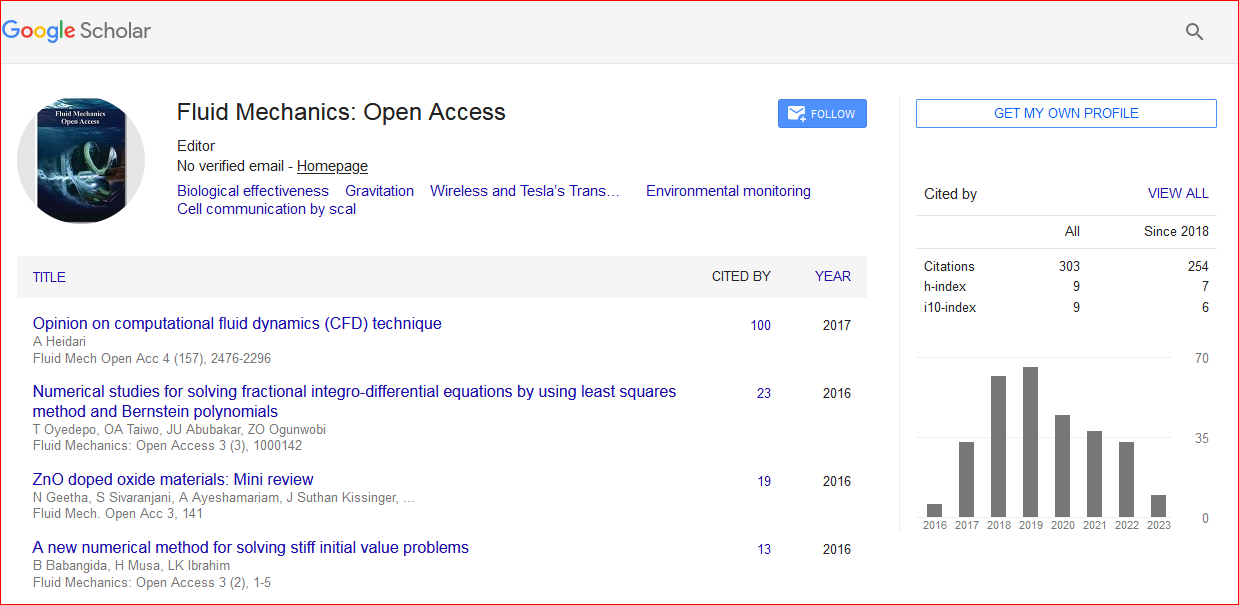
Fluid Mechanics: Open Access received 291 citations as per Google Scholar report