Brief Report - (2025) Volume 14, Issue 3
Received: 01-May-2025, Manuscript No. jtm-26-185725;
Editor assigned: 05-May-2025, Pre QC No. P-185725;
Reviewed: 19-May-2025, QC No. Q-185725;
Revised: 22-May-2025, Manuscript No. R-185725;
Published:
29-May-2025
, DOI: 10.37421/2167-1222.2025.14.677
Citation: Ruiz, Alejandro. ”Advanced Trauma Resuscitation Strategies for Critically Injured.” J Trauma Treat 14 (2025):677.
Copyright: © 2025 Ruiz A. This is an open-access article distributed under the terms of the Creative Commons Attribution License, which permits unrestricted use, distribution and reproduction in any medium, provided the original author and source are credited.
The field of trauma resuscitation has witnessed significant evolution, with a growing emphasis on balanced strategies to improve outcomes for critically injured patients. Recent advancements focus on early interventions and tailored approaches to address the complex physiological derangements associated with severe trauma. These strategies aim to mitigate life-threatening conditions and stabilize patients for definitive care. The evolving landscape of trauma resuscitation underscores the importance of a multidisciplinary and evidence-based approach to patient management. This introduction will explore key areas of advancement, drawing upon recent literature to highlight current best practices and future directions. The integration of novel monitoring technologies and damage control principles is central to modern trauma care, promising enhanced patient survival rates and reduced morbidity. This review will systematically present these advancements, providing a comprehensive overview of the current state of trauma resuscitation. The initial management of polytrauma necessitates rapid hemorrhage control to prevent irreversible shock and multi-organ failure. Innovations in surgical techniques and interventional radiology are crucial for achieving this objective, alongside the judicious use of hemostatic agents. A coordinated, multidisciplinary effort is paramount in the timely application of evidence-based interventions to reduce mortality in severely bleeding trauma patients. The understanding and management of coagulopathy in trauma have shifted towards a more proactive and comprehensive approach. Early recognition, thorough laboratory assessment, and targeted administration of blood products are now central to preventing and treating trauma-induced coagulopathy. The use of viscoelastic hemostatic assays plays a vital role in guiding transfusion strategies and optimizing patient care. Point-of-care ultrasound (POCUS) has emerged as an invaluable tool for the rapid assessment of trauma patients. Its ability to quickly identify life-threatening conditions at the bedside enables faster diagnostic decisions and subsequent interventions, particularly in pre-hospital and emergency department settings. Airway management in patients with severe facial trauma and associated cervical spine injury presents unique challenges. Current best practices and advanced techniques are essential for securing a patent airway and preventing complications, thereby optimizing patient outcomes in these complex scenarios. The detrimental impact of hypothermia on trauma outcomes is well-established, necessitating robust strategies for its prevention and management. Active warming measures, implemented in both pre-hospital and in-hospital settings, are critical for maintaining normothermia and supporting vital physiological functions. Damage control orthopedics (DCO) has become a cornerstone in the management of severe extremity injuries and polytrauma. The principles of temporary stabilization followed by delayed definitive fixation are designed to prevent complications and allow for patient resuscitation. Extracorporeal membrane oxygenation (ECMO) is increasingly recognized for its potential role in managing refractory shock and severe respiratory failure in trauma patients. In select cases where conventional therapies have failed, ECMO can offer a life-saving option for critically ill trauma survivors. The management of traumatic brain injury (TBI) within the context of polytrauma is complex, requiring a sophisticated approach. Multimodal neuromonitoring and timely interventions, such as early decompressive craniectomy, are vital for improving neurological outcomes in these patients. Advancements in emergency surgical procedures for thoracic trauma continue to refine the management of critical injuries. Updated guidelines and techniques for conditions like hemothorax, pneumothorax, and great vessel injuries emphasize the importance of timely surgical intervention and the increasing utility of minimally invasive approaches.
The evolving landscape of trauma resuscitation is characterized by a profound shift towards balanced resuscitation strategies, incorporating early use of blood products and judicious fluid administration. This approach aims to mitigate coagulopathy and hypothermia, two critical factors that exacerbate outcomes in critically injured patients. The integration of novel monitoring technologies and adherence to damage control resuscitation principles are key to improving survival rates and reducing morbidity [1].
Rapid hemorrhage control is of paramount importance in the initial management of polytrauma. Advancements in surgical techniques, interventional radiology, and the application of hemostatic agents are crucial for achieving hemostasis. A multidisciplinary approach that emphasizes the timely implementation of evidence-based interventions is stressed to reduce mortality in severely bleeding trauma patients [2].
The understanding of trauma-induced coagulopathy has evolved significantly, moving beyond simple anticoagulant reversal to a more comprehensive strategy. This includes early recognition, detailed laboratory assessment, and targeted administration of blood products such as fibrinogen and prothrombin complex concentrate. Viscoelastic hemostatic assays are instrumental in guiding transfusion decisions and optimizing management [3].
Point-of-care ultrasound (POCUS) has revolutionized the rapid assessment of trauma patients. Its utility in the immediate identification of life-threatening conditions like pneumothorax, hemoperitoneum, and cardiac tamponade enables quicker diagnostic pathways and timely interventions, especially in pre-hospital and emergency department settings [4].
Securing an airway in patients with severe facial trauma and concomitant cervical spine injury presents substantial challenges. This paper reviews current best practices and advanced techniques for airway control in these complex scenarios, highlighting potential complications and strategies to optimize patient outcomes [5].
Hypothermia significantly impacts trauma outcomes, and therefore, strategies for its prevention and management are critical. Active warming measures, implemented across both pre-hospital and in-hospital environments, are essential for maintaining normothermia, which in turn improves coagulation and immune function in critically injured individuals [6].
Damage control orthopedics (DCO) plays a vital role in managing patients with severe extremity injuries and polytrauma. The core principles of DCO, including temporary stabilization and delayed definitive fixation, are designed to prevent complications such as fat embolism syndrome and facilitate the patient's overall resuscitation [7].
Extracorporeal membrane oxygenation (ECMO) is an emerging therapy for refractory shock and severe respiratory failure in trauma patients. It offers a life-saving intervention for critically ill individuals when conventional treatments prove insufficient, outlining specific indications, contraindications, and potential benefits [8].
The management of traumatic brain injury (TBI) within the context of polytrauma is inherently complex. This review emphasizes the importance of multimodal neuromonitoring and the role of early decompressive craniectomy in selected patients to mitigate secondary brain injury and improve neurological outcomes [9].
Current concepts in the surgical management of thoracic trauma highlight advancements in emergency procedures for conditions such as hemothorax, pneumothorax, and great vessel injuries. There is a growing emphasis on minimally invasive approaches when appropriate, underscoring the critical need for timely surgical intervention to improve outcomes [10].
This collection of research explores critical aspects of trauma resuscitation, focusing on advanced strategies for managing critically injured patients. Key areas include balanced resuscitation with early blood product use and judicious fluid administration to combat coagulopathy and hypothermia. The importance of rapid hemorrhage control through surgical and interventional techniques is emphasized, alongside the evolving understanding and management of trauma-induced coagulopathy with the aid of viscoelastic assays. Point-of-care ultrasound (POCUS) is highlighted for its rapid diagnostic capabilities. Airway management in complex facial and cervical spine injuries, prevention and management of hypothermia, and the role of damage control orthopedics are discussed. Emerging therapies like ECMO for refractory shock and the complex management of traumatic brain injury in polytrauma patients are also covered. Finally, advancements in the surgical management of thoracic trauma, including minimally invasive approaches, are detailed.
None
None
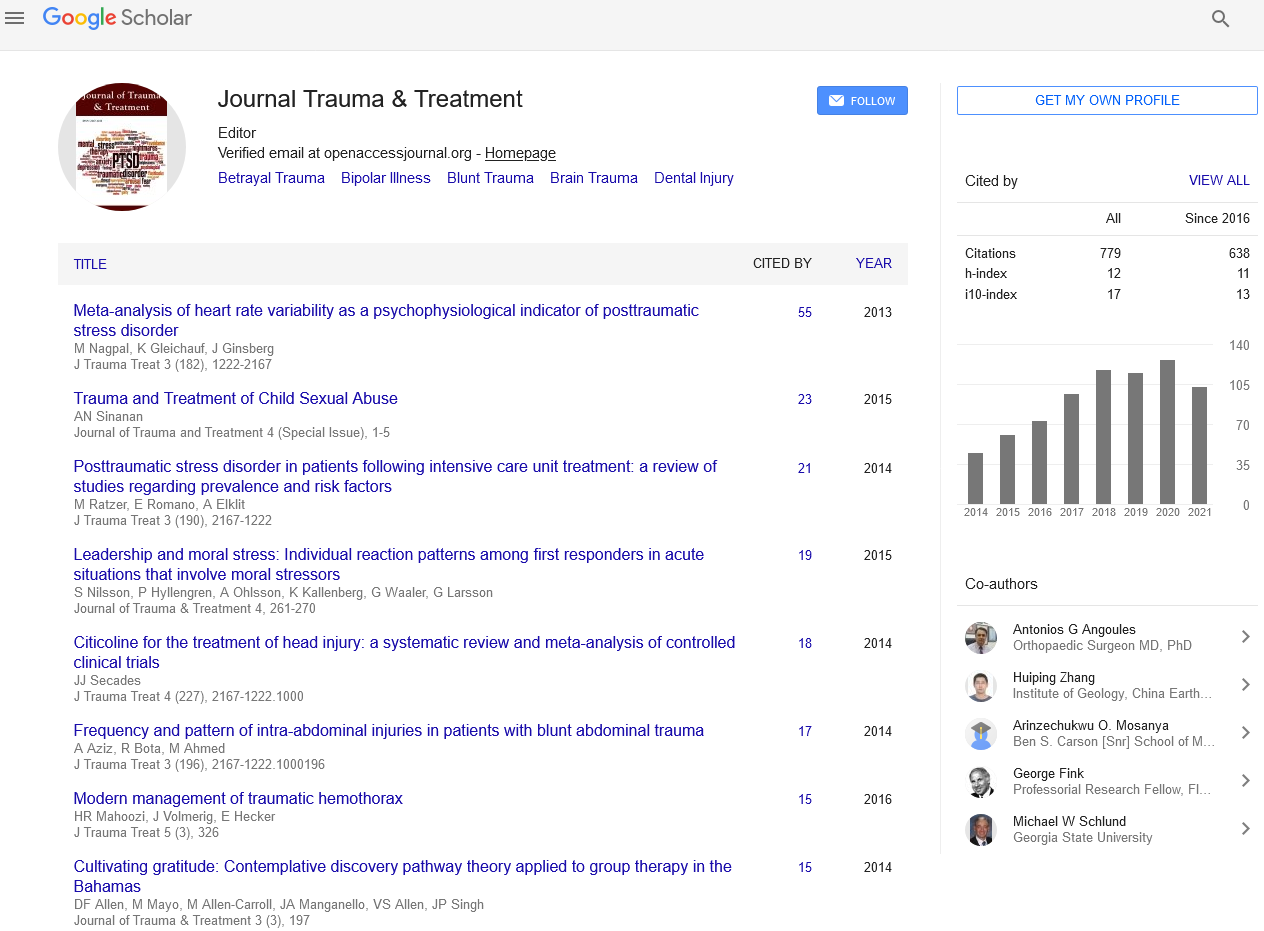
Journal of Trauma & Treatment received 1048 citations as per Google Scholar report