Short Communication - (2025) Volume 16, Issue 3
Received: 29-May-2025, Manuscript No. gjto-25-175449;
Editor assigned: 02-Jun-2025, Pre QC No. P-175449;
Reviewed: 16-Jun-2025, QC No. QC-175449;
Revised: 23-Jun-2025, Manuscript No. R-175449;
Published:
30-Jun-2025
, DOI: 10.37421/2229-8711.2025.16.453
Citation: Mendes, Carlos. ”Advanced Technologies Reshaping Smart Manufacturing Future.” Global J Technol Optim 16 (2025):453.
Copyright: © 2025 Mendes C. This is an open-access article distributed under the terms of the Creative Commons Attribution License, which permits unrestricted use,
distribution and reproduction in any medium, provided the original author and source are credited.
This article offers a comprehensive review of Digital Twin technology within Smart Manufacturing, exploring its concepts, enabling technologies like IoT and Artificial Intelligence (AI), and various applications across the product lifecycle. The authors outline key challenges and suggest future research directions, emphasizing the potential of Digital Twins to enhance decision-making and operational efficiency in industrial environments[1]. This paper reviews the role of Artificial Intelligence (AI) in smart manufacturing, identifying current applications in areas such as intelligent production, quality control, and predictive maintenance. The authors discuss the benefits, challenges, and future trends of integrating AI, highlighting its capacity to drive innovation and improve sustainability and efficiency in manufacturing processes[2]. The article presents a review of Industrial Internet of Things (IIoT)-based smart manufacturing, covering its foundational concepts, architectural frameworks, and key technologies. It examines various applications and benefits, from real-time monitoring to advanced process control, while also addressing challenges and suggesting future research to fully realize the potential of IIoT in manufacturing[3].
This paper provides a comprehensive survey on cybersecurity challenges and solutions within smart manufacturing environments. It covers various attack surfaces, vulnerabilities, and existing countermeasures, emphasizing the critical need for robust security strategies to protect interconnected industrial systems from evolving cyber threats and ensure operational integrity[4]. The article offers an integrated review of sustainable smart manufacturing, exploring how smart technologies can enhance environmental, economic, and social sustainability in production. It identifies key drivers, barriers, and potential solutions, proposing a framework for future research and implementation to achieve eco-friendly and resource-efficient manufacturing systems[5]. This paper reviews human-robot collaboration (HRC) in smart manufacturing, highlighting its benefits for flexibility, productivity, and safety. The authors discuss various aspects of HRC, including interaction types, control strategies, and safety considerations, outlining a future research agenda to foster more intuitive and efficient collaborative workplaces[6].
The article provides a review of big data analytics applications in smart manufacturing, detailing how data collection, processing, and analysis techniques can enhance various manufacturing operations. It covers predictive maintenance, quality improvement, process optimization, and supply chain management, while also discussing challenges and future research needs in this rapidly evolving field[7]. This comprehensive review explores edge computing for smart manufacturing, addressing its advantages in reducing latency and bandwidth use, and enhancing data security. It highlights the challenges, proposed solutions, and future directions for deploying edge computing to support real-time data processing and intelligent decision-making at the manufacturing floor[8]. This paper reviews smart quality control mechanisms in manufacturing systems, presenting a framework that integrates various smart technologies like IoT, AI, and big data. It examines how these technologies enable real-time monitoring, defect prediction, and adaptive quality management, discussing current practices, challenges, and future research opportunities to achieve higher product quality and efficiency[9]. This review focuses on flexible robotic assembly for smart manufacturing, outlining the current challenges in achieving high adaptability and reconfigurability with industrial robots. The authors discuss advancements in robotic perception, manipulation, and control, proposing future research directions to overcome limitations and fully realize the potential of flexible automation in dynamic production environments[10].
Digital Twin technology is crucial for smart manufacturing, encompassing its core concepts, supporting technologies like the Internet of Things (IoT) and Artificial Intelligence (AI), and diverse applications throughout the product lifecycle. This technology enhances decision-making and operational efficiency in industrial settings by addressing key challenges and proposing future research directions [1]. Artificial Intelligence also plays a vital role in smart manufacturing, with applications spanning intelligent production, quality control, and predictive maintenance. Its integration drives innovation, improves sustainability, and boosts efficiency in manufacturing processes by tackling current benefits and challenges [2]. Similarly, the Industrial Internet of Things (IIoT) forms the bedrock of smart manufacturing, involving foundational concepts, architectural designs, and critical technologies. It enables capabilities like real-time monitoring and advanced process control, although realizing its full potential requires overcoming present challenges and pursuing future research avenues [3].
Addressing cybersecurity is essential in smart manufacturing environments, considering the various attack surfaces, vulnerabilities, and the existing countermeasures required. Robust security strategies are critical for protecting interconnected industrial systems from evolving cyber threats and for ensuring operational integrity [4]. Furthermore, sustainable smart manufacturing explores how intelligent technologies can improve environmental, economic, and social sustainability in production. It identifies key drivers, barriers, and solutions, proposing frameworks for future research aimed at achieving eco-friendly and resource-efficient systems [5].
Human-robot collaboration (HRC) offers significant benefits in smart manufacturing, enhancing flexibility, productivity, and safety. Research discusses HRC interaction types, control strategies, and safety aspects, outlining a research agenda for more intuitive and efficient collaborative workspaces [6]. Big data analytics finds extensive application in smart manufacturing, leveraging data collection, processing, and analysis techniques to optimize various operations. This includes predictive maintenance, quality improvement, process optimization, and supply chain management, alongside addressing current challenges and future research needs [7]. Edge computing is another critical area, explored for its advantages in reducing latency, conserving bandwidth, and bolstering data security within smart manufacturing. It addresses challenges, proposes solutions, and outlines future directions for deploying edge computing to support real-time data processing and intelligent decision-making on the factory floor [8].
Smart quality control mechanisms are integral to modern manufacturing systems, integrating technologies such as IoT, AI, and big data. These enable real-time monitoring, defect prediction, and adaptive quality management, driving higher product quality and efficiency by considering current practices, challenges, and research opportunities [9]. Flexible robotic assembly is also central to smart manufacturing, addressing challenges in achieving high adaptability and reconfigurability with industrial robots. Advances in robotic perception, manipulation, and control are crucial, with future research directions aimed at overcoming limitations and fully realizing flexible automation in dynamic production environments [10].
Smart manufacturing is undergoing a significant transformation, propelled by the integration of advanced technologies designed to boost operational efficiency, sustainability, and flexibility across industrial environments. Key foundational pillars include Digital Twin technology, offering comprehensive system reviews and enhancing decision-making, along with Artificial Intelligence, which drives intelligent production, quality control, and predictive maintenance capabilities. The Industrial Internet of Things provides essential frameworks and technologies for real-time monitoring and advanced process control, vital for modern production systems. Addressing crucial cross-cutting concerns, cybersecurity measures are paramount to protect interconnected industrial systems from evolving threats, while sustainable smart manufacturing initiatives focus on integrating smart technologies to achieve eco-friendly and resource-efficient production. Operational improvements are significantly supported by big data analytics, enabling enhanced process optimization and predictive maintenance, and edge computing, which facilitates real-time data processing and intelligent decision-making directly on the manufacturing floor. Furthermore, advancements in human-robot collaboration contribute to improved workplace safety, flexibility, and productivity, while smart quality control mechanisms leverage IoT and AI for precise defect prediction and adaptive quality management. Flexible robotic assembly is also crucial for adapting to dynamic production environments, pushing the boundaries of automation through enhanced robotic perception and control. Ultimately, each of these technological domains presents unique challenges, with ongoing research actively dedicated to maximizing their potential, fostering continuous innovation, and building resilient, high-performing manufacturing systems for the future.
None
None
Yuqian L, Wei C, Xinguo M. "Digital Twin in Smart Manufacturing: A Comprehensive Review and Future Perspectives".J Manuf Syst 55 (2020):93-119.
Indexed at, Google Scholar, Crossref
Xiaolong M, Wei S, Bo F. "Artificial intelligence in smart manufacturing: A review and outlook".J Clean Prod 358 (2022):131972.
Indexed at, Google Scholar, Crossref
Yanan L, Jingchao W, Mengqi L. "Industrial Internet of Things-based smart manufacturing: A review and future directions".J Intell Manuf 34 (2023):1675-1698.
Indexed at, Google Scholar, Crossref
Wei W, Bo L, Zhibin L. "Cybersecurity in smart manufacturing: A comprehensive survey".J Manuf Syst 60 (2021):843-861.
Indexed at, Google Scholar, Crossref
Mohammad F, Hossein A, Hamid M. "Sustainable smart manufacturing: An integrated review and future research directions".J Clean Prod 284 (2021):124694.
Indexed at, Google Scholar, Crossref
Haoyuan C, Haoyuan L, Ying L. "Human-robot collaboration in smart manufacturing: A review and future research agenda".Robot Comput Integr Manuf 80 (2023):102484.
Indexed at, Google Scholar, Crossref
Ali A, Hamid RK, Reza G. "Big data analytics for smart manufacturing: A review and future perspectives".J Manuf Syst 63 (2022):367-385.
Indexed at, Google Scholar, Crossref
Junxing W, Guangming W, Liang L. "Edge computing for smart manufacturing: A comprehensive review of challenges, solutions, and future directions".J Manuf Syst 68 (2023):300-323.
Indexed at, Google Scholar, Crossref
Wei D, Junjun L, Li L. "Smart quality control in manufacturing systems: A review and framework".J Intell Manuf 32 (2021):1339-1361.
Indexed at, Google Scholar, Crossref
Zhaowei L, Jing-Ming H, Jun W. "Review of flexible robotic assembly for smart manufacturing: Current challenges and future directions".Robot Comput Integr Manuf 63 (2020):101882.
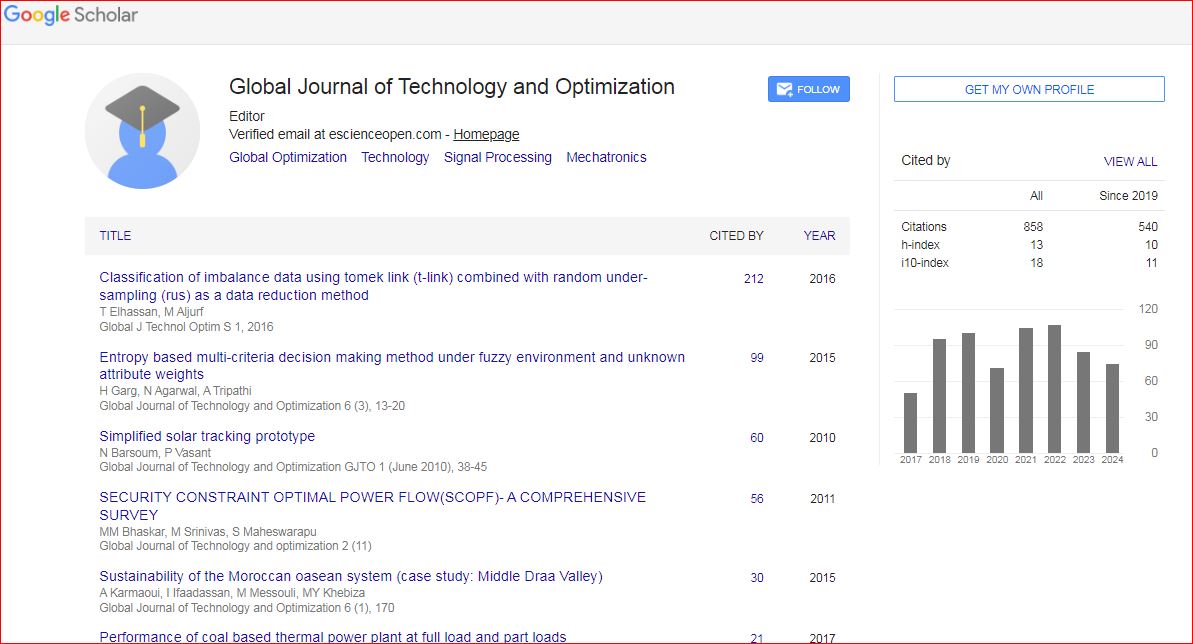
Global Journal of Technology and Optimization received 847 citations as per Google Scholar report