Multiple sclerosis (MS) is considered an autoimmune disease that affects the brain and spinal cord of the central nervous system. The disease affects women more often than men. The symptoms of MS that mainly affect women seem to be related to hormonal levels. Some researchers believe that lower testosterone levels may play a role. Others believe that fluctuations in female hormones may be a factor. More research is needed to determine the true causes of these differences in symptoms. The main symptoms that affect women more than men are menstrual problems, symptoms related to pregnancy and menopause problems. Menstrual problem, research has shown that some women have increased MS symptoms during their period. This may be due to a drop in estrogen levels during this period. Symptoms that worsened for study participants included weakness, imbalance, depression, and fatigue. Some good news for women with MS: Research has shown that MS has no effect on fertility. This means that MS will not stop you from getting pregnant and giving birth to a healthy child. In an even better news, for most women, MS symptoms stabilize or improve during pregnancy, especially during the second and third trimesters. However, it is common for them to return after delivery.
Research Article: Journal of Health & Medical Informatics
Research Article: Journal of Health & Medical Informatics
Editorial: Journal of Health & Medical Informatics
Editorial: Journal of Health & Medical Informatics
Research Article: Journal of Health & Medical Informatics
Research Article: Journal of Health & Medical Informatics
Mini Review: Journal of Health & Medical Informatics
Mini Review: Journal of Health & Medical Informatics
Research Article: Journal of Health & Medical Informatics
Research Article: Journal of Health & Medical Informatics
Posters & Accepted Abstracts: Alternative & Integrative Medicine
Posters & Accepted Abstracts: Alternative & Integrative Medicine
AcceptedAbstracts: Cancer Science & Therapy
AcceptedAbstracts: Cancer Science & Therapy
Scientific Tracks Abstracts: Journal of Hypertension: Open Access
Scientific Tracks Abstracts: Journal of Hypertension: Open Access
Posters & Accepted Abstracts: Journal of Diabetic Complications & Medicine
Posters & Accepted Abstracts: Journal of Diabetic Complications & Medicine
Posters & Accepted Abstracts: Journal of Health & Medical Informatics
Posters & Accepted Abstracts: Journal of Health & Medical Informatics
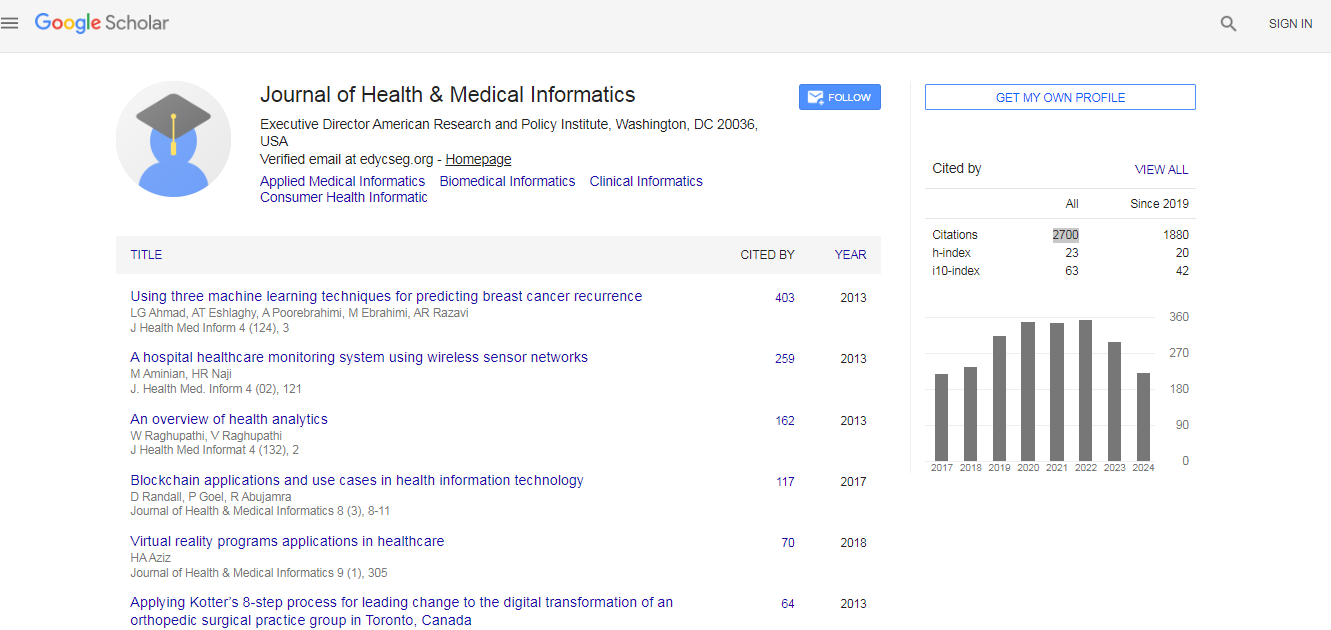
Journal of Health & Medical Informatics received 2700 citations as per Google Scholar report
 Spanish
  Chinese
  Russian
  German
  French
  Japanese
  Portuguese
  Hindi
Hindi 