Phylogenetic analysis show the developmental connections among groups of living forms, or among a group of related nucleic acid or protein sequences. Phylogenetic connections among genes can help to conclude which ones may have comparative functions. The evolutionary history inferred from phylogenetic analysis is usually depicted as branching, treelike diagrams that represent an estimated pedigree of the inherited relationships among molecules (‘‘gene trees’’), organisms, or both. Phylogenetics is sometimes called cladistics because the word ‘‘clade,’’ a set of descendants from a single ancestor, is derived from the Greek word for branch.
Research Article: Journal of Phylogenetics & Evolutionary Biology
Research Article: Journal of Phylogenetics & Evolutionary Biology
Research Article: Journal of Phylogenetics & Evolutionary Biology
Research Article: Journal of Phylogenetics & Evolutionary Biology
Research Article: Journal of Phylogenetics & Evolutionary Biology
Research Article: Journal of Phylogenetics & Evolutionary Biology
Posters & Accepted Abstracts: Molecular and Genetic Medicine
Posters & Accepted Abstracts: Molecular and Genetic Medicine
Scientific Tracks Abstracts: Molecular and Genetic Medicine
Scientific Tracks Abstracts: Molecular and Genetic Medicine
Scientific Tracks Abstracts: Journal of Molecular Biomarkers & Diagnosis
Scientific Tracks Abstracts: Molecular Biomarkers & Diagnosis
Posters & Accepted Abstracts: Journal of Tissue Science and Engineering
Posters & Accepted Abstracts: Journal of Tissue Science and Engineering
Accepted Abstracts: Journal of Tissue Science and Engineering
Accepted Abstracts: Journal of Tissue Science and Engineering
Scientific Tracks Abstracts: Metabolomics:Open Access
Scientific Tracks Abstracts: Metabolomics:Open Access
Scientific Tracks Abstracts: Metabolomics:Open Access
Scientific Tracks Abstracts: Metabolomics:Open Access
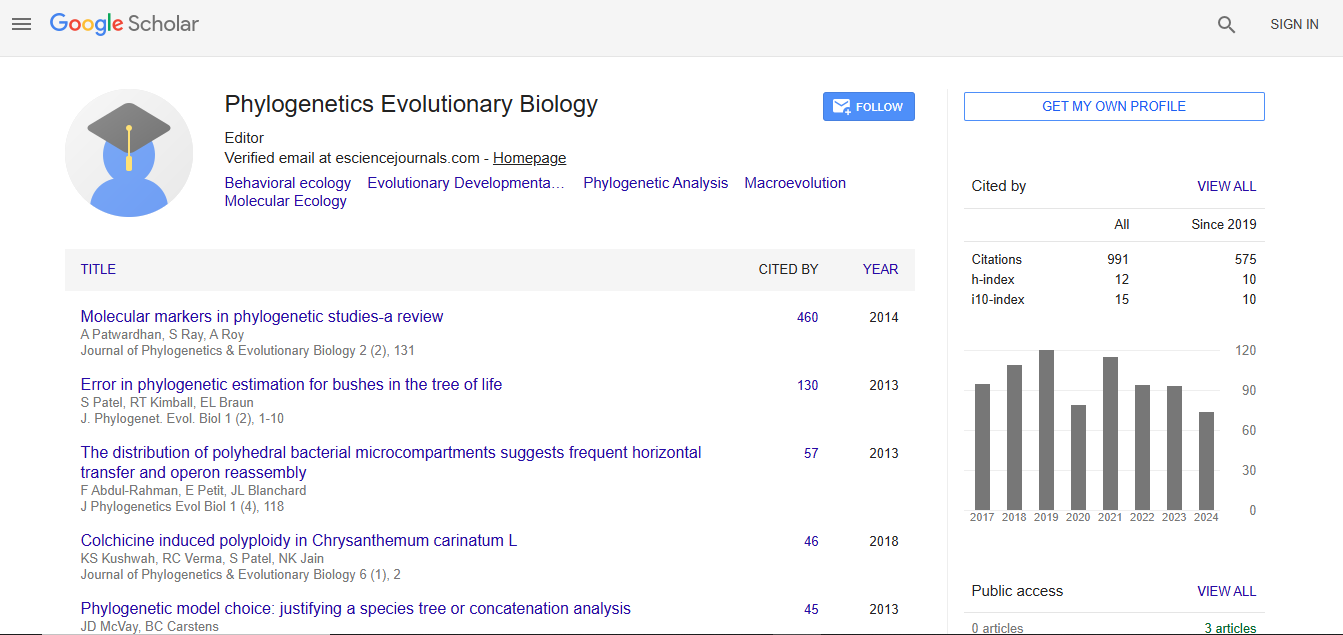
Journal of Phylogenetics & Evolutionary Biology received 911 citations as per Google Scholar report

 Spanish
  Chinese
  Russian
  German
  French
  Japanese
  Portuguese
  Hindi
Hindi 