A gene is said to be polymorphic if there is more than one allele occupying the locus of that gene within a population. In addition to having more than one allele at a particular site, each allele must also be considered polymorphic in the population at a rate of at least 1 per cent. Gene polymorphisms may be present in any region of the genome. Most polymorphisms are silent, meaning that they don't change the function or expression of a gene.
A polymorphic gene variant may lead to the production of an abnormal form of the protein or abnormal expression; this condition is associated with the disease.
In the laboratory, polymorphisms may be identified using a variety of methods. Many methods use PCR to boost a gene sequence.
Research Article: Human Genetics & Embryology
Research Article: Human Genetics & Embryology
Review Article: Human Genetics & Embryology
Review Article: Human Genetics & Embryology
Review Article: Human Genetics & Embryology
Review Article: Human Genetics & Embryology
Commentary: Human Genetics & Embryology
Commentary: Human Genetics & Embryology
Review Article: Human Genetics & Embryology
Review Article: Human Genetics & Embryology
Review Article: Human Genetics & Embryology
Review Article: Human Genetics & Embryology
Posters & Accepted Abstracts: Molecular and Genetic Medicine
Posters & Accepted Abstracts: Molecular and Genetic Medicine
Posters-Accepted Abstracts: Journal of Molecular Biomarkers & Diagnosis
Posters-Accepted Abstracts: Molecular Biomarkers & Diagnosis
Accepted Abstracts: Journal of Molecular Biomarkers & Diagnosis
Accepted Abstracts: Molecular Biomarkers & Diagnosis
Scientific Tracks Abstracts: Journal of Tissue Science and Engineering
Scientific Tracks Abstracts: Journal of Tissue Science and Engineering
Scientific Tracks Abstracts: Journal of Tissue Science and Engineering
Scientific Tracks Abstracts: Journal of Tissue Science and Engineering
Scientific Tracks Abstracts: Metabolomics:Open Access
Scientific Tracks Abstracts: Metabolomics:Open Access
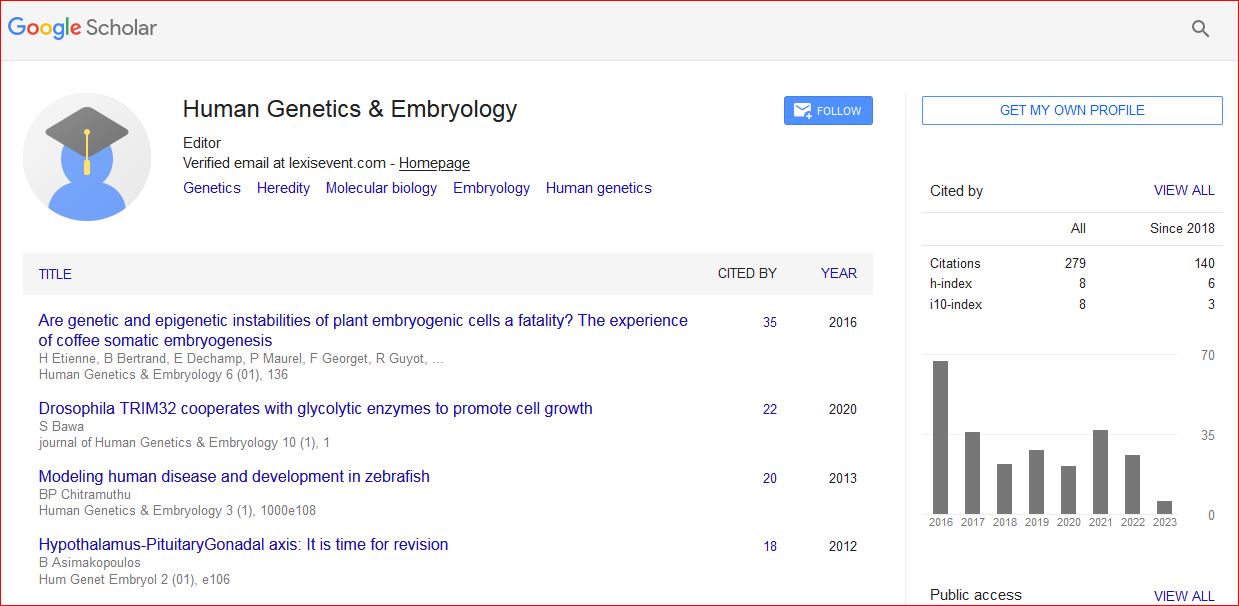
Human Genetics & Embryology received 309 citations as per Google Scholar report


 Spanish
  Chinese
  Russian
  German
  French
  Japanese
  Portuguese
  Hindi
Hindi 