Opinion - (2025) Volume 13, Issue 6
Received: 01-Dec-2025, Manuscript No. jpgeb-26-184330;
Editor assigned: 03-Dec-2025, Pre QC No. P-184330;
Reviewed: 17-Dec-2025, QC No. Q-184330;
Revised: 22-Dec-2025, Manuscript No. R-184330;
Published:
29-Dec-2025
, DOI: 10.37421/2329-9002.2025.13.409
Citation: Novak, Pavel R.. ”Unlocking Understudied Taxa: New Methods for Evolution.” J Phylogenetics Evol Biol 13 (2025):409.
Copyright: © 2025 Novak R. Pavel This is an open-access article distributed under the terms of the Creative Commons Attribution License, which permits unrestricted use, distribution and reproduction in any medium, provided the original author and source are credited.
The field of phylogenetics has undergone a remarkable transformation, particularly in its capacity to illuminate the evolutionary histories of organisms that have historically been understudied. Modern molecular techniques, coupled with sophisticated computational methodologies, are now enabling unprecedented progress in resolving the evolutionary relationships within these 'understudied taxa,' shedding light on the intricate tapestry of life's diversity [1].
These advancements are crucial for a deeper comprehension of biodiversity and for the development of effective conservation strategies that acknowledge the unique evolutionary trajectories of all lineages [4].
The study of diversification dynamics within neglected lineages, facilitated by phylogenetic analyses, is revealing novel insights into fundamental evolutionary processes. By examining the evolutionary relationships of these groups, researchers can better understand adaptation, biogeography, and the mechanisms of speciation, thereby reshaping our understanding of life's history [2].
The 'dark matter' of biodiversity, encompassing these less-explored organisms, is increasingly becoming illuminated as genomic data and advanced bioinformatic tools are applied to previously intractable phylogenetic questions [3].
The application of genomics to phylogenetics is particularly transformative for understudied invertebrate groups, enabling the resolution of complex evolutionary histories that were once beyond reach. The development of specialized bioinformatic tools is crucial for handling the data-rich yet often sparse datasets characteristic of these organisms [3].
Methodological innovations are also expanding the reach of phylogenetic studies to data-deficient taxa, employing approaches like reduced-representation sequencing and phylogenomics with non-model organisms to make previously inaccessible groups amenable to evolutionary inquiry [5].
High-throughput sequencing technologies are playing a pivotal role in democratizing phylogenetic research, empowering scientists to generate large-scale molecular data for previously understudied taxa. This facilitates the construction of robust evolutionary hypotheses and the exploration of evolutionary novelties across diverse lineages [7].
The integration of morphological and molecular data is also proving invaluable for understudied groups, especially those with incomplete fossil records, as it helps to resolve phylogenetic uncertainties and provide a more comprehensive evolutionary picture [8].
Phylogenetic studies are increasingly focusing on specific understudied groups to understand regional biodiversity. For example, research on understudied amphibians using both mitochondrial and nuclear markers has revealed novel insights into their diversification across geographical regions, highlighting the importance of targeted phylogenetic investigations for understanding regional biodiversity hotspots [9].
Furthermore, understanding the influence of historical climate change on the evolutionary trajectories of understudied taxa is a critical area of research, utilizing phylogenetic methods to reconstruct past distributions and infer how climatic shifts have shaped genetic diversity and speciation patterns [10].
The advancements in phylogenetic and evolutionary studies are essential for illuminating the relationships within groups of organisms that have historically received less research attention. These efforts are vital for understanding the breadth of life's evolution and for ensuring that conservation efforts are informed by a comprehensive understanding of evolutionary history [1].
The ability to resolve evolutionary histories for these 'understudied taxa' has profound implications for biodiversity assessment and the formulation of targeted conservation plans [4].
Phylogenetic analyses of understudied taxa are critical for unlocking fundamental evolutionary processes. These studies can reveal novel insights into adaptation, biogeography, and speciation, thereby enhancing our understanding of diversification in previously neglected lineages [2].
The application of advanced techniques to these less-explored groups is essential for a complete picture of evolutionary history [3].
The development and application of new bioinformatic tools are instrumental in tackling complex phylogenetic questions within understudied groups, particularly those with limited genomic resources. These tools are essential for analyzing the unique datasets generated from these taxa [3].
Methodological breakthroughs, such as innovative sequencing approaches, are making previously inaccessible groups viable for phylogenetic study [5].
High-throughput sequencing is a key driver in expanding phylogenetic research to understudied organisms, enabling the generation of substantial molecular data. This capacity is fundamental for building strong evolutionary hypotheses and exploring unique evolutionary developments [7].
Similarly, the combined use of morphological and molecular data offers a more complete understanding of evolutionary history for understudied groups, especially when fossil evidence is scarce [8].
Targeted phylogenetic studies of understudied groups, such as amphibians in biodiversity hotspots, provide crucial insights into regional evolutionary patterns and diversification [9].
Moreover, investigating the impact of historical climate change on these taxa through phylogeographic methods helps to elucidate their evolutionary responses and speciation patterns, thereby contributing to a broader understanding of macroevolutionary processes [10].
The exploration of phylogenetic and evolutionary studies is fundamentally reshaping our understanding of organismal relationships, particularly for those lineages that have historically been less investigated. Leveraging modern molecular techniques alongside advanced computational methods, significant strides are being made in unraveling the evolutionary histories of these 'understudied taxa.' This progress is vital for a comprehensive grasp of biodiversity and for formulating effective conservation strategies that acknowledge the intricate patterns of life's evolution [1].
The implications extend to a deeper appreciation of life's grand evolutionary narrative and underscore the necessity of sustained investment in these research domains [1].
Understudied taxa often serve as crucial reservoirs of information regarding fundamental evolutionary processes. Phylogenetic analyses conducted on these groups can yield novel insights into adaptation, biogeography, and the mechanisms driving speciation. Case studies demonstrating how detailed molecular phylogenies have dramatically altered our perception of diversification within previously neglected lineages are increasingly common [2].
This work effectively illuminates what can be termed the 'dark matter' of biodiversity, revealing evolutionary histories that were once obscure [3].
Specifically, the integration of genomic data with phylogenetic approaches is proving exceptionally powerful for resolving complex evolutionary questions within understudied invertebrate groups. These advancements are supported by the development of new bioinformatic tools specifically designed to handle the data-rich yet often sparse datasets characteristic of these organisms [3].
Furthermore, methodological innovations are crucial for enabling phylogenetic studies of taxa with limited existing genetic resources. Techniques such as reduced-representation sequencing and phylogenomics applied to non-model organisms are making previously inaccessible groups amenable to rigorous evolutionary study [5].
High-throughput sequencing technologies are a significant democratizing force in phylogenetic research, empowering scientists to generate extensive molecular datasets for previously understudied taxa. This capability is essential for constructing robust evolutionary hypotheses and for exploring the emergence of evolutionary novelties across diverse lineages [7].
Complementing these molecular efforts, the integration of morphological and molecular data is proving invaluable for understudied groups, particularly those with incomplete fossil records. This multi-data approach is vital for resolving phylogenetic uncertainties and painting a more complete picture of evolutionary history [8].
Targeted phylogenetic investigations into specific understudied groups, such as amphibians within biodiversity hotspots, are yielding significant insights into regional diversification patterns. By employing a combination of genetic markers, researchers can unravel complex evolutionary relationships and highlight the importance of focused studies for understanding regional biodiversity [9].
Moreover, the influence of historical climate change on the evolutionary trajectories of understudied taxa is a critical area of research. Phylogenetic methods are being used to reconstruct past distributions and infer how climatic shifts have shaped the genetic diversity and speciation patterns within these less-explored groups [10].
Advancements in phylogenetics are making it possible to resolve evolutionary histories for groups of organisms that were previously difficult to study. This is critical for understanding the full scope of biodiversity and for developing conservation plans that account for unique evolutionary lineages [4].
The insights gained from these studies are essential for both basic scientific understanding and practical conservation efforts [4].
The study of diversification in understudied lineages through phylogenetic analysis is crucial for understanding evolutionary processes. These analyses provide novel perspectives on adaptation and speciation, which are key to comprehending the broader patterns of life's evolution [2].
Genomic data and new bioinformatic tools are essential for tackling complex phylogenetic questions in understudied groups, especially invertebrates. This allows for the resolution of evolutionary histories that were previously intractable [3].
Methodological innovations are expanding the scope of phylogenetic studies to include data-deficient taxa. Techniques like phylogenomics are making more organisms accessible to evolutionary research [5].
High-throughput sequencing provides the data necessary to build robust evolutionary hypotheses for understudied taxa, facilitating the exploration of evolutionary novelties [7].
The integration of morphological and molecular data is also critical for a comprehensive understanding of evolutionary history [8].
Specific phylogenetic studies of understudied amphibians are revealing patterns of diversification in biodiversity hotspots [9].
Furthermore, understanding evolutionary responses to climate change in understudied taxa is crucial for comprehending their long-term trajectories [10].
This collection of research highlights the significant advancements in phylogenetic and evolutionary studies, particularly concerning understudied taxa. Modern molecular techniques and computational methods are now enabling the resolution of evolutionary histories for these previously neglected organisms, offering crucial insights into biodiversity, adaptation, biogeography, and speciation. The application of genomics and specialized bioinformatic tools is proving instrumental, as are methodological innovations and high-throughput sequencing, which democratize research and expand its reach. The integration of diverse data types, including morphological and molecular data, along with phylogeographic approaches to understand climate change impacts, further enriches our understanding. These studies not only advance fundamental scientific knowledge but also have direct implications for conservation efforts, helping to prioritize and protect unique evolutionary lineages.
None
None
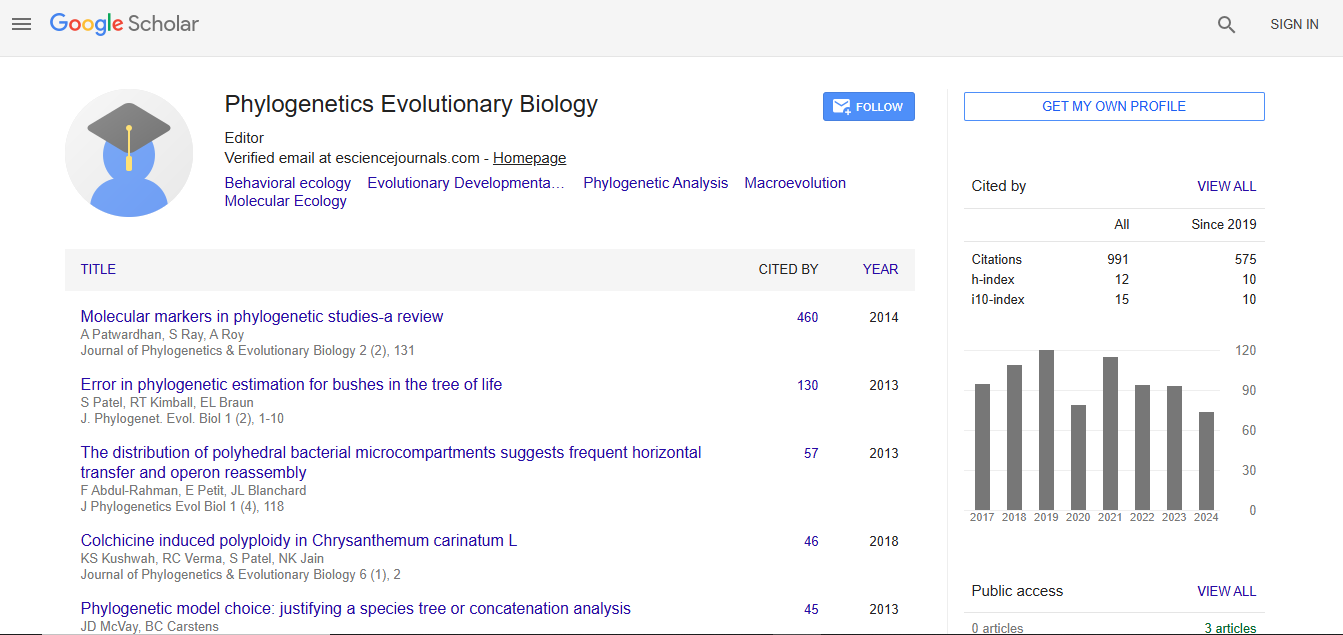
Journal of Phylogenetics & Evolutionary Biology received 911 citations as per Google Scholar report