Opinion - (2025) Volume 12, Issue 3
Received: 01-May-2025, Manuscript No. jlop-26-179028;
Editor assigned: 05-May-2025, Pre QC No. P-179028;
Reviewed: 19-May-2025, QC No. Q-179028;
Revised: 22-May-2025, Manuscript No. R-179028;
Published:
29-May-2025
, DOI: 10.37421/2469-410X. 2025.12.202
Citation: Novák, Pavel. ”Ultrafast Optical Imaging: Revolutionizing Transient Event Visualization.” J Laser Opt Photonics 12 (2025):202.
Copyright: © 2025 Novák P. This is an open-access article distributed under the terms of the Creative Commons Attribution License, which permits unrestricted use, distribution and reproduction in any medium, provided the original author and source are credited.
Ultrafast optical imaging techniques are revolutionizing our ability to visualize dynamic processes at unprecedented temporal resolutions, often relying on femtosecond laser pulses to capture transient phenomena across diverse scientific fields, including materials science and biology. The fundamental challenge lies in simultaneously achieving high spatial and temporal resolution, which necessitates sophisticated optical setups and advanced reconstruction algorithms. Recent advancements have seen techniques such as time-resolved pump-probe microscopy, compressed ultrafast photography, and single-shot imaging pushing the boundaries of observational capabilities [1].
Compressed ultrafast photography (CUP) stands out for its remarkable ability to capture events occurring within picoseconds to nanoseconds by encoding temporal information into spatial dimensions. This technique cleverly bypasses the need for high-speed detectors by employing a spatial light modulator and a chirped optical pulse to create a compressed representation of the temporal sequence, with subsequent processing reconstructing the high-speed dynamics. Ongoing developments aim to enhance both spatial resolution and the captured temporal window [2].
Single-shot ultrafast imaging methods are indispensable for studying transient phenomena that unfold too rapidly or unpredictably for repeated measurements. These approaches frequently utilize advanced encoding schemes, such as spatial-to-temporal conversion, to record the entire temporal evolution of a light pulse or a fast event within a single acquisition. Significant improvements in detector technology and computational reconstruction have substantially boosted the performance of these single-shot imaging systems [3].
Time-resolved pump-probe microscopy remains a cornerstone of ultrafast optical imaging, fundamentally enabling the study of excited-state dynamics in materials and molecules. This method involves a pump pulse initiating a process and a time-delayed probe pulse interrogating the system's response. By systematically varying the delay between these pulses, researchers can meticulously map the evolution of spectral, structural, or electronic properties with femtosecond precision, while ongoing advancements in laser technology and detection schemes continue to extend the limits of sensitivity and speed [4].
Coherent diffractive imaging (CDI) within the ultrafast regime offers label-free, high-resolution visualization of dynamic nanoscale structures. It reconstructs the electron density of a sample by analyzing the diffraction patterns generated by coherent X-ray or electron pulses. When implemented with ultrafast sources, CDI becomes a powerful tool for observing transient states and dynamics in processes like material phase transitions or molecular rearrangements [5].
Computational ghost imaging techniques, especially when extended to the ultrafast domain, present innovative pathways for reconstructing images from incomplete or noisy data. By correlating measurements from a reference beam with those from a signal beam, images can be formed even without direct spatial resolution from the detector. Ultrafast implementations are actively exploring its utility in scenarios where conventional imaging methods face significant challenges [6].
Deep learning methodologies are progressively being integrated into ultrafast optical imaging workflows to improve image reconstruction, reduce noise, and enhance data interpretation. Through the training of neural networks on extensive datasets, these AI-driven approaches can surmount the limitations inherent in traditional algorithms, leading to both faster and more accurate imaging of complex ultrafast phenomena [7].
The development of novel ultrafast light sources, including few-cycle pulse lasers and high-harmonic generation sources, plays a critical role in advancing ultrafast optical imaging capabilities. These advanced sources provide the essential temporal resolution and specific spectral characteristics required for probing a broad spectrum of dynamic processes at the atomic and molecular levels, thereby expanding the scope of ultrafast investigations [8].
Phase-contrast imaging techniques, when synergistically combined with ultrafast optical sources, enable high-contrast visualization of transparent and weakly absorbing samples. This capability is particularly advantageous in biological imaging, where it allows researchers to circumvent the need for potentially damaging staining procedures. Furthermore, ongoing progress in phase retrieval algorithms has led to marked improvements in both the quality and speed of these imaging modalities [9].
Holographic techniques are being effectively adapted for ultrafast imaging applications to capture both the amplitude and phase of light fields, thereby yielding richer information about dynamic processes. Ultrafast holography proves invaluable for reconstructing three-dimensional information of transient events, offering profound insights into wave propagation, material deformation, and the intricate mechanisms of chemical reactions [10].
Ultrafast optical imaging techniques are at the forefront of scientific visualization, offering unparalleled temporal resolutions for observing dynamic processes. These methods, frequently leveraging femtosecond laser pulses, enable the capture of transient phenomena across a broad spectrum of disciplines, from materials science to biology. A persistent hurdle involves the simultaneous achievement of high spatial and temporal resolution, often addressed through intricate optical setups and sophisticated reconstruction algorithms. Prominent techniques include time-resolved pump-probe microscopy, compressed ultrafast photography, and various single-shot methods, all contributing to pushing the frontiers of observable phenomena [1].
Compressed ultrafast photography (CUP) provides an extraordinary capability to record events on picosecond to nanosecond timescales by transforming temporal information into spatial dimensions. This technique ingeniously circumvents the requirement for high-speed detectors by employing a spatial light modulator and a chirped optical pulse to generate a compressed representation of the temporal sequence. Subsequent computational processing, typically involving deconvolution algorithms, then reconstructs the high-speed dynamics. Current research efforts are focused on refining spatial resolution and expanding the temporal range of captured events [2].
Single-shot ultrafast imaging methodologies are crucial for the investigation of transient phenomena that occur too rapidly or unpredictably for repeated measurement campaigns. These techniques commonly rely on advanced encoding strategies, such as the conversion of spatial information to temporal information, enabling the recording of the complete temporal evolution of a light pulse or a fleeting event in a single experimental acquisition. Significant advancements in both detector technology and computational reconstruction have markedly enhanced the efficacy of single-shot imaging systems [3].
Time-resolved pump-probe microscopy is a foundational technique in ultrafast optical imaging, vital for elucidating excited-state dynamics in both materials and molecules. The experimental paradigm involves an initial pump pulse that initiates a specific process, followed by a time-delayed probe pulse that interrogates the system's subsequent response. By precisely controlling the time delay between these pulses, researchers can meticulously map the temporal evolution of spectral, structural, or electronic properties with femtosecond precision. Continuous progress in laser technology and detection schemes further extends the limits of sensitivity and operational speed [4].
Coherent diffractive imaging (CDI) adapted for the ultrafast regime offers a powerful approach for label-free, high-resolution imaging of dynamic nanoscale structures. This technique reconstructs the electron density distribution of a sample by meticulously analyzing the diffraction patterns produced by coherent X-ray or electron pulses. When utilized with ultrafast radiation sources, CDI facilitates the observation of transient states and dynamic processes in areas such as material phase transitions or complex molecular rearrangements [5].
Computational ghost imaging techniques, particularly those extended to operate in the ultrafast temporal domain, introduce novel methodologies for image reconstruction from data that may be incomplete or affected by noise. By establishing correlations between measurements acquired from a reference beam and those from a signal beam, images can be successfully formed even when the detector lacks inherent spatial resolving capabilities. Ultrafast implementations are actively being explored for application in scenarios where conventional imaging approaches prove problematic [6].
Deep learning approaches are increasingly being incorporated into ultrafast optical imaging workflows, aiming to improve the quality of image reconstruction, enhance noise reduction capabilities, and refine data interpretation. By training sophisticated neural networks on extensive datasets, these machine learning methods can effectively overcome the limitations associated with traditional imaging algorithms, thereby achieving faster and more accurate imaging of intricate ultrafast phenomena [7].
The continuous development of novel ultrafast light sources, including advanced few-cycle pulse lasers and sophisticated high-harmonic generation sources, is paramount for the progression of ultrafast optical imaging. These specialized sources provide the indispensable temporal resolution and precise spectral characteristics necessary for probing a wide array of dynamic processes at the atomic and molecular scales, opening new avenues for investigation [8].
Phase-contrast imaging techniques, when integrated with ultrafast optical sources, offer a significant advantage in visualizing transparent and weakly absorbing samples with exceptional contrast. This is particularly valuable in biological imaging applications, where it allows for the avoidance of invasive and potentially damaging staining procedures. Moreover, ongoing advancements in phase retrieval algorithms have led to substantial enhancements in both the image quality and the operational speed of these phase-contrast imaging modalities [9].
Holographic techniques are being progressively adapted for ultrafast imaging purposes, enabling the capture of both the amplitude and phase information of light fields. This comprehensive data acquisition provides richer insights into dynamic processes. Ultrafast holography proves particularly useful for reconstructing three-dimensional information of transient events, offering valuable perspectives on wave propagation dynamics, material deformation characteristics, and the kinetics of chemical reactions [10].
Ultrafast optical imaging techniques are revolutionizing the visualization of dynamic processes with unprecedented temporal resolution, utilizing femtosecond laser pulses to capture transient phenomena. Key methods include time-resolved pump-probe microscopy, compressed ultrafast photography, and single-shot imaging, which collectively push observational limits. Compressed ultrafast photography encodes temporal information into spatial dimensions for picosecond to nanosecond event capture, bypassing the need for high-speed detectors. Single-shot imaging is essential for unpredictable, rapid events, employing advanced encoding schemes for single acquisitions. Time-resolved pump-probe microscopy allows detailed study of excited-state dynamics by varying time delays between pulses. Coherent diffractive imaging offers label-free, high-resolution imaging of nanoscale dynamics. Computational ghost imaging reconstructs images from incomplete data, and deep learning enhances reconstruction and noise reduction. Novel ultrafast light sources are critical for probing atomic and molecular dynamics. Phase-contrast imaging visualizes transparent samples with high contrast, and holographic techniques capture both amplitude and phase for richer 3D information of transient events.
None
None
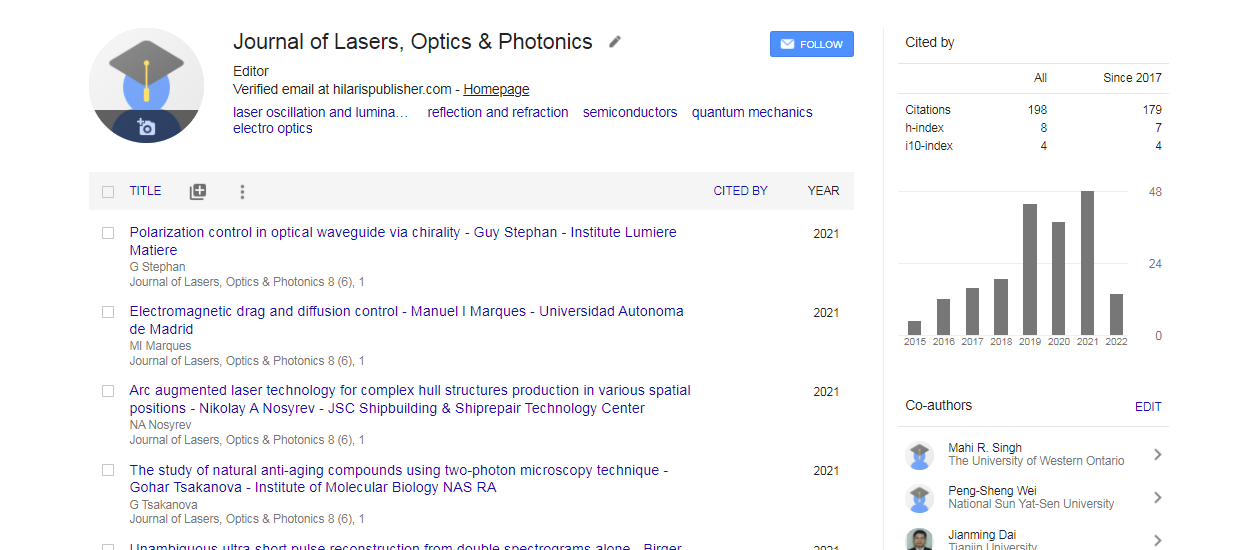
Journal of Lasers, Optics & Photonics received 279 citations as per Google Scholar report