Short Communication - (2026) Volume 16, Issue 2
Received: 28-Feb-2026
Editor assigned: 02-Mar-2026
Reviewed: 16-Mar-2026
Revised: 23-Mar-2026
Published:
30-Mar-2026
, DOI: 10.37421-2165-7920.2026.16.1717
Citation: Yusuf, Hina. ”Typhoid Fever: Diagnosis, Management, and Public Health Challenges.” J Clin Case Rep 16 (2026):1717.
Copyright: © 2026 Yusuf H. This is an open-access article distributed under the terms of the Creative Commons Attribution License, which permits unrestricted use, distribution and reproduction in any medium, provided the original author and source are credited.
Typhoid fever, a systemic illness caused by Salmonella enterica serovar Typhi, continues to pose a significant global health challenge, particularly in endemic regions. This report details a rare presentation of typhoid fever complicated by intestinal perforation, emphasizing the diagnostic difficulties and critical management required for a favorable outcome. The patient, a young adult from an endemic area, exhibited non-specific abdominal symptoms that rapidly worsened, necessitating immediate intervention. High clinical suspicion for enteric fever complications is crucial, even in the absence of classic signs, underscoring the importance of prompt antibiotic therapy and supportive care [1].
The epidemiological landscape of typhoid fever reveals persistent burdens in South Asia, with studies exploring its trends and clinical characteristics, including complications like perforation. Such research highlights risk factors associated with severe outcomes and advocates for enhanced public health measures, improved sanitation, and timely surgical access for patients with intestinal complications [2].
A comprehensive review synthesizes current knowledge on the diagnosis and management of typhoid intestinal perforation. It stresses the pivotal role of early surgical intervention and meticulous post-operative care. The review delves into diagnostic modalities, surgical techniques, and the challenges encountered in managing this life-threatening complication, especially in high-incidence zones, advocating for multidisciplinary approaches to enhance patient outcomes [3].
Further insights into surgical management are provided by a case series focusing on surgical outcomes in patients with typhoid intestinal perforation. This study evaluates various surgical approaches and their impact on morbidity and mortality, suggesting that prompt surgical repair, alongside appropriate antibiotic therapy and intensive care, leads to improved prognoses. The challenges of managing multiple perforations and associated sepsis are also addressed [4].
The diagnostic process for typhoid intestinal perforation is significantly aided by imaging. An article investigates the role of various imaging modalities, discussing their utility and limitations. Ultrasound and CT scans are highlighted for their ability to facilitate early detection and localization of perforations, thereby enabling prompt surgical management. The importance of correlating imaging findings with clinical presentation is emphasized [5].
The growing issue of antibiotic resistance presents a significant challenge to the treatment of typhoid fever, including complicated presentations like perforation. A prospective study evaluates the impact of these resistance patterns on patient outcomes, underscoring the increasing difficulty posed by multidrug-resistant Salmonella Typhi and its implications for treatment efficacy. This necessitates judicious antibiotic use and continuous surveillance of resistance trends [6].
Specific challenges arise when managing typhoid intestinal perforation in pediatric populations. A case report describes the successful management of this complication in a child, emphasizing the diagnostic and therapeutic difficulties in younger age groups. The report stresses the importance of a high index of suspicion for enteric fever complications and the critical role of prompt surgical intervention and intensive supportive care in this vulnerable demographic [7].
Advancements in surgical techniques are continually evolving to improve outcomes for typhoid intestinal perforation. A review focuses on minimizing invasiveness and enhancing patient recovery, discussing the feasibility of laparoscopic approaches, particularly in resource-limited settings. The benefits of early mobilization and reduced hospital stays associated with minimally invasive surgery are also explored [8].
Understanding the inflammatory response is key to managing severe typhoid intestinal perforation. A study investigates inflammatory markers and their correlation with disease severity. The utility of C-reactive protein (CRP) and white blood cell count in predicting complications and guiding management decisions is examined, suggesting that elevated inflammatory markers can serve as early indicators of severe disease, prompting aggressive intervention [9].
From a public health perspective, typhoid fever, including its intestinal perforation complication, remains a significant concern in endemic regions. A comprehensive review discusses these implications, highlighting the need for integrated strategies involving sanitation, vaccination, and improved healthcare access for disease control. The review also addresses the socioeconomic burden associated with typhoid and its complications [10].
This case report details a rare presentation of typhoid fever complicated by intestinal perforation, emphasizing the diagnostic challenges and critical management required for a favorable outcome. The patient, a young adult from an endemic region, presented with non-specific abdominal symptoms that rapidly progressed. Early recognition and surgical intervention were crucial for a positive outcome, highlighting the necessity of high clinical suspicion for enteric fever complications even without classic signs. The report also underscores the importance of prompt antibiotic therapy and supportive care [1].
The study explores the epidemiological trends and clinical characteristics of typhoid fever and its complications, such as perforation, within a resource-limited setting. It highlights the persistent burden of typhoid in South Asia and identifies risk factors linked to severe outcomes. The findings support enhanced public health interventions, improved sanitation, and timely access to surgical care for patients presenting with intestinal complications [2].
This review synthesizes current knowledge regarding the diagnosis and management of typhoid intestinal perforation, with a particular emphasis on the critical role of early surgical intervention and post-operative care. It discusses various diagnostic modalities, surgical techniques, and the challenges inherent in managing this life-threatening complication, especially in areas with high incidence rates. The authors advocate for multidisciplinary approaches to improve patient outcomes [3].
A case series focusing on surgical outcomes in patients with typhoid intestinal perforation evaluates different surgical approaches and their impact on morbidity and mortality. The results suggest that timely surgical repair, complemented by appropriate antibiotic therapy and intensive care, contributes to better prognoses. The study also addresses the complexities of managing multiple perforations and associated sepsis [4].
This article investigates the role of imaging in the diagnosis of typhoid intestinal perforation, examining the effectiveness and limitations of various diagnostic tools. It points out that ultrasound and CT scans can significantly aid in the early detection and localization of perforations, thereby facilitating prompt surgical management. The importance of correlating imaging findings with the patient's clinical presentation is stressed [5].
This prospective study examines how antibiotic resistance patterns influence the outcomes of typhoid fever, including cases with complicated presentations like perforation. The research emphasizes the increasing challenge posed by multidrug-resistant Salmonella Typhi and its impact on treatment effectiveness. It calls for judicious antibiotic use and continuous monitoring of resistance trends [6].
A case report describes the successful management of typhoid intestinal perforation in a pediatric patient, underscoring the difficulties in diagnosis and treatment for younger individuals. The report highlights the need for a high index of suspicion for enteric fever complications and the essential role of prompt surgical intervention and intensive supportive care in this vulnerable population [7].
This article reviews advancements in surgical techniques for typhoid intestinal perforation, aiming to minimize invasiveness and improve patient outcomes. It discusses laparoscopic approaches and their applicability in managing this condition, particularly in resource-limited contexts. The advantages of early mobilization and reduced hospital stays associated with minimally invasive surgery are also explored [8].
This study investigates inflammatory markers and their relationship with the severity of typhoid intestinal perforation. It assesses the usefulness of C-reactive protein (CRP) and white blood cell count in predicting complications and guiding management decisions. The findings indicate that elevated inflammatory markers can serve as early indicators of severe disease, prompting aggressive intervention [9].
This comprehensive review addresses the public health implications of typhoid fever, including the challenges presented by intestinal perforation in endemic areas. It emphasizes the necessity of integrated strategies encompassing sanitation, vaccination, and improved healthcare access for disease control. The review also touches upon the socioeconomic impact of typhoid and its complications [10].
Typhoid fever, particularly when complicated by intestinal perforation, presents significant diagnostic and management challenges, especially in endemic regions. Early recognition, prompt surgical intervention, and comprehensive supportive care are crucial for positive outcomes. Advanced imaging modalities and a high clinical suspicion are vital for timely diagnosis. The growing threat of antibiotic resistance necessitates judicious antibiotic use and continuous surveillance. Management strategies are evolving, with a focus on minimally invasive surgical techniques and multidisciplinary approaches. Inflammatory markers can aid in assessing disease severity, and public health initiatives focused on sanitation, vaccination, and improved healthcare access are essential for controlling the disease and mitigating its socioeconomic burden.
None
None
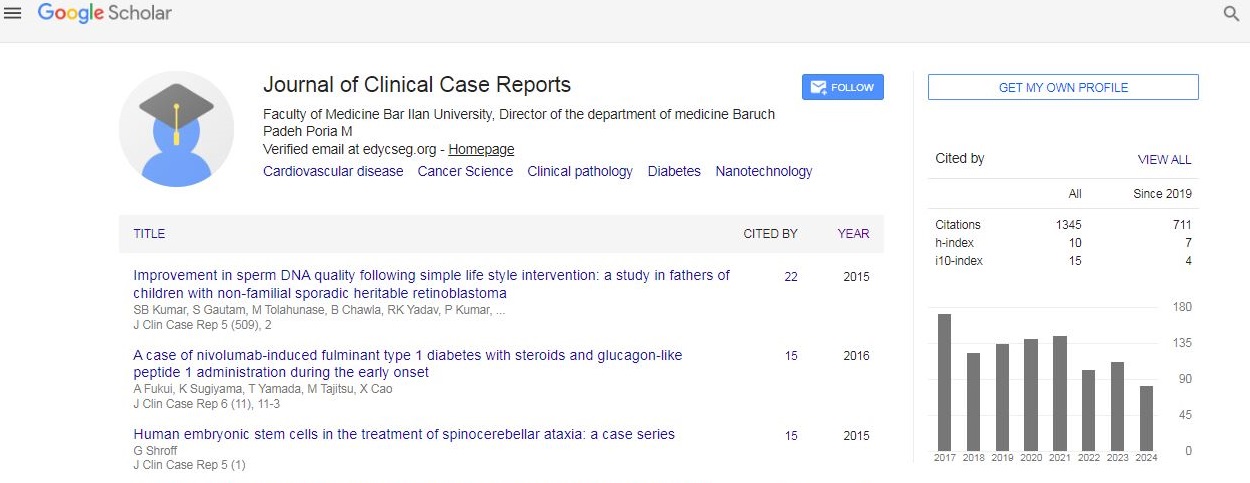
Journal of Clinical Case Reports received 1345 citations as per Google Scholar report