Commentary - (2025) Volume 12, Issue 3
Received: 01-May-2025, Manuscript No. jlop-26-179033;
Editor assigned: 05-May-2025, Pre QC No. P-179033;
Reviewed: 19-May-2025, QC No. Q-179033;
Revised: 22-May-2025, Manuscript No. R-179033;
Published:
29-May-2025
, DOI: 10.37421/2469-410X. 2025.12.204
Citation: Okoye, Samuel. ”Tunable Lasers: Driving Precision Measurement Technologies.” J Laser Opt Photonics 12 (2025):204.
Copyright: © 2025 Okoye S. This is an open-access article distributed under the terms of the Creative Commons Attribution License, which permits unrestricted use, distribution and reproduction in any medium, provided the original author and source are credited.
The field of precision measurement is profoundly impacted by advancements in tunable laser sources, offering unparalleled flexibility in wavelength selection essential for metrology, spectroscopy, and interferometry [1].
Recent innovations have focused on developing broadly tunable fiber lasers, optical parametric oscillators (OPOs), and quantum cascade lasers (QCLs), each with unique advantages for specific precision tasks [1].
These advancements are crucial for pushing the boundaries of measurement sensitivity through ultra-fine wavelength control and stabilization [1].
The performance of broadly tunable mid-infrared quantum cascade lasers (QCLs) has been investigated for high-resolution gas spectroscopy, demonstrating sub-Doppler resolution vital for trace gas detection [2].
Techniques like frequency comb referencing are employed to achieve this precision, which is paramount for environmental monitoring and industrial process control [2].
The design considerations for optimizing tunability and spectral purity in QCLs are detailed for these demanding applications [2].
Research into highly stable, wavelength-tunable fiber lasers for precision optical interferometry highlights methods for achieving broad tunability with extremely narrow linewidths and high frequency stability, crucial for reducing systematic errors in interferometric measurements [3].
Experimental results demonstrate improved sensitivity in displacement and refractive index measurements enabled by these lasers, contributing to advancements in nanoscale metrology [3].
Tunable optical parametric oscillators (OPOs) are being explored for advanced spectroscopic measurements requiring broad wavelength access, with high-power, synchronously pumped OPOs capable of tuning across significant portions of the visible and infrared spectrum [4].
This broad tunability facilitates the interrogation of a wide range of molecular resonances with high spectral resolution, making them suitable for complex analytical chemistry and materials science [4].
Novel approaches to achieving fine wavelength control in external-cavity diode lasers (ECDLs) for precision frequency stabilization integrate femtosecond laser frequency combs, enabling precise wavelength locking for applications like atomic clocks and high-accuracy spectroscopy [5].
These methods are essential for achieving absolute frequency accuracy and demonstrate the demonstrated stability achieved [5].
Tunable semiconductor lasers, including distributed feedback (DFB) lasers and tunable laser diodes (TLDs), play a significant role in miniaturized precision measurement systems, discussing their wavelength tuning mechanisms and performance characteristics for compact metrology instruments [6].
Emerging trends in integrated photonics are leading to highly compact and stable tunable laser sources suitable for portable sensing and measurement devices [6].
Tunable fiber lasers are being employed in Raman spectroscopy for quantitative analysis and material characterization, where precise wavelength tuning allows for selective excitation of specific Raman modes, enhancing sensitivity and reducing spectral overlap in complex samples [7].
The robustness and broad tunability of fiber lasers make them advantageous for on-site and in-situ measurements in chemical sensing and biomedical diagnostics [7].
Frequency-agile lasers are being investigated for advanced optical coherence tomography (OCT) systems to enable high-resolution imaging. Rapidly tunable lasers, such as swept-source lasers, significantly improve acquisition speeds and depth penetration, critical for detailed imaging of biological tissues and materials [8].
This tunability supports advancements in medical diagnostics and non-destructive testing [8].
Tunable diode laser absorption spectroscopy (TDLAS) integrated with fiber optics is being developed for remote sensing applications. These systems measure gas concentrations at a distance by analyzing specific wavelength absorption, with flexibility in wavelength selection crucial for targeting different gases and adapting to varying atmospheric conditions for environmental monitoring [9].
The use of precisely tunable lasers in gravitational wave detectors is crucial for enhancing sensitivity and reducing noise. These lasers are employed to probe optical cavities and maintain interferometer alignment, with precise wavelength control and stabilization fundamental to achieving the extreme sensitivity required for detecting faint gravitational waves in astrophysics research [10].
The fundamental principles and recent advancements in tunable laser sources for high-precision measurement applications are explored, emphasizing their unparalleled flexibility in selecting specific wavelengths crucial for enhanced accuracy and resolution in metrology, spectroscopy, and interferometry [1].
Key innovations include broadly tunable fiber lasers, optical parametric oscillators (OPOs), and quantum cascade lasers (QCLs), along with their unique advantages and limitations for different precision measurement tasks, and emerging techniques for ultra-fine wavelength control and stabilization [1].
The performance of broadly tunable mid-infrared quantum cascade lasers (QCLs) for high-resolution gas spectroscopy is investigated, demonstrating sub-Doppler resolution for trace gas detection through techniques like frequency comb referencing [2].
This level of precision is vital for environmental monitoring, industrial process control, and fundamental physics research, with authors detailing design considerations for optimizing tunability and spectral purity in QCLs for such demanding applications [2].
A study focuses on the development of a highly stable, wavelength-tunable fiber laser for precision optical interferometry, detailing methods for achieving broad tunability while maintaining extremely narrow linewidth and high frequency stability, crucial for reducing systematic errors in interferometric measurements [3].
Experimental results demonstrate improved sensitivity in displacement and refractive index measurements enabled by the tunable laser's performance, relevant to advancements in nanoscale metrology and optical testing [3].
The application of tunable optical parametric oscillators (OPOs) for advanced spectroscopic measurements requiring broad wavelength access is discussed, including the design and optimization of high-power, synchronously pumped OPOs that can be tuned across significant portions of the visible and infrared spectrum [4].
This broad tunability allows for the interrogation of a wide range of molecular resonances with high spectral resolution, suitable for complex analytical chemistry and materials science applications, emphasizing the role of advanced nonlinear crystals and pump laser technology [4].
A novel approach to achieving fine wavelength control in external-cavity diode lasers (ECDLs) for precision frequency stabilization is presented, integrating a femtosecond laser frequency comb with an ECDL to enable precise locking of the laser's wavelength to the comb's grid, essential for absolute frequency accuracy in applications such as atomic clocks and high-accuracy spectroscopy [5].
The article details calibration procedures and demonstrated stability achieved with this technique [5].
Advancements in tunable semiconductor lasers are reviewed, focusing on their role in miniaturized precision measurement systems, covering various diode laser technologies like distributed feedback (DFB) lasers and tunable laser diodes (TLDs) [6].
The discussion includes their wavelength tuning mechanisms and performance characteristics relevant to compact metrology instruments, highlighting emerging trends in integrated photonics for creating highly compact and stable tunable laser sources suitable for portable sensing and measurement devices [6].
The use of tunable fiber lasers in Raman spectroscopy for quantitative analysis and material characterization is explored, detailing how precise wavelength tuning allows for selective excitation of specific Raman modes, enhancing sensitivity and reducing spectral overlap in complex samples [7].
The advantages of fiber lasers, such as robustness and broad tunability, are discussed for on-site and in-situ measurements in diverse fields including chemical sensing and biomedical diagnostics [7].
The application of frequency-agile lasers in advanced optical coherence tomography (OCT) for high-resolution imaging is investigated, explaining how rapidly tunable lasers, such as swept-source lasers, enable faster acquisition speeds and improved depth penetration in OCT systems [8].
This tunability is critical for achieving detailed cross-sectional imaging of biological tissues and materials with unprecedented clarity, supporting advancements in medical diagnostics and non-destructive testing [8].
The integration of tunable diode laser absorption spectroscopy (TDLAS) with fiber optics for remote sensing applications is discussed, focusing on the development of a tunable diode laser system capable of measuring gas concentrations at a distance by analyzing the absorption of specific wavelengths [9].
The flexibility of wavelength selection is key to targeting different gases and adapting to varying atmospheric conditions, enhancing the accuracy and range of environmental monitoring and industrial safety systems [9].
The use of tunable lasers in gravitational wave detectors for enhancing sensitivity and reducing noise is examined, highlighting how precisely tunable lasers are employed to probe optical cavities and maintain interferometer alignment [10].
The ability to precisely control and stabilize the laser wavelength is fundamental to achieving the extreme sensitivity required for detecting faint gravitational waves, a critical aspect of modern astrophysics and cosmology research, with authors discussing specific laser requirements and technological challenges [10].
This collection of research highlights the critical role of tunable laser sources in advancing precision measurement technologies across various scientific and industrial domains. Studies cover a range of tunable laser types, including fiber lasers, quantum cascade lasers (QCLs), optical parametric oscillators (OPOs), and diode lasers. Key applications discussed include high-precision metrology, detailed spectroscopic analysis for environmental monitoring and industrial control, enhanced optical coherence tomography (OCT) for medical imaging, and sensitive gravitational wave detection. Innovations in wavelength control, frequency stabilization, and miniaturization are driving improvements in accuracy, resolution, and sensitivity. Techniques such as frequency comb referencing and integrated photonics are enabling new levels of performance and portability for these advanced laser systems.
None
None
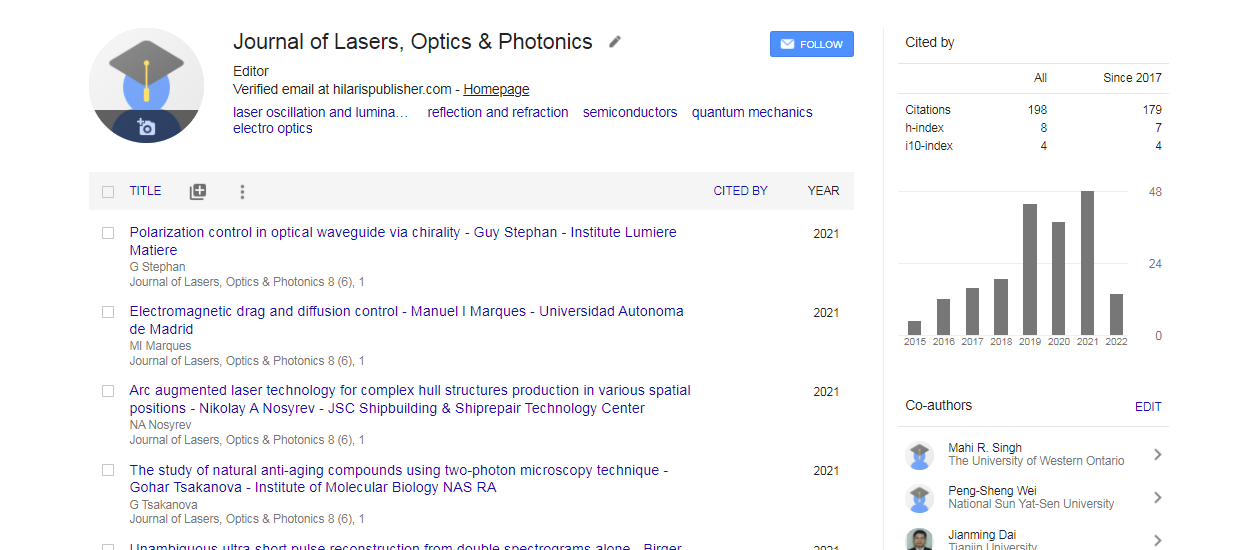
Journal of Lasers, Optics & Photonics received 279 citations as per Google Scholar report