Opinion - (2025) Volume 12, Issue 6
Received: 01-Dec-2025, Manuscript No. ijn-26-184024;
Editor assigned: 03-Dec-2025, Pre QC No. P-184024;
Reviewed: 17-Dec-2025, QC No. Q-184024;
Revised: 22-Dec-2025, Manuscript No. R-184024;
Published:
29-Dec-2025
, DOI: 10.37421/2376-0281.2025.12.663
Citation: Chen, Olivia. "Neurorehabilitation for Stroke Aphasia: Personalized, Tech-Driven Recovery." Int J Neurorehabilitation Eng 12 (2025):662.
Copyright: © 2025 Chen O. This is an open-access article distributed under the terms of the Creative Commons Attribution License, which permits unrestricted use, distribution and reproduction in any medium, provided the original author and source are credited.
Transcranial Magnetic Stimulation (TMS) has emerged as a significant non-invasive neuromodulation technique extensively utilized in the field of neurorehabilitation. Its application is particularly noteworthy in facilitating motor and cognitive recovery subsequent to various neurological events, including stroke, traumatic brain injury, and spinal cord injury [1].
Key research findings consistently highlight TMS's remarkable capacity to modulate cortical excitability, thereby fostering neuroplasticity and ultimately improving functional outcomes across diverse patient populations [1].
The strategic integration of TMS with established conventional rehabilitation therapies presents a promising avenue for the development of highly personalized and effective treatment approaches tailored to individual patient needs [1].
Repetitive Transcranial Magnetic Stimulation (rTMS) has demonstrated considerable efficacy in restoring upper limb motor function among stroke survivors. Studies indicate that the application of rTMS to the affected motor cortex can yield significant improvements in motor scores and a notable reduction in spasticity, underscoring its therapeutic potential [2].
The research in this area further emphasizes the critical importance of precisely defining stimulation parameters and their optimal timing relative to concurrent motor training to achieve the most beneficial results [2].
The role of TMS in addressing cognitive deficits that frequently arise after traumatic brain injury (TBI) is a subject of ongoing investigation and growing interest. A synthesis of current evidence indicates that TMS can effectively enhance executive functions, attention, and memory recall in TBI patients, offering new hope for cognitive rehabilitation [3].
It is suggested that TMS facilitates this cognitive improvement by actively modulating the activity within prefrontal and parietal brain networks, thereby presenting a promising strategy for enhancing the quality of life for individuals affected by TBI [3].
The potential therapeutic benefits of TMS are also being explored for individuals suffering from spinal cord injury (SCI), focusing on its application to improve motor control and sensory function below the injury site. Preliminary findings suggest that TMS can modulate spinal excitability and contribute to functional recovery, although it is acknowledged that further research is imperative to establish standardized and optimal protocols for this specific patient group [4].
A particularly encouraging clinical trial has evaluated the synergistic effects of combining TMS with robot-assisted therapy for individuals experiencing post-stroke hemiparesis. The results from this trial reveal a significant synergistic effect, wherein TMS appears to enhance the neuroplastic changes induced by robotic training, leading to more substantial improvements in motor function than either therapy alone [5].
This outcome strongly suggests that a personalized and integrated therapeutic approach involving both TMS and robotic assistance is highly beneficial [5].
The neurophysiological mechanisms that underpin TMS-induced neuroplasticity, particularly as they relate to rehabilitation, are a crucial area of current understanding. Research in this domain delves into how specific stimulation protocols, such as theta-burst stimulation, can effectively induce long-term potentiation-like effects within targeted brain circuits, thereby facilitating the processes of learning and recovery [6].
A thorough comprehension of these underlying mechanisms is essential for optimizing the clinical application of TMS therapies [6].
The effectiveness of TMS in aiding speech and language recovery in patients experiencing post-stroke aphasia is another area where promising results are emerging. Studies suggest that the application of inhibitory rTMS to the contralesional hemisphere can lead to measurable improvements in speech fluency and comprehension [7].
This research highlights TMS's potential to effectively retune language networks within the brain and thereby facilitate the recovery of vital communication abilities [7].
Furthermore, the application of TMS for improving gait and balance in individuals diagnosed with various neurological disorders is under active examination. Reviews of studies involving conditions such as Parkinson's disease, multiple sclerosis, and stroke indicate that TMS can positively influence motor control and contribute to a reduction in the risk of falls [8].
The authors in this field stress the critical need for the development of standardized protocols and further investigation into the long-term effects of these interventions [8].
The impact of high-frequency rTMS on both mood and cognitive function in patients undergoing neurorehabilitation for depression is also being studied. Preliminary findings suggest that rTMS can effectively alleviate depressive symptoms and simultaneously enhance cognitive performance, pointing to a dual benefit for patients who experience comorbid conditions [9].
This research advocates for the broader integration of neuromodulation techniques into comprehensive neurorehabilitation programs [9].
Finally, a prospective study has investigated the long-term benefits of combining TMS with occupational therapy for individuals seeking to regain upper limb motor function following chronic stroke. The outcomes of this study demonstrate sustained improvements in functional independence and overall quality of life for those who received TMS, underscoring its potential as a lasting therapeutic intervention and highlighting the need for continued research into optimal treatment durations [10].
Transcranial Magnetic Stimulation (TMS) is a non-invasive neuromodulation technique that is increasingly recognized for its role in neurorehabilitation, with a particular focus on enhancing motor and cognitive recovery following neurological insults like stroke, traumatic brain injury, and spinal cord injury [1].
The fundamental mechanism of TMS in this context involves its capacity to modulate cortical excitability, promote neuroplasticity, and ultimately improve functional outcomes, making it a valuable tool in restorative therapies [1].
The integration of TMS with conventional rehabilitation methods is showing significant promise for creating personalized treatment plans that are tailored to the specific needs and recovery trajectories of individual patients [1].
Repetitive Transcranial Magnetic Stimulation (rTMS) has shown a notable impact on the recovery of upper limb motor function in individuals who have experienced a stroke. Research findings indicate that targeted application of rTMS to the affected motor cortex can lead to statistically significant improvements in motor performance scores and a concurrent reduction in spasticity, demonstrating its therapeutic value [2].
Crucially, the effectiveness of rTMS in stroke rehabilitation is highly dependent on specific stimulation parameters and the precise timing of its application in relation to motor training exercises, suggesting a need for optimized treatment protocols [2].
The exploration of TMS for cognitive rehabilitation after traumatic brain injury (TBI) is a growing area of interest, focusing on its ability to ameliorate cognitive deficits such as impaired executive functions, attention difficulties, and memory problems [3].
Evidence suggests that TMS can facilitate cognitive recovery by influencing the activity of key brain networks, including those in the prefrontal and parietal lobes, thus offering a potential pathway to improve cognitive function and overall quality of life [3].
For patients with spinal cord injury (SCI), TMS is being investigated for its potential to improve motor control and sensory perception below the level of the injury. This approach aims to leverage TMS's ability to modulate spinal excitability and encourage functional recovery, though the development of standardized and effective protocols for this population requires further dedicated research [4].
A significant clinical advancement is the demonstration of synergistic effects when TMS is combined with robot-assisted therapy for individuals suffering from post-stroke hemiparesis. This combined approach has shown that TMS can amplify the neuroplastic effects induced by robotic training, resulting in greater gains in motor function than either intervention alone, highlighting the benefits of integrated therapeutic strategies [5].
Understanding the underlying neurophysiological mechanisms that drive TMS-induced neuroplasticity is paramount for its effective application in rehabilitation settings. Studies are actively investigating how specific TMS protocols, such as theta-burst stimulation, can induce long-term potentiation-like changes in neural circuits, thereby facilitating learning and functional recovery [6].
This foundational knowledge is critical for refining and optimizing therapeutic interventions [6].
In the context of post-stroke aphasia, TMS is being explored for its capacity to improve speech and language functions. Research suggests that inhibitory rTMS applied to the non-affected hemisphere can lead to improvements in speech fluency and comprehension, indicating TMS's potential to rebalance language networks and aid in communication recovery [7].
The application of TMS for managing gait and balance disorders in individuals with neurological conditions, including Parkinson's disease, multiple sclerosis, and stroke, is also gaining traction. Evidence indicates that TMS can enhance motor control and reduce the risk of falls, though the establishment of consistent protocols and the long-term impact of these interventions require further investigation [8].
For patients experiencing comorbid depression and cognitive impairment during neurorehabilitation, high-frequency rTMS is showing promise. This intervention has been observed to improve depressive symptoms and cognitive performance concurrently, suggesting a dual therapeutic benefit and supporting the integration of neuromodulation into comprehensive care plans [9].
Finally, the long-term efficacy of TMS combined with occupational therapy for upper limb motor recovery in chronic stroke patients has been evaluated. Prospective studies reveal that TMS can contribute to sustained improvements in functional independence and quality of life, underscoring its value as a lasting intervention and emphasizing the ongoing need to explore optimal treatment durations [10].
Transcranial Magnetic Stimulation (TMS) is a non-invasive technique increasingly used in neurorehabilitation to enhance motor and cognitive recovery after neurological events like stroke, traumatic brain injury, and spinal cord injury. TMS works by modulating cortical excitability and promoting neuroplasticity. Studies show its efficacy in improving functional outcomes and its promise when combined with conventional therapies for personalized treatment. Specific applications include restoring upper limb motor function in stroke survivors, addressing cognitive deficits after TBI, and improving motor and sensory functions in spinal cord injury. TMS has demonstrated synergistic effects with robot-assisted therapy and occupational therapy, leading to significant and sustained functional improvements. Research also highlights its role in improving speech and language functions in post-stroke aphasia and enhancing gait and balance in various neurological disorders. Furthermore, TMS shows potential for improving mood and cognitive function in patients with comorbid depression and cognitive impairment. Ongoing research focuses on optimizing stimulation parameters, understanding neurophysiological mechanisms, and establishing long-term protocols for various neurological conditions.
None
None
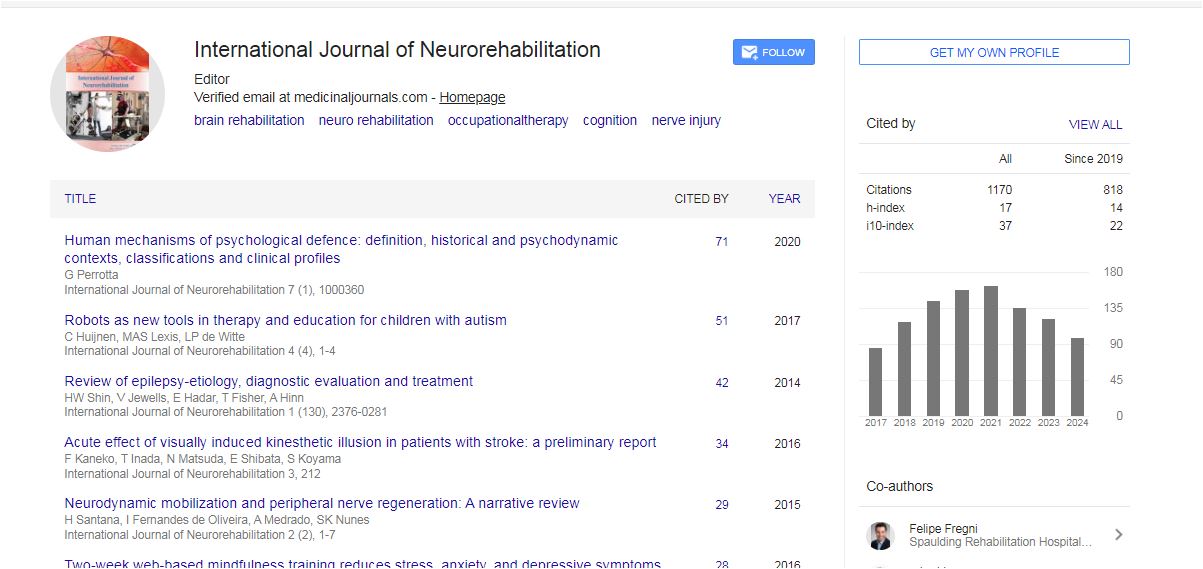
International Journal of Neurorehabilitation received 1078 citations as per Google Scholar report