Perspective - (127) Volume 11, Issue 4
Received: 01-Jul-2025, Manuscript No. jefc-26-188266;
Editor assigned: 03-Jul-2025, Pre QC No. P-188266;
Reviewed: 17-Jul-2025, QC No. Q-188266;
Revised: 22-Jul-2025, Manuscript No. R-188266;
Published:
29-Jul-2025
, DOI: 10.37421/2472-0542.2025.11.550
Citation: Lin, Chen Yu. ”Chemical Dynamics in Processed Foods: Safety, Quality, Flavor.” J Exp Food Chem 11 (2025):550.
Copyright: © 2025 Lin Y. Chen This is an open-access article distributed under the terms of the Creative Commons Attribution License, which permits unrestricted use, distribution and reproduction in any medium, provided the original author and source are credited.
The intricate realm of processed foods necessitates a profound understanding of the chemical interactions that govern ingredient behavior and product quality. This research compilation delves into several critical aspects of food chemistry, focusing on how various components interact under processing conditions to influence safety, stability, and sensory attributes. The first study elucidates the complex chemical landscape of food additives, detailing how their inherent properties lead to the formation of novel compounds within processed food matrices, with significant implications for both food safety and nutritional value [1].
Further investigations explore the functional roles and chemical behaviors of specific food ingredients. For instance, the impact of emulsifiers on the texture and stability of dairy products is examined, revealing how their chemical structures dictate their interactions with proteins and ultimately influence sensory perception [2].
Conversely, the study on artificial sweeteners addresses their potential for degradation under various processing conditions. It highlights the formation of potentially harmful byproducts, underscoring the importance of careful selection and monitoring to mitigate adverse chemical transformations [3].
The stability and interactions of natural colorants, such as anthocyanins in acidic beverage systems, are also a focal point. This research employs advanced spectroscopic techniques to understand reaction mechanisms that can lead to color loss or undesirable changes, offering insights for optimizing their use to maintain visual appeal [4].
In the context of lipid oxidation in processed oils, the interplay between antioxidants and metal ions is scrutinized. This work details the chemical mechanisms by which these interactions can either accelerate or inhibit oxidation, proposing strategies to enhance antioxidant efficacy and improve the shelf-life of fat-containing foods [5].
The fundamental chemical reactions that contribute to flavor development are also explored. The Maillard reaction in baked goods, influenced by the interaction of added sugars and amino acids under thermal processing, is quantified to understand its impact on flavor compounds and melanoidins, thereby providing control over sensory profiles [6].
The functional properties of hydrocolloids as thickeners in acidic processed foods are investigated, with a focus on their chemical stability. Factors such as pH, temperature, and ionic interactions are examined for their influence on viscosity and gelling capabilities, offering practical guidance for achieving desired textures [7].
Particular attention is given to the formation of potentially harmful compounds like heterocyclic amines (HCAs) in processed meat products. This research examines the role of ingredient interactions and processing parameters, including the influence of food additives, on HCA generation, crucial for risk mitigation [8].
In the burgeoning field of plant-based alternatives, the effect of pH adjusters on protein stability is a key concern. This study details how acid-induced denaturation and aggregation in plant-based beverages are modulated by pH modifiers and other ingredients, impacting texture and mouthfeel [9].
Finally, the complex interplay between preservatives and flavor compounds in formulated beverages is analyzed. This research identifies reaction products that can lead to flavor degradation or off-flavors, proposing strategies to maintain the sensory integrity of flavored processed drinks [10].
The chemical intricacies of processed foods are multifaceted, involving a dynamic interplay of ingredients and processing parameters that significantly influence product characteristics. The first contribution meticulously examines the chemical interactions of food additives, revealing the formation of novel compounds and their potential impact on food safety and nutritional quality, emphasizing the critical role of analytical chemistry in deciphering these complex relationships [1].
Moving to the realm of dairy products, research into emulsifiers highlights how their molecular structures dictate their behavior in emulsions. These emulsifiers interact with proteins to form colloidal structures that profoundly affect the texture, stability, and overall sensory appeal of dairy beverages [2].
Artificial sweeteners, essential for reduced-sugar formulations, are also subject to scrutiny. Their degradation pathways under various processing conditions, including high temperature and pH fluctuations, are investigated, identifying the generation of potentially harmful byproducts and stressing the need for vigilant monitoring [3].
In the pursuit of visually appealing processed foods, the stability of natural colorants, particularly anthocyanins in acidic beverages, is a critical consideration. Advanced spectroscopic methods are employed to unravel the reaction mechanisms underlying color degradation or alteration, providing insights for optimizing their application [4].
The oxidative stability of processed oils, a key determinant of shelf-life, is addressed through the lens of antioxidant and metal ion interactions. This research elucidates how these interactions can synergistically or antagonistically influence lipid oxidation, offering pathways to enhance antioxidant effectiveness [5].
Flavor development in baked goods is significantly influenced by the Maillard reaction. This study quantifies the impact of varying sugar and amino acid ratios on the extent of this reaction and the resulting flavor profiles and melanoidin formation, enabling better control over sensory attributes [6].
For processed foods requiring specific textural properties, the chemical stability of hydrocolloids is paramount. Investigations into their behavior in acidic food systems under varying temperature and pH conditions reveal how these factors, along with ionic interactions, affect viscosity and gelling, guiding formulators in achieving desired textures [7].
Health concerns associated with processed meats are partially addressed by research into heterocyclic amine (HCA) formation. This work details the influence of ingredient interactions, such as those between creatine, amino acids, and sugars, along with processing parameters and the presence of additives, on HCA levels [8].
Plant-based dairy alternatives are gaining prominence, and their textural characteristics are often dependent on protein functionality. The effect of pH adjusters on protein stability and aggregation in these beverages is examined, providing crucial information for optimizing product quality [9].
Lastly, the sensory quality of formulated beverages is directly impacted by the interactions between preservatives and flavor compounds. This research identifies undesirable reaction products and proposes methods to minimize flavor degradation, ensuring the palatable experience of flavored processed drinks [10].
This collection of research explores the chemical complexities within processed foods. Studies examine the interactions of food additives, emulsifiers in dairy, and degradation of artificial sweeteners, highlighting safety and quality implications. Investigations into natural colorant stability, antioxidant efficacy in oils, and flavor formation through the Maillard reaction in baked goods are presented. Additionally, the stability of hydrocolloids in acidic systems, the formation of heterocyclic amines in processed meats, protein behavior in plant-based alternatives, and preservative-flavor compound interactions in beverages are detailed. The overarching theme emphasizes how chemical interactions under processing conditions profoundly influence food safety, nutritional value, texture, stability, and sensory attributes.
None
None
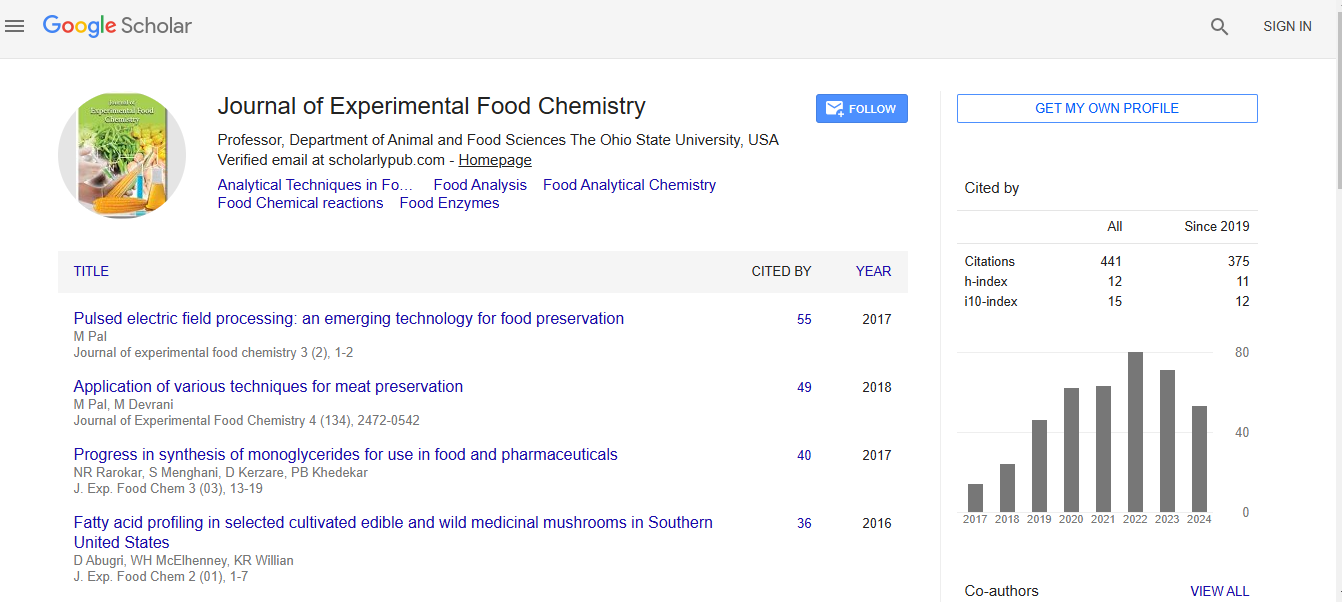
Journal of Experimental Food Chemistry received 389 citations as per Google Scholar report