Opinion - (2025) Volume 13, Issue 5
Received: 01-Oct-2025, Manuscript No. jpgeb-26-184319;
Editor assigned: 03-Oct-2025, Pre QC No. P-184319;
Reviewed: 17-Oct-2025, QC No. Q-184319;
Revised: 22-Oct-2025, Manuscript No. R-184319;
Published:
29-Oct-2025
, DOI: 10.37421/2329-9002.2025.13.400
Citation: Rossi, Isabella F.. ”Structural Variants: Drivers of Evolution and Adaptation.” J Phylogenetics Evol Biol 13 (2025):400.
Copyright: © 2025 Rossi F. Isabella This is an open-access article distributed under the terms of the Creative Commons Attribution License, which permits unrestricted use, distribution and reproduction in any medium, provided the original author and source are credited.
Structural variants (SVs) represent a fundamental aspect of genomic diversity and evolution, encompassing a range of alterations such as insertions, deletions, inversions, and translocations. Their high mutation rate and profound impact on gene regulation and function make them critical drivers of evolutionary innovation and adaptation within and between species. Recent technological advancements in sequencing and bioinformatics have significantly enhanced our ability to detect and characterize these SVs, offering unprecedented insights into their roles in evolutionary processes like speciation, domestication, and disease resistance. Non-allelic homologous recombination is a primary mechanism generating structural variation, playing a significant role in evolutionary change. Understanding these large-scale genomic rearrangements is crucial for deciphering adaptive evolution and phenotypic plasticity, highlighting the rapid advancement in the study of structural variants in evolutionary genomics with emerging methods for detection and interpretation. This body of research investigates the intricate impact of structural variants on gene regulation and expression. It provides evidence that insertions, deletions, and inversions can alter enhancer-promoter interactions or disrupt coding sequences, ultimately leading to the emergence of novel phenotypes. The work emphasizes the dynamic nature of SVs in evolution and their substantial contribution to the divergence of gene expression patterns among species. Focusing specifically on human evolution, this publication delves into the role of structural variants in shaping primate genomes. It identifies recurrent structural rearrangements that have occurred since the divergence of humans and chimpanzees, many of which are associated with genes vital for neurological development and immune function, underscoring SVs as key contributors to human-specific traits. This study examines the influence of structural variants within domesticated species, particularly their role in agricultural traits. It illustrates how chromosomal rearrangements, including translocations and duplications, have been instrumental in the selection for desirable characteristics such as yield and disease resistance, offering a clear demonstration of SVs' power in driving rapid evolutionary change. The advent of long-read sequencing technologies has substantially improved the detection and characterization of complex structural variants. This advancement facilitates a more comprehensive understanding of SVs across diverse lineages, revealing their critical roles in speciation and adaptation and highlighting ongoing methodological progress in this field. This article explores the prevalence and functional significance of mobile elements as a significant source of structural variation. It demonstrates how transposable elements can mediate rearrangements like insertions and inversions, leading to gene duplication or disruption, and emphasizes their crucial role in genome evolution and the generation of new genetic material. The evolutionary consequences of gene duplications, frequently mediated by structural variants, are thoroughly explored in this research. The study highlights how gene copy number variations can result in neofunctionalization or subfunctionalization, thereby providing essential raw material for evolutionary innovation and underscoring the importance of understanding the genomic architecture that facilitates these events. This research centers on the role of inversions in shaping genomic landscapes and their significant impact on adaptation. It illustrates how chromosomal inversions can effectively suppress recombination and maintain linked beneficial alleles, thereby facilitating rapid adaptation to local environments and emphasizing the evolutionary significance of these complex structural changes. The study of structural variants in non-model organisms presents distinct challenges and opportunities. This paper details recent progress in analyzing SVs in species with limited genomic resources, underscoring their importance for understanding diversification and adaptation in a broader evolutionary context and advocating for the application of advanced genomic methods to a wider range of taxa.
Structural variants (SVs), such as insertions, deletions, inversions, and translocations, are identified as fundamental drivers of evolutionary innovation and adaptation due to their high mutational rate and significant impact on gene regulation and function. Their crucial role in shaping genomic diversity within and between species is further elucidated by recent advancements in sequencing technologies and bioinformatic tools that have revolutionized SV detection and characterization, providing unprecedented insights into their evolutionary roles. Non-allelic homologous recombination is highlighted as a key mechanism driving evolutionary change through the generation of structural variation. This reference emphasizes the importance of understanding these large-scale genomic rearrangements for deciphering adaptive evolution and phenotypic plasticity, underscoring the rapid advancements in the field of evolutionary genomics with emerging methods for SV detection and interpretation. The impact of structural variants on gene regulation and expression is a central theme, demonstrating how insertions, deletions, and inversions can modify enhancer-promoter interactions or disrupt coding sequences, leading to novel phenotypes. This research underscores the dynamic nature of SVs in evolution and their contribution to the divergence of gene expression patterns between species. Focusing on primate and human evolution, this work investigates recurrent structural rearrangements that have occurred since the divergence of humans and chimpanzees. The identification of SVs associated with genes involved in neurological development and immune function highlights their contribution to human-specific traits. Within domesticated species, structural variants play a significant role in agricultural traits. Chromosomal rearrangements like translocations and duplications are shown to be instrumental in the selection for desirable characteristics such as yield and disease resistance, providing a clear example of SVs' power in rapid evolutionary change. Advancements in long-read sequencing technologies have markedly improved the detection and characterization of complex structural variants. This progress enables a more comprehensive understanding of SVs across diverse lineages, revealing their roles in speciation and adaptation and indicating ongoing methodological improvements in the field. Mobile elements are presented as a significant source of structural variation, mediating rearrangements such as insertions and inversions. This leads to gene duplication or disruption, emphasizing their crucial role in genome evolution and the emergence of new genetic material. Gene duplications, often facilitated by structural variants, have profound evolutionary consequences. This study highlights how gene copy number variations can lead to neofunctionalization or subfunctionalization, providing raw material for evolutionary innovation and stressing the importance of understanding the genomic architecture supporting these events. Chromosomal inversions are examined for their role in shaping genomic landscapes and promoting adaptation. The research demonstrates how inversions can suppress recombination and maintain linked beneficial alleles, facilitating rapid adaptation to local environments and highlighting the evolutionary significance of these complex structural changes. Analyzing SVs in non-model organisms presents unique challenges and opportunities. This paper details recent progress in this area, emphasizing the importance of SVs for understanding diversification and adaptation in a broader evolutionary context and advocating for the application of advanced genomic methods to a wider range of taxa.
Structural variants (SVs) such as insertions, deletions, inversions, and translocations are key drivers of evolutionary innovation and adaptation. They significantly impact gene regulation, function, and genomic diversity. Recent technological advancements have greatly improved the detection and characterization of SVs, providing insights into their roles in speciation, domestication, and disease resistance. Non-allelic homologous recombination is a major mechanism generating SVs. SVs shape gene regulation, leading to novel phenotypes and divergence in gene expression. In human and primate evolution, SVs are linked to genes involved in neurological development and immune function. In domesticated species, SVs contribute to desirable traits like yield and disease resistance. Long-read sequencing technologies have enhanced SV detection, aiding the understanding of their roles in speciation and adaptation. Mobile elements, like transposable elements, act as a source of SVs, leading to gene duplication or disruption. Gene duplications mediated by SVs provide raw material for evolutionary innovation. Chromosomal inversions help in rapid adaptation by suppressing recombination and maintaining beneficial alleles. Studying SVs in non-model organisms offers insights into diversification and adaptation.
None
None
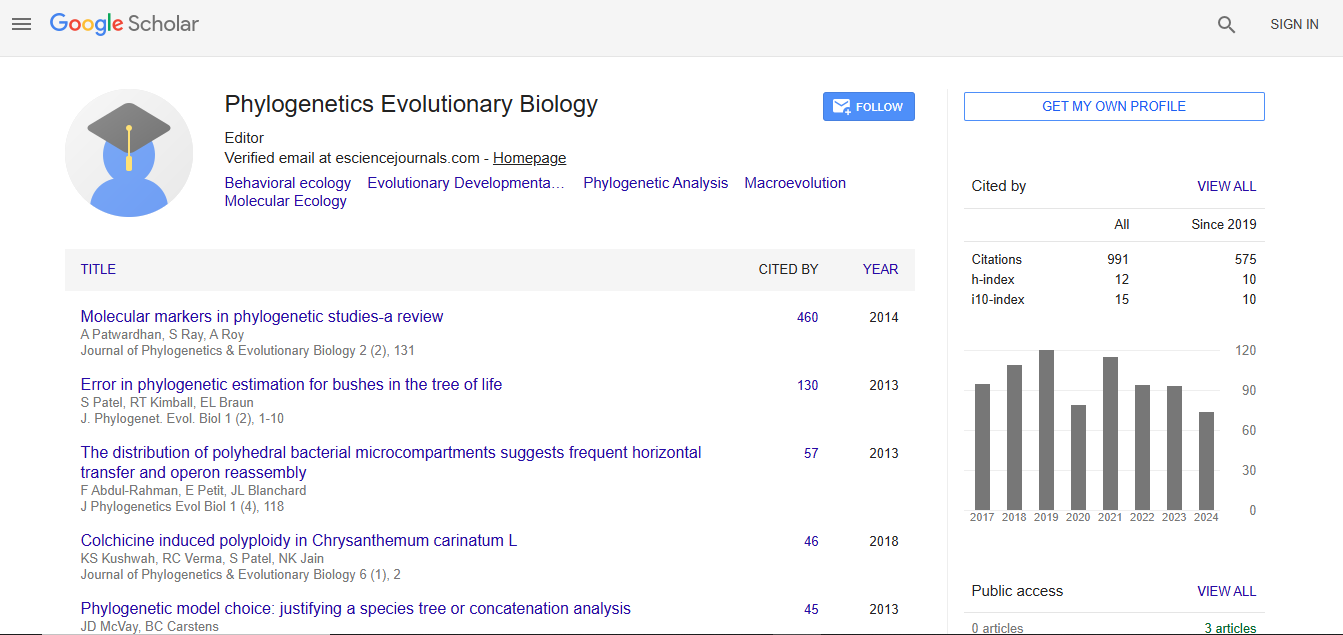
Journal of Phylogenetics & Evolutionary Biology received 911 citations as per Google Scholar report