Brief Report - (2025) Volume 12, Issue 4
Received: 02-Aug-2025, Manuscript No. fmoa-26-187926;
Editor assigned: 04-Aug-2025, Pre QC No. P-187926;
Reviewed: 18-Aug-2025, QC No. Q-187926;
Revised: 25-Aug-2025, Manuscript No. R-187926;
Published:
29-Aug-2025
, DOI: 10.37421/2476-2296.2025.12.343
Citation: Li, Chen. ”River Flow and Sediment Transport: Advanced Modeling Insights.” Fluid Mech Open Acc 12 (2025):343.
Copyright: © 2025 Li C. This is an open-access article distributed under the terms of the Creative Commons Attribution License, which permits unrestricted use, distribution and reproduction in any medium, provided the original author and source are credited.
The intricate dynamics of river flow and sediment transport are fundamental to understanding fluvial geomorphology and managing water resources effectively. Advanced hydrodynamic modeling techniques have emerged as indispensable tools for dissecting these complex processes, enabling researchers to quantify the interplay between water and sediment with increasing precision. These models are crucial for predicting changes in riverbed morphology, assessing the spatial distribution of erosion and deposition, and ultimately informing sustainable management strategies in riverine environments. The development of coupled hydrodynamic and sediment transport models has been a significant advancement in the field, allowing for a more holistic simulation of river behavior. These models often incorporate multiple sediment fractions, acknowledging that different particle sizes exhibit distinct transport characteristics. The insights gained from such simulations are invaluable for engineering projects, such as those involving river training or infrastructure development, as well as for environmental impact assessments. Investigating the influence of hydraulic structures on river dynamics is another critical area of research. Through the application of three-dimensional hydrodynamic models, scientists can meticulously quantify alterations in flow velocity, turbulence intensity, and the capacity of the flow to entrain sediment. The findings from these studies underscore the profound impact that the design and placement of structures like bridge piers can have on sediment transport regimes, leading to localized scour or deposition. Furthermore, the validation of numerical models against real-world data is paramount for ensuring their reliability. Shallow-water models, for instance, are extensively used to simulate flood waves and their associated sediment transport. Rigorous calibration and comparison with field observations bolster confidence in these models' ability to predict the extent and consequences of flood events, including the critical deposition and erosion patterns. The role of natural elements, such as vegetation, in modulating sediment transport processes is also a key area of investigation. Hydrodynamic models integrated with vegetation modules can effectively analyze how root systems and plant structures influence flow resistance and sediment deposition. This research highlights vegetation's potential to reduce flow velocities, promote sediment accumulation, and stabilize riverbanks, offering promising avenues for ecological restoration. Computational efficiency and accuracy are continually being enhanced through novel techniques in numerical modeling. Adaptive mesh refinement, for example, dynamically adjusts the resolution of computational grids based on flow gradients and sediment concentrations. This method proves effective in capturing fine-scale flow structures and transport phenomena, which are particularly important in complex riverine landscapes. The operational aspects of water control structures, such as reservoirs, significantly affect downstream sediment dynamics. One-dimensional models are often employed to simulate altered flow regimes and sediment loads resulting from dam releases. These studies frequently reveal a substantial reduction in downstream sediment supply, leading to notable geomorphological impacts that require careful management for river ecosystem health. Complementing traditional physical and numerical modeling approaches, machine learning techniques are increasingly being leveraged to enhance sediment transport predictions. By training algorithms on historical flow and sediment data, researchers can improve the accuracy of forecasting sediment yields, especially under changing environmental conditions. This data-driven approach offers a powerful complementary tool for operational management and long-term planning. For highly dynamic river systems like braided rivers, high-resolution three-dimensional hydrodynamic models are essential. These models possess the capability to resolve intricate flow patterns and eddy structures, providing detailed insights into sediment resuspension and deposition processes. Such granular understanding is vital for managing these complex and rapidly changing environments. Finally, the overarching influence of climate change on river systems cannot be overstated. Studies incorporating coupled hydrological and hydrodynamic models project how altered precipitation patterns will affect river flow and sediment transport, often leading to increased flood frequency and intensity. These projections are critical for developing adaptive strategies to ensure resilient river management in the face of a changing climate.
The study of river flow and sediment transport is a multidisciplinary endeavor that leverages sophisticated modeling techniques to understand and predict the behavior of these dynamic systems. Advanced hydrodynamic modeling is central to this pursuit, allowing for the detailed simulation of water movement and its interaction with sediment particles. Accurate parameterization and the selection of appropriate numerical schemes are highlighted as critical factors in capturing the complex interplay between water and sediment, which is essential for predicting morphological changes in riverine environments. Coupled hydrodynamic and sediment transport models represent a significant advancement, enabling the simulation of complex river systems with greater fidelity. These models often account for multiple sediment fractions, recognizing the differential transport characteristics of various particle sizes. The ability to predict scour and deposition under diverse flow conditions makes these models invaluable for river engineering and environmental impact assessments. Research into the impact of hydraulic structures on river flow and sediment dynamics is crucial for infrastructure development and river management. Three-dimensional hydrodynamic models provide a detailed quantification of flow velocity, turbulence, and sediment entrainment around structures such as bridge piers. The findings consistently demonstrate how structural design and placement can significantly alter sediment transport patterns, leading to localized erosion or deposition. Validation of numerical models is a cornerstone of reliable scientific inquiry. Shallow-water models, in particular, are employed to simulate flood inundation and sediment transport, with their accuracy being tested against field data. The meticulous calibration procedures and comparisons with observed phenomena confirm the reliability of these models in predicting flood impacts and sediment distribution. The influence of natural factors, such as vegetation, on sediment transport is a growing area of research. Hydrodynamic models coupled with vegetation modules are used to assess how plant structures and root systems affect flow resistance and sediment deposition. Studies indicate that vegetation can effectively reduce flow velocities, promoting sediment deposition and bank stabilization, which has implications for ecological restoration efforts. Advancements in computational techniques are continually improving the efficiency and accuracy of hydrodynamic and sediment transport modeling. Adaptive mesh refinement is one such technique that dynamically adjusts the computational grid resolution based on flow gradients and sediment concentrations. This approach enhances the model's ability to capture fine-scale flow structures and transport phenomena in complex river systems. The impact of anthropogenic activities, like reservoir operations, on downstream sediment transport is a significant concern. One-dimensional models are frequently used to simulate the altered flow regimes and sediment loads downstream of dams. These studies reveal substantial reductions in sediment supply, leading to geomorphological changes that require careful consideration for river ecosystem management. In addition to traditional modeling, machine learning techniques are being integrated to improve sediment transport predictions. By learning from historical data, these models can offer enhanced accuracy in forecasting sediment yields, particularly under changing environmental conditions. This synergy between physics-based models and data-driven approaches provides robust tools for management and planning. For particularly complex river systems, such as braided rivers, high-resolution three-dimensional hydrodynamic models are indispensable. These models can resolve intricate flow structures and eddy dynamics, offering detailed insights into sediment resuspension and deposition processes. Understanding these fine-scale processes is crucial for managing rivers prone to rapid channel changes. Finally, the projected impacts of climate change on river systems are a major focus of current research. Coupled hydrological and hydrodynamic models are used to assess how altered precipitation patterns may influence river flow and sediment transport. These studies project potential increases in flood frequency and intensity, necessitating adaptive management strategies for rivers worldwide.
This collection of research explores the multifaceted field of river flow and sediment transport through advanced hydrodynamic modeling. Studies investigate the critical role of accurate parameterization and numerical schemes in capturing complex interactions, essential for predicting morphological changes and informing sustainable water management. Coupled models are highlighted for their ability to simulate multiple sediment fractions and predict scour and deposition, crucial for engineering projects and environmental assessments. The impact of hydraulic structures, vegetation, and reservoir operations on sediment dynamics is detailed, emphasizing the need for precise quantification of flow alterations. Innovations in computational techniques, such as adaptive mesh refinement, enhance model accuracy and efficiency. Furthermore, the integration of machine learning offers complementary predictive capabilities, while high-resolution 3D models are vital for complex systems like braided rivers. The overarching influence of climate change on river systems, projected through coupled hydrological and hydrodynamic models, underscores the necessity for adaptive management strategies.
None
None
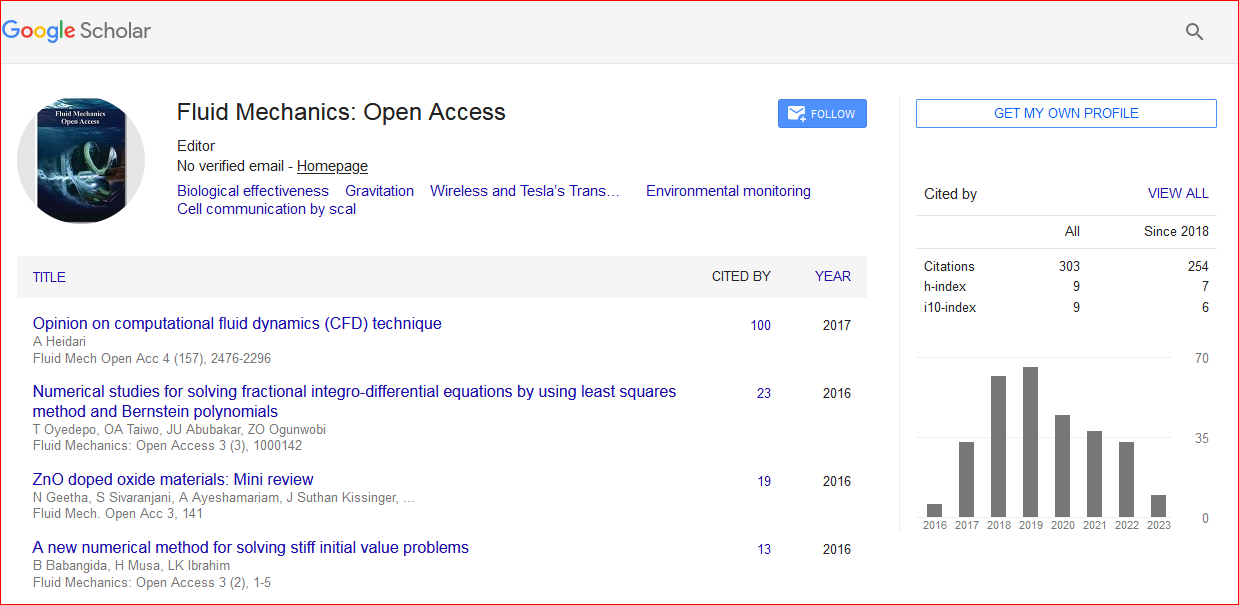
Fluid Mechanics: Open Access received 291 citations as per Google Scholar report